
OpenAI began rolling out Health in ChatGPT to eligible users across the United States on July 23, expanding the feature beyond the limited pilot launched in January.
The service allows users to connect Apple Health and supported medical records so ChatGPT can consider personal health information, track changes over time and provide responses based on the user’s wider health context.
The rollout covers logged-in users aged 18 and older on ChatGPT Free, Go, Plus and Pro plans. It is available on the web and iOS, although OpenAI says the gradual rollout may take several weeks to reach every eligible account. Apple Health connectivity requires an iPhone.
OpenAI Targets Growing Health-Related Use
OpenAI says more than 300 million people now use ChatGPT for health-related questions each week.
However, the information needed to answer those questions is often spread across medical records, patient portals, fitness applications and wearable devices. Health in ChatGPT aims to bring selected information together in one place, reducing the need for users to repeatedly upload or explain the same details.
The January pilot also showed that users did not always enter the dedicated Health section before asking health-related questions. More than 70% of health conversations among early users took place outside that space.
Questions about allergies, injuries and dietary restrictions often appeared naturally during conversations about meals, recipes, restaurants and activities. OpenAI redesigned the experience so connected health information can now be used in other ChatGPT conversations when the user gives permission.
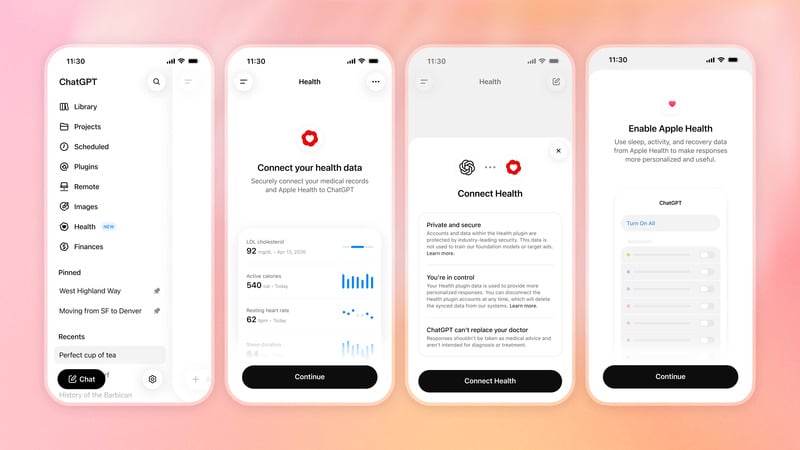
The Health tab remains the main place for connecting accounts, reviewing records, checking trends and managing permissions.
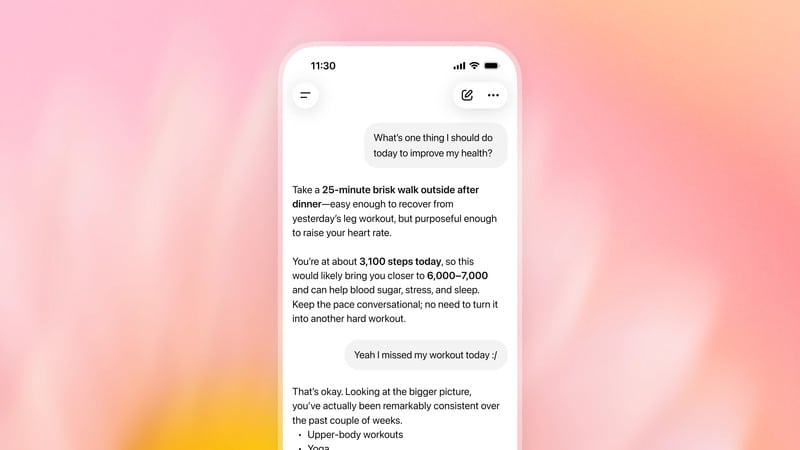
Users Can Connect Health Records and Applications
Users can connect Apple Health, supported medical records from US healthcare providers, One Medical and Function Health. They can also connect more than one supported account.
OpenAI selected Baltimore-based b.well Connected Health to provide the infrastructure for medical-record connectivity. At the time of the partnership announcement, b.well said its network covered more than 2.2 million US healthcare providers and 320 health plans, laboratories and other data sources.
Health also supports applications including MyFitnessPal, Weight Watchers, Peloton, AllTrails and Instacart. Wearable and fitness applications such as Whoop, Oura, Garmin and Strava can share information with ChatGPT through Apple Health when the user enables the required permissions. The exact information available may vary by application and metric.
Users can upload files such as PDF laboratory reports, request summaries in plain language, compare new results with earlier tests and prepare questions for medical appointments.
They can also ask ChatGPT to review health patterns, help organise care information or compare insurance options based on their healthcare needs and history.
Physicians Helped Evaluate the System
OpenAI said in January that it had worked with more than 260 physicians across 60 countries over two years. The group provided feedback on model responses more than 600,000 times across 30 areas of focus.
OpenAI later updated that figure, saying physicians had reviewed more than 700,000 model responses. Its global network covers 49 languages and 26 medical specialties.
The company also developed HealthBench with 262 physicians who had practised in 60 countries. The evaluation framework contains 5,000 realistic health conversations and 48,562 physician-written criteria used to assess model responses.
OpenAI Details Its Privacy Controls
OpenAI says connected medical records, Apple Health information, and conversations that use that data will not be used to train its foundation models or target advertisements.
All ChatGPT conversations receive encryption at rest and in transit, while information connected through Health receives additional encryption protections.
By default, ChatGPT asks for permission before using connected health information in a response. Users can approve access for one request or allow continued access and disable future prompts.
Users can disconnect an account at any time. OpenAI says data synchronised from that source will be deleted from its systems within 30 days. However, information already included in conversation history remains until the user deletes those chats.
Health conversations can create memories when ChatGPT’s memory setting is enabled. However, OpenAI says memories are not created directly from synchronised medical records or Apple Health data.
Users who want complete separation can use Temporary Chat, disable memory, or create a separate project with project-specific memory.
HIPAA Protections Remain Limited
OpenAI says Health in ChatGPT is not intended for clinical or covered-entity use and does not offer a Business Associate Agreement.
This means the consumer feature is not positioned as a HIPAA-compliant service for hospitals, insurers, or other covered healthcare organisations. OpenAI offers separate healthcare products for eligible clinical use.
The Center for Democracy and Technology has warned that consumer AI companies and many health applications are generally not covered by HIPAA in the same way as healthcare providers and insurers.
The organisation said these services create unanswered privacy questions because users are relying partly on company policies rather than the same legal protections that apply to traditional medical organisations.
OpenAI has committed not to use connected health information for model training or advertising. However, privacy advocates argue that company policies can change unless external laws prevent them from doing so.
Study Raises Accuracy and Safety Concerns
OpenAI states that Health is designed to support medical care, not replace it, and is not intended to diagnose conditions or provide treatment.
A study published in Nature Medicine in February tested ChatGPT Health using 60 clinician-written scenarios across 21 clinical fields.
Researchers found that the system correctly handled clear emergencies such as strokes and anaphylaxis but undertriaged 52% of cases classified as emergencies. In some cases, it recommended evaluation within 24 to 48 hours instead of immediate emergency care.
The study also found inconsistent activation of suicide-crisis safeguards. Researchers said the results raised concerns about missed high-risk emergencies and required further real-world validation.
b.well Expands Across Consumer Health Platforms
b.well’s role extends beyond ChatGPT. The company has also announced partnerships or collaborations involving Google, Samsung, Perplexity and athenahealth.
These agreements allow consumers to access, combine or share medical information through different AI, mobile and healthcare platforms.
The growing reliance on a shared health-data infrastructure makes b.well’s security, governance and consent systems increasingly important as more technology companies add personalised healthcare features.
Regulations Continue to Develop
Government oversight has not developed as quickly as the use of artificial intelligence in healthcare.
By late April, the National Conference of State Legislatures had identified healthcare-related AI laws signed in 12 states during 2026. However, the United States still lacks a dedicated federal framework covering all consumer AI health services.
Health in ChatGPT gives users greater control over the medical information they connect and how the system uses it. However, questions remain about privacy protections, legal accountability, and the accuracy of AI responses in complex or urgent situations.
Stay Connected with ProPakistani
Get the latest tech news, telecom insights, and product launches wherever you prefer.
Add ProPakistani to Preferred Sources and see more of our stories in Google Search and Top Stories.












