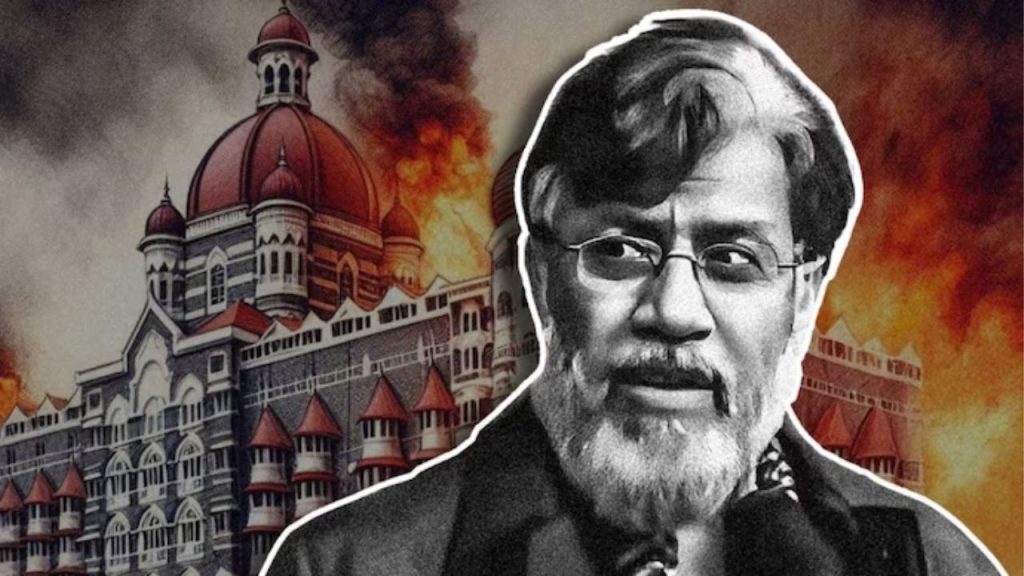
It takes little imagination, to connect Indian latest security melodrama, the alleged confession of Tahawwur Hussain Rana, to an old and disquieting playbook. If the memory of the readers is not too burdened, they may recall the troubling story of Afzal Guru, whose conviction and execution were riddled with inconsistencies, political compulsions, and the chilling phrase “to satisfy the collective conscience of society.” In both cases, and countless others in between, India’s strategy is clear – when truth is inconvenient and justice elusive, fabrication and manipulation, becomes a patriotic act.
Now, in 2025, the world is witnessing a renewed attempt to frame Pakistan in the international court of public opinion, this time through the coerced and highly suspect “confession” of Tahawwur Hussain Rana, a Pakistani-origin Canadian citizen imprisoned in India.
The announcement of his alleged admission to involvement in the 2008 Mumbai attacks has been splashed across Indian media with alarming uniformity, as though truth was never in question, and evidence already settled. However, beneath the headlines, lies a more cynical reality, “India is once again weaponizing manfactured confessions and associations, recycling unproven charges in the service of political theatre”.
The Indian media, long transformed from watchdog to megaphone, is parroting the government’s line that Rana confessed to deep connections with the ISI and Lashkar-e-Taiba. Yet no transcript has been released, no legal oversight is evident, and no international observers have been granted access. All that exists are fabricated media leaks, timed curiously to coincide with both rising domestic discontent and heightened global scrutiny of India’s internal repression.
Many people, probably do not know, and what’s conveniently ignored is that, Tahawwur Rana was already tried in the United States, where he was acquitted on charges relating to the Mumbai attacks. That trial, held under stringent U.S. federal standards and with access to classified intelligence from multiple countries, could not establish his guilt. His past involvement with the Pakistan Army was negligible, a brief medical assignment during the First Gulf War, and there has been no linkage or credible evidence whatsoever, of any operational link to Pakistani intelligence or militant groups, thereafter.
In contrast, the Indian judicial and investigative process now at play is opaque, unreviewable, and deeply politicized, traits that have come to define its treatment of cases involving Muslims, Kashmiris, or alleged Pakistani actors.
This isn’t the first time India has resorted to such theatrics. This is something buit-in within the Indian mindset and their way of life. The 2013 execution of Afzal Guru, accused of involvement in the 2001 Indian Parliament attacks, remains a haunting example of political capital extracted from judicial ambiguity. Even the Supreme Court judgment noted the lack of direct evidence but still ordered his execution under pressure from the political Government, not because it met the highest threshold of justice, but because it would “satisfy the collective conscience of society.”
This precedent has become a doctrine, where strategic messaging, not truth, drives prosecution. And now, Tahawwur Rana is being cast in a similar role, not because the facts support it, but because the optics do. His story is being used to reinforce India’s long-running narrative, that Pakistan is the fountainhead of all terrorism in South Asia, a narrative too convenient to abandon, regardless of counterevidence.
One needs to ascertain the reason of resorting to such tactics by India and ask, two pertinent questions – why now? and why this case? The answer lies partly in India’s internal landscape, where political pressure, economic vulnerabilities, and growing dissent are being managed through externalised blame. When the domestic narrative is collapsing, on unemployment, communal violence, and rural distress, resurrecting the specter of Pakistani terror offers a time-tested distraction.
Moreover, with India eager to reassert its regional dominance and bolster its security credentials ahead of elections or diplomatic engagements, a high-profile “confession” ticks every box. What’s equally concerning is the muted response of the international community.
The same democratic governments that demand due process and human rights at home appear willing to look the other way when India flouts both. Selective outrage, it seems, is the cost of doing business with a strategic partner. However, silence is complicity, especially when justice systems are weaponized, and truth is bent to serve nationalistic ends. If international norms are to mean anything, they must apply universally, not just when politically convenient.
The Tahawwur Rana case, like the Afzal Guru episode before it, is not an isolated aberration. It reflects a well-worn and practiced pattern of Indian state conduct, one defined by habitual economy of truth, deceit, evidence fabrication, coercive confessions, and the strategic misuse of media and courts. The Indian state apparatus has perfected the art of turning unverified allegations into public verdicts, blurring the line between truth and propaganda with dangerous precision. This habitual distortion becomes even more glaring when viewed against the case of Commander Kulbhushan Jadhav, an actual serving officer of the Indian Navy, operating under the alias Mubarak Hussain Patel, who was apprehended inside Pakistan’s territory.
Kulbhushan was not a retired official or a diasporic businessman like Rana, he was a functioning asset of Indian intelligence, with direct undeniable ties to RAW and the National Security Adviser’s office, managing subversive operations in Balochistan and coordinating with terrorist proxies like the Balochistan Liberation Army (BLA). Unlike the shadowy allegations, India throws at civilians, Kulbhushan’s case presented hard evidence, recovered documents, video confession, and human intelligence, all pointing to state-sponsored terrorism by India on Pakistani soil. That is not conjecture, that is an act of war and yet, even as India continues to demand global sympathy over self-staged spectacles like Rana’s “confession,” it refuses to account for its own military officer caught red-handed conducting terrorism abroad. The hypocrisy is staggering, and if India insists on playing this game of falsohood, the least it can do is uphold a respectable standard of absurdity.
Lastly, India’s selective memory is deeply suspicious. The handling of the event of Taj Hotel attacks of 26/11, particularly the on-the-spot death of ATS Chief Hemant Karkare, remains an enduring mystery. Karkare had unearthed dangerous links between Hindutva terror cells and domestic attacks, and his sudden death during the Mumbai siege, conveniently removed a threat, not to national security, but to the internal contradictions of the glaring falsehood of Indian Security Narrative.
Disclaimer: The views and opinions expressed in this article are those of the author and do not necessarily reflect the official policy or position of ProPakistani. The content is provided for informational purposes only and is not intended as professional advice. ProPakistani does not endorse any products, services, or opinions mentioned in the article.