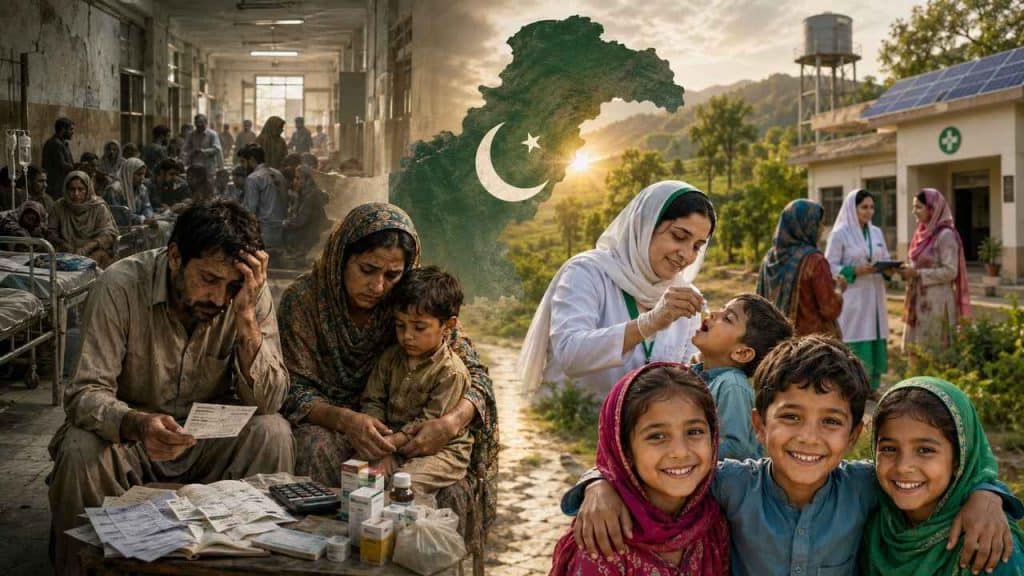
Let us start with a simple question. If a family of five has one earning member who falls seriously ill, what happens? Bills pile up. Savings disappear. Children may drop out of school. The family does not just have a health problem; they have an economic crisis. Now multiply that story across millions of Pakistani households, and you begin to understand what chronic underinvestment in public healthcare actually costs this country.
According to the Pakistan Economic Survey 2024-25, Pakistan spends just 0.9 percent of its GDP on public health, roughly Rs 925 billion for a nation of 240 million people. The World Health Organisation recommends at least 5 percent of GDP for countries that want to provide basic health coverage to all citizens. We are not at 5 percent. We are not at 3 percent. We are at less than 1 percent, and that gap has consequences that touch every corner of Pakistani society.
This is not simply a health story. It is an economic story, a poverty story, and ultimately a story about the kind of country we want Pakistan to be.
Where We Stand: The Regional Picture
Numbers can feel abstract, so it helps to compare. According to World Bank data, Pakistan spent just $68 per person per year on government healthcare in 2022. Iran spent $475. China spent $623. India, with all its own development challenges, spent $107. Even Sri Lanka, which went through an economic collapse so severe it ran out of fuel and cooking gas in 2022, still managed to spend $246 per person on health. Bangladesh allocates around 2.36 percent of its GDP to healthcare; Pakistan spends less than half of that share.
Across South Asia, the average government health expenditure is 3.1 percent of GDP, more than three times what Pakistan spends. This is not just a gap. It is a gulf, and it shows up directly in the lives of ordinary people.
Pakistan’s maternal mortality rate stands at 155 deaths per 100,000 live births. Sri Lanka’s is 29. Bangladesh’s is 123. Iran’s is 22. According to the WHO, every single day in Pakistan, 675 newborns and 27 mothers die from largely preventable causes, over 9,800 maternal deaths and nearly 250,000 newborn deaths every year.
One in three Pakistani children under five is stunted – meaning their physical and mental development has been permanently affected by poor nutrition and inadequate early healthcare. Pakistan has just one doctor for every 1085 people and 1,696 hospitals for a population the size of Brazil. These are not statistics. They are the daily reality for millions of families.
The Real Cost: When Families Pay the Bill
Here is what happens when the state does not provide adequate healthcare: ordinary citizens pay for it themselves, and many cannot afford to.
A 2024 World Bank analysis estimates that 11 million Pakistanis will be pushed into poverty this year alone simply because of medical bills. These are not people with rare conditions. These are people who needed a hospital visit, a scan, or medicine for diabetes or hypertension, and had no public system to fall back on.
Research based on Pakistan Bureau of Statistics household surveys found that by 2018-19, 13 percent of Pakistani households were experiencing “catastrophic health expenditure,” spending such a large share of their income on healthcare that they had to cut back on food or pull children out of school.
Think about what this means in practice. A factory worker in Faisalabad with high blood pressure needs medication every month. Without a functioning public health system, he buys it from a private pharmacy. A bad month comes, an unexpected emergency, and suddenly the family is borrowing money or selling assets to stay afloat. Over time, this cycle pushes millions of households further from economic stability, not closer to it. This is the hidden cost of underinvestment: it does not just harm people’s health. It actively creates poverty.
What We Have Got Right
The picture is not entirely bleak. Pakistan has made genuine progress, and those achievements deserve recognition, not just as reasons for optimism, but as proof that the right policies work.
Life expectancy has risen from 65.7 years in 2015 to 67.3 years in 2022. Child stunting has fallen from 41.4 percent to 34 percent over the same period. DPT immunisation coverage among young children rose from 72 percent to 85 percent between 2015 and 2022. Maternal mortality has fallen from 276 deaths per 100,000 live births in 2006 to 155 in 2024.
Two programmes deserve particular credit. The Lady Health Worker (LHW) program, 100,000 trained women delivering primary care in communities across the country, has contributed to a 20 percent increase in immunisation coverage since 2010 and helped reduce child mortality in the areas it serves. It is cost-effective, it works, and it is the kind of model other developing countries actively study. The Sehat Sahulat Programme, which provides health insurance of up to Rs 1 million per family per year for hospitalisation at public and private hospitals, has been recognised internationally as a credible step toward universal health coverage.
These programmes prove that Pakistan knows how to build effective health delivery systems when there is political will behind them. The blueprints exist. What is needed now is the sustained funding to match the ambition.
Health Is Not a Cost
The most persistent myth in Pakistani budget discussions is that health spending is a cost that responsible governments should keep low. The evidence from around the world says otherwise.
The Brookings Institution, after studying nearly 200 countries, found that addressing avoidable health conditions in developing countries could boost GDP by 7 percent by 2040. For every dollar invested in health in developing economies, the estimated return is between $2 and $4, through higher productivity, better-educated children, and a larger working population.
The World Bank calculates that every dollar invested in combating malnutrition yields a $23 return through improved productivity and health outcomes. For a country where one in three children is stunted, this is not an abstract number. It is money being left on the table every single year.
The IMF has found that preventive health policies can raise annual GDP growth by 0.2 to 0.3 percentage points over the long run — meaningful for a country like Pakistan that is striving to grow its economy. And the World Economic Forum notes that poor health costs economies roughly 15 percent of GDP annually through lost productivity and premature death. In other words, not investing in healthcare is itself enormously expensive. It just shows up as missing growth rather than a visible budget line.
A country that keeps its workers healthy produces more. A country where children grow up vaccinated and well-nourished has a more capable workforce in twenty years. These are not soft outcomes. They are the foundation of economic growth.
What the Region Teaches Us
Bangladesh made primary healthcare a national priority, community health workers, scaled immunisation, maternal outreach, and sustained it across governments. Today, it has a life expectancy of 74 years, seven years more than Pakistan, and has dramatically reduced child and maternal mortality. Thailand committed to universal health coverage in 2002 when it was still a developing economy, held to that commitment, and today has a life expectancy of 78 years with significantly reduced out-of-pocket health spending. Sri Lanka built strong public health institutions over decades; even after economic collapse, those institutions held. Its maternal mortality rate — 29 per 100,000 live births — is one-fifth of Pakistan’s.
The pattern is the same everywhere: countries that invest in health see better outcomes, and those outcomes feed back into economic strength. The health investment comes first. The economic dividend follows.
The Path Forward
Reaching 3 percent of GDP in public health spending within five years is a reasonable starting goal. It would still leave Pakistan below the South Asian average, but it would represent a genuine turning point, one that requires commitment at both federal and provincial levels, since health is primarily a provincial responsibility after the 18th Amendment.
Pakistan does not need to invent new solutions. It needs to fund and scale what already works. Expand the Lady Health Worker programme, better pay, better equipment, and more workers proportional to the population. Properly resource Sehat Sahulat so it reliably reaches the most vulnerable and is protected from ad hoc budget cuts. Fix the Basic Health Units: over 5,400 exist across the country, but too many are understaffed and short of medicines. Getting these functional would help more people than building new hospitals in major cities. And put prevention at the centre, vaccinations, nutrition, maternal care, because these cost a fraction of treating the diseases that result from neglecting them.
A Different Kind of Strength
Pakistan has 240 million people and one of the youngest populations in the world. That is a remarkable national asset, but only if those young people are healthy, educated, and able to contribute. A generation stunted by inadequate early healthcare and nutrition is not a demographic dividend. It is a lost opportunity on a massive scale.
Pakistan has already demonstrated, through the Lady Health Worker programme and Sehat Sahulat, that it can design and run effective health interventions. Those are not small things. They are the foundation to build on. What they need is sustained, serious investment, the kind that does not quietly disappear when fiscal pressures rise.
Spending 0.9 percent of GDP on health while one in three children is stunted and 11 million people are pushed into poverty by medical bills is not prudent fiscal management. It is a cost we are paying in a different currency – in shorter lives, in lost potential, and in families that cannot get ahead no matter how hard they try.
A healthier Pakistan is a more productive and more equitable Pakistan. The programmes to build on are already there. What remains is the political will to fund them properly — and to treat the health of 240 million Pakistanis as the national priority it has always deserved to be.
Disclaimer: The views and opinions expressed in this article are those of the author and do not necessarily reflect the official policy or position of ProPakistani. The content is provided for informational purposes only and is not intended as professional advice. ProPakistani does not endorse any products, services, or opinions mentioned in the article.