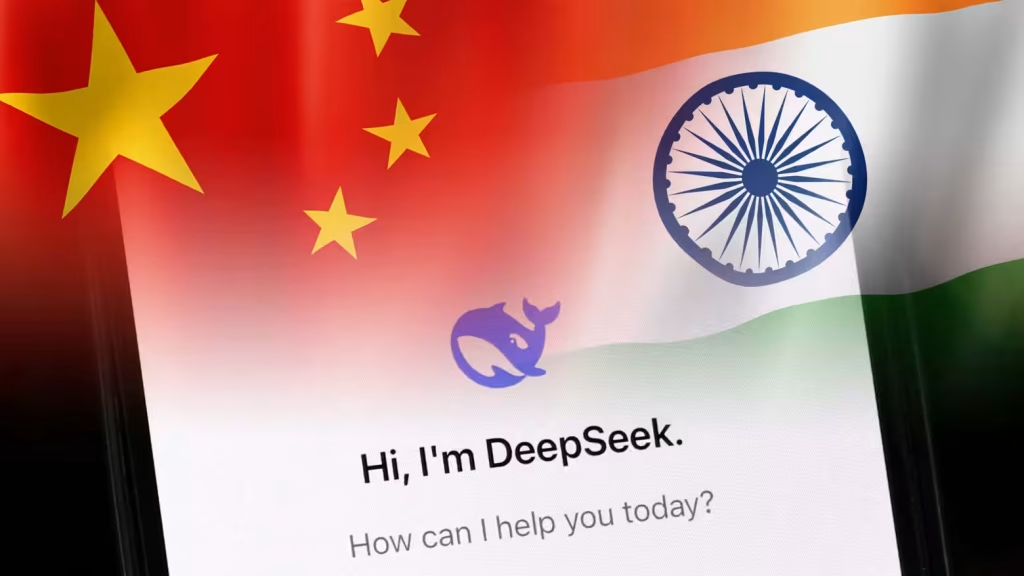
At the 2025 Shanghai Cooperation Organisation (SCO) summit in Tianjin, a significant event occurred: member countries, including India and China, pledged to increase cooperation in artificial intelligence (AI). At first glance, this appears to be a positive step toward equitable AI access for member states and beyond the SCO. However, for Pakistan, this initiative raises serious concerns. With the Pakistani armed forces heavily dependent on Chinese-supplied AI systems and hardware, closer Sino-Indian collaboration could threaten Islamabad’s AI sovereignty and reduce its military edge.
Pakistan’s Excessive Dependence on China’s AI Stack
Despite government efforts to foster AI development, Pakistan’s AI ecosystem remains in its infancy. Much of Pakistan’s defense and communications infrastructure is imported from China, which serves as the country’s principal supplier. For example, the JF-17 Thunder program illustrates this over-reliance: avionics, radars, and increasingly AI-driven subsystems are designed and manufactured in China. These systems rely on Chinese semiconductors, machine learning models, and algorithmic architectures. In the short term, this relationship has strengthened Pakistan’s armed forces, but it exposes Islamabad to even the slightest changes in Beijing’s strategic priorities. This vulnerability was evident in Xi Jinping’s remarks to Narendra Modi: “It is the right choice for both sides to be friends who have good neighborly and amicable ties, partners who enable each other’s success, and to have the dragon and the elephant dance together.” Such political calculations by Chinese leadership will always leave Islamabad exposed unless it develops its own technology stack.
Trump’s Aggressive Policies in a Multipolar World
The changing international environment is likely to accelerate these challenges for Pakistan. US President Donald Trump’s confrontational approach toward India, China, and Russia, through tariffs, technology restrictions, and aggressive rhetoric, has pushed these powers to unite around anti-American sentiments. Washington’s confrontational stance has encouraged these countries to strengthen platforms like the SCO and BRICS. These geopolitical forums, with Beijing, Moscow, and New Delhi at their core, represent a significant challenge to Western-led institutions, which are now at risk as both the US and Israel take steps to protect their own interests.
For Pakistan, the danger lies in misunderstanding these shifts. Islamabad often views strains in the India-US relationship as reasons to celebrate. However, it can no longer take comfort in the ongoing friction between China and India, which has historically prevented normalization between the world’s two most populous countries. These tensions include long-standing border disputes, such as China’s seizure of Ladakh, India’s membership in the QUAD, and competing military strategies in the Indian Ocean, characterized as the String of Pearls versus the Diamond Necklace. If India’s relations with China and Russia improve under SCO-led AI initiatives, Pakistan may soon find itself increasingly isolated.
Impact on Pakistan’s Armed Forces
Dependence on Chinese AI-enabled ecosystems in an era of deepening Sino-Indian cooperation could create several problems for Pakistan’s armed forces:
- Downgraded Priority: Pakistan may lose privileged access to advanced Chinese AI systems if India becomes a more valuable partner for China.
- Technology Limitations: Beijing could restrict the sharing of sensitive algorithms or chipsets to avoid disappointing New Delhi.
- Operational Risk: In the worst case, platforms used by Pakistan’s armed forces could become technologically stagnant, undermining their effectiveness against a better-equipped Indian military.
- Most concerning, Beijing could disable critical systems, such as beyond-visual-range (BVR) systems, in any future conflict with India, severely hampering Pakistan’s military performance.
Strategic Blind Spots
The belief in Islamabad that India’s alienation from Washington automatically benefits Pakistan is misguided. On the contrary, India’s participation in BRICS, the SCO, and Bretton Woods institutions demonstrates its determination to align with both Eurasian and Western powers. Pakistan risks undermining its nascent AI ecosystem if New Delhi chooses greater SCO cooperation to boost its own AI capacity rather than remaining subordinate to Washington. This scenario could create a serious strategic security problem for Islamabad.
Recommendations for Pakistan
- Indigenous Development: Accelerate investment in local AI chip design, algorithm research, and training datasets to reduce reliance on imports.
- Diversify Partnerships: The recent Saudi-Pakistan agreement is a positive step toward broadening cooperation, including in AI infrastructure and ecosystems. This should be expanded to include technological partnerships with Turkey and other Gulf countries, especially in dual-use technologies.
- AI Defense Doctrine: Develop a dedicated strategy for AI in the Pakistani armed forces, with emphasis on sovereignty, resilience, and cybersecurity.
Conclusion
In a multipolar era, the SCO’s AI cooperation initiative – shaped in part by Trump’s unconventional policies – highlights the convergence of Chinese, Indian, and Russian digital ambitions. This could be highly damaging for Pakistan, where dependence on Chinese AI systems poses a strategic risk rather than a benefit. Unless Islamabad revises its strategy and invests in indigenous capabilities, Pakistan’s AI sovereignty and the operational credibility of its armed forces will remain vulnerable to unpredictable shifts in Eurasian geopolitics.
Disclaimer: The views and opinions expressed in this article are those of the author and do not necessarily reflect the official policy or position of ProPakistani. The content is provided for informational purposes only and is not intended as professional advice. ProPakistani does not endorse any products, services, or opinions mentioned in the article.



Hi abid . Eat 💩