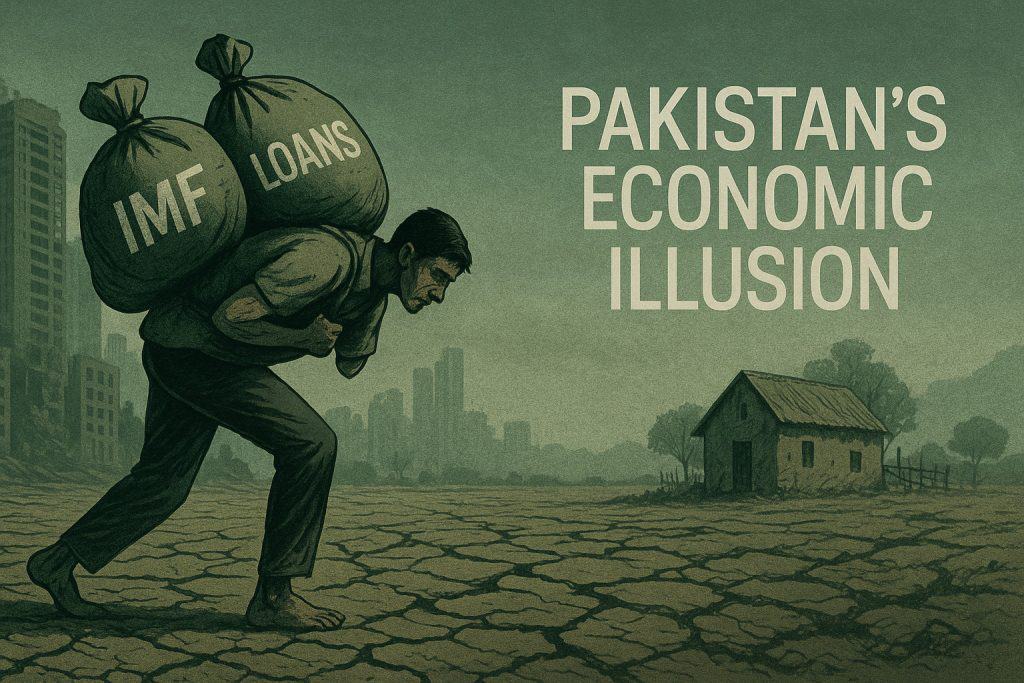
Let’s not sugarcoat anything; we have been in this situation for decades. Pakistan isn’t failing, but let’s not pretend it’s thriving either. What we’re witnessing isn’t a revival, it’s survival from one IMF tranche to the next and from loan to loan. Well, we can’t call it a repair by just patching a sinking boat with duct tape.
It’s a carefully staged survival.
Let’s face the real truth. The truth that we all know but no one bothers to acknowledge. This country has been stuck in a financial ICU for the last 40+ years. We’ve mistaken IMF tranches and shrinking inflation as economic “wins,” while the real issues grow deeper and more dangerous.
This year, Pakistan’s inflation dropped to 0.3 percent in April 2025, the lowest in decades. But let’s ask the uncomfortable question: Is it because the economy improved or because people stopped buying? Demand hasn’t just reduced, it’s collapsed. It’s not stability, it’s stagnation. People don’t have cash, jobs, or even hope.
Pakistan’s current GDP growth of 2.7 percent is only sufficient to keep us breathing; it’s not sufficient to engage our youth, develop existing or new industries, or lift families out of poverty. Approximately 42 percent of the population now survives below the poverty line, and it is no longer confined to rural areas; it’s now urban.
And yet, the government continues to rely on the same old playbook: go to the IMF, take a loan, make temporary cuts, repeat. Since 1958, Pakistan has entered 25 IMF programs (it’s no longer emergency help; it’s addiction,) most recently receiving a $1 billion release and a $1.4 billion climate resilience package in May 2025. We now owe $131 billion in external debt, out of which $22 billion is due this year alone. Nearly 10 percent of our GDP goes into paying off just the interest. Imagine working hard every day and having all your salary go to the lender; you eat what’s left, if anything. That’s Pakistan right now.
Regardless of a 6.7 percent cut in the budget this year, the government has increased the defense sector budget by 20 percent, whereas funding for education, digital infrastructure, and climate resilience remains low. For clarity, I’m not saying I’m against the defense budget, but I’m emphasizing the need to allocate equal importance to education and health, which are essential for the common people. Roughly around 1.3% of Pakistanis pay income tax, yet the salaried & middle class are burdened with direct or indirect taxes on electricity, petrol, and basic goods.
Meanwhile, our agriculture sector, which still employs over a third of our population, is now collapsing. Cotton production is down 30.7 percent, wheat 8.9 percent, maize 15.4 percent. The climate crisis is no longer a threat; it’s a reality that is again being ignored by our government. The 2022 floods displaced 33 million people and caused $30 billion in damage, yet serious climate adaptation plans are missing in action, and our government is simply trying to leverage this point to borrow some extra dollars.
To put it bluntly, Pakistan does not have an economic model. We have a loan model. We borrow, we repay, and we borrow again. Nothing is built sustainably. Nothing grows. Nothing transforms. And that comes at a brutal cost.
What we need to change?
- We need to stop lying to ourselves.
- We need to stop relying on loans and IMF tranches, and instead do the reforms & restructuring to grow the economy internally.
- Equal importance should be given to Education, Health, and Industry.
- We should tax the untouchables; all stakeholders of the economy should be taxed, including real estate giants, feudal lords, and retail barons. Not just the salaried class. Real changes should be brought to increase the tax net and implement uniform tax rates rather than a complex tax rate system, which is the biggest loophole in our Tax system.
- Lastly, we should stop importing luxury goods while common people cannot afford basic necessities like milk.
We have all grown tired of hearing that Pakistan is rich in this sector and that sector, but unfortunately, those are all just stories. We have to keep in mind that every new IMF loan is a bandage on a bullet wound. It keeps us from bleeding out, but never heals the injury. This is not just an economic crisis, it’s a moral crisis as well.
Pakistan’s youth, entrepreneurs, and real taxpayers deserve more than survival. We deserve dignity, direction, and a real plan. And that begins by calling this what it is, not progress, but delay. Not revival, but repetition. The first step forward is admitting we’ve been standing still. We have to keep in mind, “Indeed, Allah will not change the condition of a people until they change what is in themselves.”
Disclaimer: The views and opinions expressed in this article are those of the author and do not necessarily reflect the official policy or position of ProPakistani. The content is provided for informational purposes only and is not intended as professional advice. ProPakistani does not endorse any products, services, or opinions mentioned in the article.

This is a considerable and honest article. The way the writer has explained Pakistan’s economic struggles is clear, thoughtful, and deeply relatable. Calling out the cycle of loans and the lack of real progress takes courage, and it’s done here with both honesty and grace. The suggestions are practical and needed. Thank you for speaking the truth so simply yet strongly. We need more voices like this. Great job👍