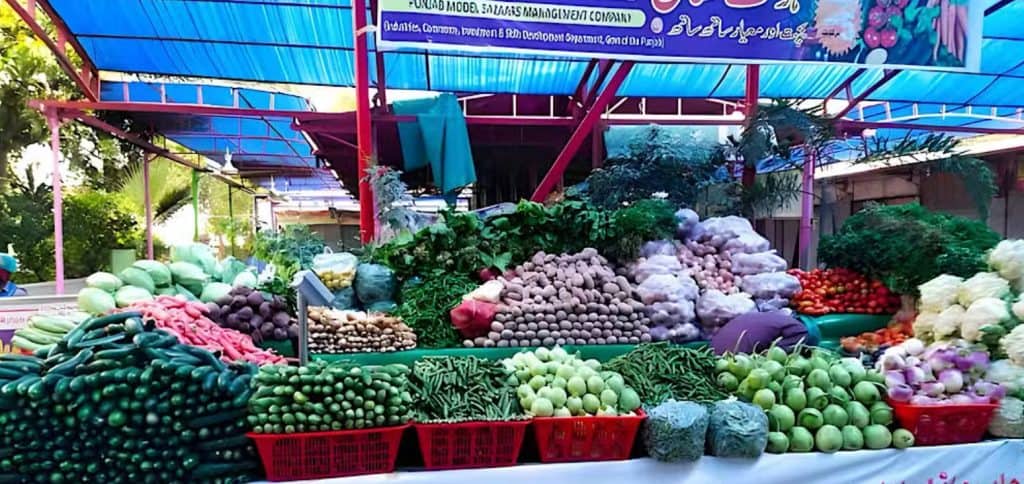
When the Punjab government converted the Punjab Model Bazaars Management Company into the Punjab Sahulat Bazaars Authority (PSBA), it reshaped a struggling network of markets into a province-wide system aimed at affordable trade.
The Authority has since expanded into one of the most visible economic programs in the province, providing regulated markets for essential goods and supporting a wide range of small entrepreneurs.
A typical Sahulat Bazaar hosts about 150 stalls. At 50 bazaars, this translates into 7,500 stalls, each often run by family businesses, women-led ventures, or small enterprises. Using the national average of six people per household, the Authority’s current network indirectly supports around 270,000 individuals. If the full target of 100 bazaars is achieved under the Rs. 10 billion ADP 2025–26 program, that figure could rise to over half a million.
Stalls are offered at nominal rents, lowering the cost of entry for micro-entrepreneurs. For many women-led businesses, this model has created opportunities to operate in secure and accessible spaces. Officials present it as a form of low-cost incubation, offering steady customer traffic without the overheads of conventional retail.
Digital integration has extended the reach of the program. The Free Home Delivery service, run without subsidies, processed more than 163,000 orders between July 2024 and July 2025, worth about Rs. 210 million. Individual markets like Township and Islampura have generated tens of millions in delivery transactions, showing that demand extends well beyond walk-in traffic.
The “Sahulat on the Go” mobile market scheme, funded at Rs. 675 million, takes goods directly to neighborhoods where land constraints make permanent bazaars difficult. This model is intended to increase access for residents in congested or underserved areas.
Price stability remains central to the Authority’s approach. Data indicates that items sold through Sahulat Bazaars are, on average, 35% cheaper than open market rates, providing nearly Rs. 74 million in consumer savings. Even when compared to officially notified prices, PSBA offers rates about 7% lower, amounting to further savings of Rs. 14.7 million. Officials attribute this to bulk procurement and vendor competition rather than direct subsidies.
Cost-cutting measures have also been introduced. Solarization at the Township Bazaar reportedly reduced monthly electricity bills from Rs. 1 million to Rs. 100,000. The program is now being extended across all existing and planned bazaars, with province-wide rollout scheduled by August 2025.
Beyond economics, the Authority emphasizes inclusivity. Stalls are reserved for SMEs and women entrepreneurs, while bazaars feature facilities such as children’s play areas, improved cleanliness, and security. This has turned them into social as well as commercial spaces, according to supporters.
With 7,500 stalls already operating, the Authority estimates that each unit supports one household directly while also connecting to upstream suppliers such as farmers and wholesalers. Officials argue that the wider ripple effects multiply the impact across local supply chains.
National recognition has followed, including an 84% compliance rating from the Pakistan Centre for Philanthropy and tax-exempt status from the Federal Board of Revenue. The model has also been discussed in interprovincial forums as an example of governance in the retail sector.
Future plans include digitized subsidy monitoring, AI-based vendor registration, real-time pricing dashboards, and climate-resilient infrastructure standards. Some federal agencies have shown interest in adopting parts of the model, particularly the mobile markets and delivery system, in other regions.
Disclaimer: The views and opinions expressed in this article are those of the author and do not necessarily reflect the official policy or position of ProPakistani. The content is provided for informational purposes only and is not intended as professional advice. ProPakistani does not endorse any products, services, or opinions mentioned in the article.