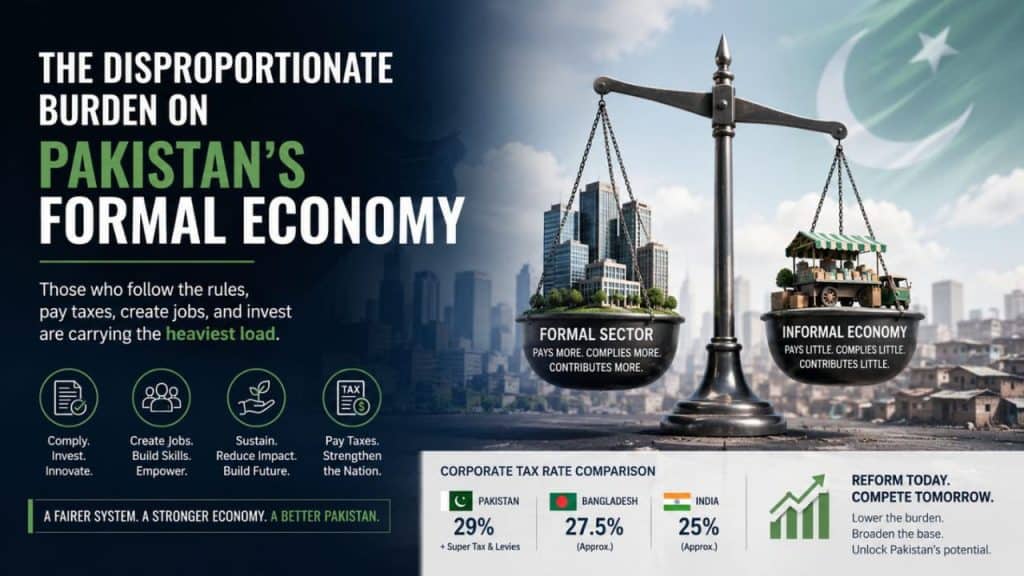
Pakistan’s formal sector continues to invest, create jobs, pay taxes, and operate within regulatory frameworks despite an increasingly difficult business environment. Yet beneath the surface of economic headlines lies a growing imbalance that deserves far more attention than it receives. The businesses that follow the rules, document transactions, pay taxes in full, and maintain international operating standards are increasingly carrying a heavier burden than those functioning largely within the informal economy.
This is no longer a challenge confined to boardrooms and corporate balance sheets. It has evolved into a broader economic issue with direct implications for investment, competitiveness, governance, and Pakistan’s long-term growth trajectory. At a time when the country is searching for economic stability, increased foreign investment, and sustainable revenue generation, the growing pressure on the formal sector deserves serious policy consideration.
Formal sector businesses, particularly multinational corporations, remain among the country’s most significant economic contributors through taxes, employment generation, technology transfer, and operational standards. These businesses invest heavily in maintaining product quality and consumer safety through rigorous testing standards, internationally aligned compliance procedures, and strict regulatory oversight. They also operate within detailed documentation systems that require transparency across supply chains, imports, production processes, and financial reporting.
Their commitments extend to sustainability initiatives such as responsible sourcing, reducing environmental impact, improving energy efficiency, and lowering carbon footprints across operations. At the same time, they support workforce development through technical training, skills transfer, and long-term investment in technology and infrastructure that contribute to broader economic activity.
For multinational companies, such standards are not discretionary. They are embedded within global operating frameworks and accountability requirements. However, the environment within which these companies operate in Pakistan increasingly places them at a disadvantage against players contributing far less to the documented economy.
The tax burden on documented companies in Pakistan remains notably high compared to several regional markets. While the standard corporate tax rate stands at 29 percent, the inclusion of super tax and various additional levies pushes the effective burden substantially higher for many businesses. Once additional costs such as customs-related taxes, import duties, and operational levies are added, the cumulative financial pressure becomes even more pronounced.
By comparison, several neighbouring economies maintain relatively lower corporate tax structures. Bangladesh’s corporate tax rate sits at roughly 27.5 percent, while India’s remains around 25 percent, highlighting the comparatively more challenging tax environment faced by businesses operating in Pakistan.
These differences directly influence how investors assess Pakistan’s competitiveness as a destination for long-term business expansion. Companies making investment decisions evaluate far more than market size alone. Predictability, regulatory consistency, ease of compliance, operational efficiency, and post-tax profitability all play a major role in determining where companies choose to invest.
For multinational businesses allocating capital across different countries, high operating costs combined with inconsistent enforcement environments can significantly weaken a market’s attractiveness. Investors are more likely to favour jurisdictions where documented businesses are able to compete fairly and where compliance does not result in disproportionately higher commercial costs.
This is one of the reasons why business forums and economic stakeholders have repeatedly advocated for structural reforms aimed at improving competitiveness and easing pressure on the documented sector. Discussions around reducing the corporate tax rate and phasing out additional tax burdens such as the super tax have increasingly gained traction in policy circles. The broader objective behind such recommendations is not simply to reduce corporate costs, but to create a more balanced, predictable, and investment-friendly economic environment.
A wider tax base, combined with simpler and more consistent compliance structures, would strengthen fiscal stability rather than continued dependence on a relatively small pool of documented businesses.
Pakistan’s long-term economic ambitions ultimately depend on fostering an environment where responsible and transparent business practices are encouraged through competitiveness and consistency rather than weighed down by structural disadvantages, particularly at a time when economic stability remains fragile.
Disclaimer: The views and opinions expressed in this article are those of the author and do not necessarily reflect the official policy or position of ProPakistani. The content is provided for informational purposes only and is not intended as professional advice. ProPakistani does not endorse any products, services, or opinions mentioned in the article.