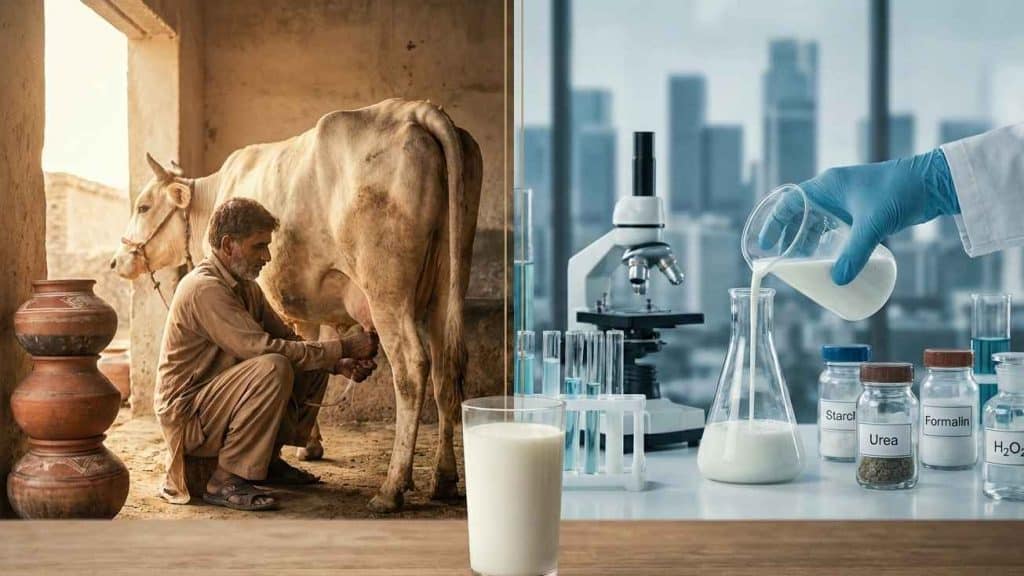
Milk is a foundational element of the human diet, providing essential nutrition to millions across the globe. In Pakistan, the livestock sector is not merely a traditional practice but an economic powerhouse; it contributes approximately 14-15% to the national GDP and secures Pakistan’s position as the 5th largest milk-producing country in the world.
However, this “energetic” economic character faces a dark reality. Driven by rapid urbanization and a surging population, the demand for milk has far outpaced ethical production. In a market where nearly 97% of consumers rely on raw milk, the imbalance between supply and demand has created a lucrative playground for those who prioritize financial gain over public welfare.
The Illusion of Household Quality
According to a survey by Gallup & Gilani Pakistan, an overwhelming 84% of households prefer fresh milk. Yet, for the average consumer, distinguishing between pure milk and a chemical cocktail is increasingly difficult.
Most Pakistani households judge milk quality by the thickness of the fat layer that forms after boiling. This is a dangerous misconception. In the modern era of food fraud, a cream layer is not a guarantee of purity. Sophisticated adulterants are now used specifically to mimic the texture and appearance of high-quality dairy.
While a consumer can perform basic screenings by observing the cream layer, smell and taste, thickness, and boiling behavior, these methods are no longer 100% reliable.
A Grim Indictment: The Adulterant Categories
The list of substances currently permeating the supply chain is a sobering reflection of an unregulated industry. These chemicals are used to preserve milk, increase volume, or artificially boost lactometer readings to deceive the buyer.
The industry’s unregulated corners rely on four main categories of contaminants:
- Volume Enhancers: Water and rice flour used to stretch the supply.
- Cosmetic Additives: Glucose, cane sugar, and starch used to manipulate lactometer readings and artificially increase thickness.
- Hazardous Stabilizers: Formalin (a preservative for cadavers), hydrogen peroxide, and caustic soda.
- Industrial Chemicals: Detergents, urea, and ammonium sulphate used to mimic the appearance of high-protein milk.
The scale of this crisis was laid bare in a 2020 investigation by Parkash Meghwar, Public Analyst for the Sindh Food Authority. A staggering 82.78% of 900 milk samples collected across Sindh were found to be adulterated. The investigation detected 20 different contaminants, including toxic substances like salicylic acid, borax, and pulverized soap.
Pharmacological Negligence
The danger begins at the source. It is a mandatory global practice that when dairy animals are vaccinated or treated with medication, their milk must not be used for a specific withdrawal period. This safety window, clearly marked on vaccine labels, ensures that harmful drug residues do not enter the human food chain.
In Pakistan, however, many dairy farmers overlook this rule. Fearing the loss of profit from withholding milk for even a few days, they continue to sell contaminated supply. They are, quite literally, risking human lives for a few extra pennies.
The Path to Reform
While global markets have achieved safety through strict regulation, Pakistan’s milk supply chain remains largely traditional and dangerously unregulated. To rebuild trust in this vital food source, we must implement:
- Legislative Reform: Enforcing mandatory pasteurization laws and strict food safety standards.
- Infrastructure Investment: Developing a modern cold chain and hygienic transportation methods to reduce contamination.
- Professional Oversight: Ensuring that all preservatives and medicines are used only under the supervision of qualified VET doctors and Quality Assurance teams.
- Digital Traceability: Using technology to track quality from the farm to the consumer’s doorstep.
Without these measures, the “white gold” meant to sustain our nation will continue to be a silent threat to public health. It is time for a collective demand for purity over profit.
Disclaimer: The views and opinions expressed in this article are those of the author and do not necessarily reflect the official policy or position of ProPakistani. The content is provided for informational purposes only and is not intended as professional advice. ProPakistani does not endorse any products, services, or opinions mentioned in the article.