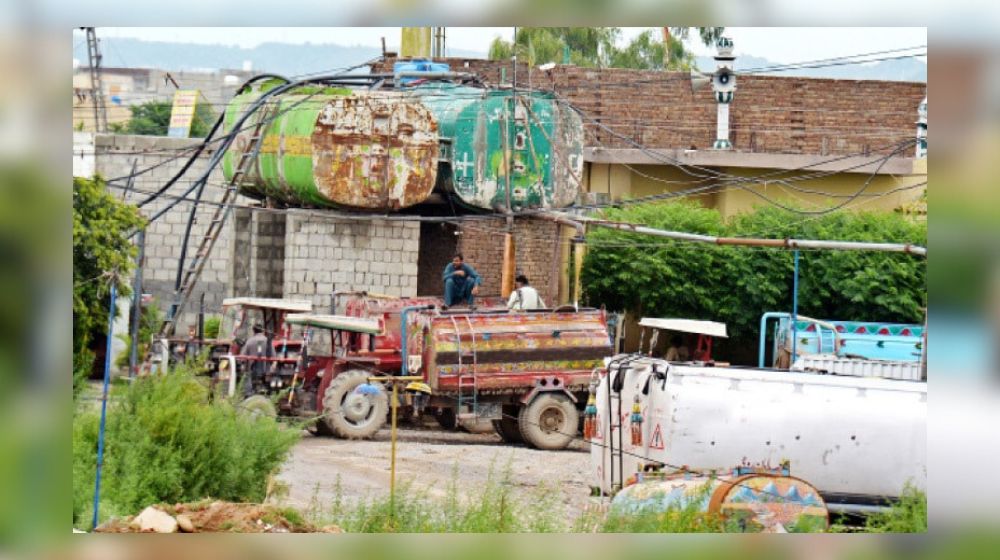
ISLAMABAD: The twin cities of Islamabad and Rawalpindi are grappling with an alarming rise in illegal water hydrants and tankers, exacerbating the existing water shortage. Despite the evident water crisis, local administrations have been unsuccessful in curbing the proliferation of the private tankers mafia and unauthorized commercial tube wells that exploit groundwater.
Residents are left with no choice but to rely on these tankers, shelling out between Rs2,200 to Rs2,500 per tanker, to address their water needs. The responsibility of water provision falls on the Capital Development Authority (CDA) in Islamabad and the Water and Sanitation Agency (Wasa) in Rawalpindi. However, both entities have been unable to fulfill their duties, citing limited resources. The primary water sources for these cities are the Simly Dam, Rawal Dam, and their respective tube wells.
The unchecked growth of these illegal hydrants has severely impacted groundwater levels. Residents lament the depletion of their local water sources due to these unauthorized activities. Iftikhar Shah, a local from Dhoke Syedan, expressed his distress, stating that their entire village’s water source has dried up because of these illegal hydrants.
In a recent move, the CDA disconnected approximately 40 unlawful water connections. An official statement highlighted that the city’s water supply had been adversely affected for months due to these unauthorized connections, leading to reduced water pressure in various sectors.
A senior official from the Islamabad District Administration voiced concerns about the potential chaos if these private tanker services were shut down. He emphasized the government’s duty to ensure water supply and mentioned that any action against the current services without proper planning could lead to multiple issues.
Following a high court directive from the previous year, the Rawalpindi district administration initiated a committee to gather data on illegal hydrants and guarantee citizens access to clean water at fair prices. Preliminary findings revealed more than 89 illegal hydrants in the district.
WASA’s spokesperson, Umer Farooq, confirmed that their survey identified 59 unauthorized water hydrants in city areas, which they plan to regularize. He also mentioned the formation of a committee to standardize water tanker rates and ensure the delivery of clean drinking water to residents.
In the Khanna East locality, the unchecked growth of commercial tube wells has significantly lowered the water table. Residents report that the CDA and the ICT administration have failed to regulate the rapid increase of deep boreholes in the area. Over the past few years, these boreholes, some reaching depths of 600 to 700 feet, have multiplied, causing many household boreholes to dry up.
Local residents are urging authorities to regulate this business and impose stringent penalties on those operating tube wells without proper authorization. They fear that if unchecked, this could result in the total depletion of underground water reserves.
The CDA Sanitation Director, Sardar Khan Zimri, clarified that the civic body does not oversee such issues in Islamabad’s rural areas. He mentioned that ensuring government water supply to all residents is currently unfeasible. Meanwhile, Mr. Zeeshan, the assistant commissioner in Khanna, stated that they periodically halt the operations of these tube wells based on public complaints. However, many owners manage to overturn these orders through the courts. He affirmed that any commercial tube well in residential areas would be sealed.
Source: DAWN