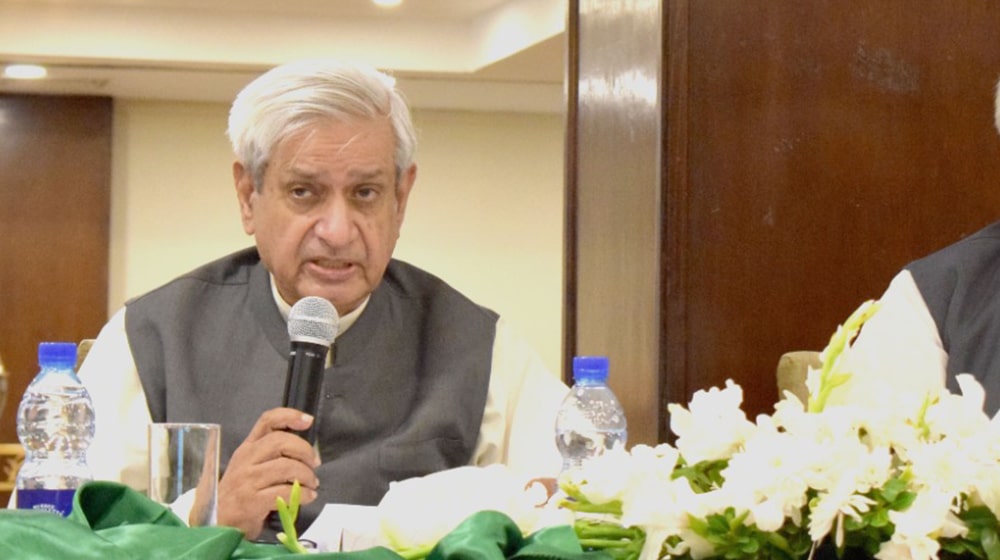
The federal Minister of National Food Security and Research, Syed Fakhar Imam, declared that agriculture is likely to face severe impacts from climate change.
He said this while addressing the Twenty-Fifth Session of the Near East Forestry and Range Commission that was hosted virtually by Egypt, and added that climate change is reducing the amount of food that can be grown at a time when more is needed than ever before.
The world’s population is expected to grow from seven to nine billion by 2050, and the population and food consumption will require food production to increase by 70 percent until then, he explained. With consumption already at 1.5 times the world’s replenishing capacity, the current food systems are unsustainable. Simultaneously, the production, storage, and transport of food produce greenhouse gas emissions that contribute to climate change.
Food systems are responsible for up to 30 percent of global greenhouse gas emissions. The production of rice, which is a staple food for almost half of the world population, is responsible for about 11 percent of all manmade methane emissions. Additionally, the cutting down of forests for new farmland as well as unsustainable farming practices are major sources of carbon dioxide emissions.
Minister Imam said that Pakistan’s agricultural sector is indispensable to its economic growth, food security, employment generation, and poverty alleviation. It contributes 192 percent to the GDP and provides employment to around 39 percent of the labor force. More than 65 to 70 percent of the population depends on agriculture for its livelihood. In spite of COVID-19, locust attacks and extreme climatic events, the agriculture sector’s performance during 2020-21 was encouraging as it has grown by 2.77 percent against the target of 2.8 percent.
However, the country’s population will be 350 million by 2050, and its food requirement will be 130 m MT. This will be possible if the land, water, and other available resources are used wisely, he said.
Minister Imam said that one billion trees have been planted in Khyber Pakhtunkhwa under the directive of Prime Minister Imran Khan, and the National Scale Ten Billion Afforestation Project is underway to counter such issues. These initiatives will increase the forest cover area, desertification control, climate mitigation, biodiversity conservation, and the improvement of the ecosystem.
The ten billion afforestation program is also aimed at promoting apiculture in the country and the production of quality honey with the additional plantation of bee-supporting flora. Minister Imam mentioned that healthy forest ecosystems are essential for sustainable agriculture production.
He proposed the following recommendations during the meeting:
- Strong linkages are required in Near East & North Africa for knowledge sharing, the transfer of technology, and human resource development in areas of sustainable agriculture production, besides the restoration and improvement of forest and rangeland ecosystems.
- Joint programs/ventures for public awareness and the promotion of more efficient climate-resilient agriculture production systems.
- A comprehensive report to document the success stories and best practices in the Near East & North Africa (NENA) region.
Stay Connected with ProPakistani
Get the latest news and stories wherever you prefer.
Add ProPakistani to Preferred Sources and see more of our stories in Google Search and Top Stories.