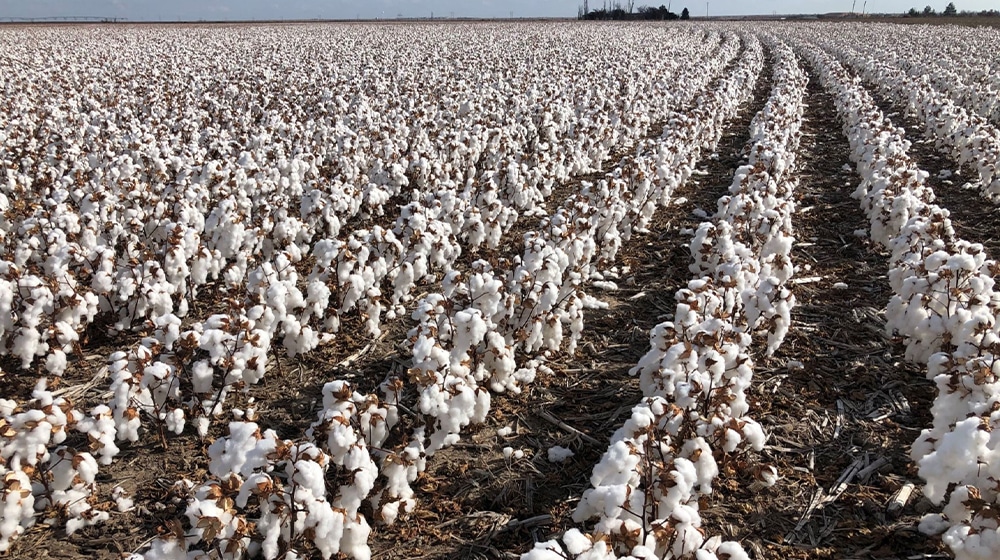
Pakistan is among the countries that are the most vulnerable to the effects of climate change, including the cultivation and production of cotton, according to a study by the State Bank of Pakistan (SBP).
Fluctuating weather conditions such as unexpected rains, especially in the monsoon, and temperature variations at critical stages of crop growth can lead to pest attacks that adversely affect cotton crop productivity.
Due to the increased risk of climate changes and lack of corresponding strategies at the government level, farmers associated with the production of cotton have switched to other crops such as rice, sugar, and maize. Resultantly, the production of the cotton crop has fallen substantially and Pakistan has resorted to importing cotton to meet the demand of its booming textile industry.
There are also multiple other reasons that have pushed farmers to substitute cotton with other Kharif crops.
Besides climate changes, the area under cotton cultivation in Pakistan has had a secular decline over the last decade which is partially due to an increase in the area under cultivation in competing for Kharif crops, such as rice, sugarcane, and maize.
Low Productivity
The long-term analysis indicates that Pakistan’s cotton productivity is stagnant. In contrast, the output per hectare for competing crops such as maize, sugarcane, and rice has grown over the years. The yield of maize has improved by more than threefold from the FY01 levels. Similarly, the sugarcane and rice yields have increased significantly over the last two decades.
The stagnancy in the cotton yield is mainly due to the unavailability of quality and certified seeds. The reliance on the old generation BT cotton is challenging for farmers due to its ineffectiveness against bollworms and other pests. Moreover, according to market experts, around 45 percent of seeds are provided by registered seed corporations, while the remaining 55 percent of seeds are sourced from unauthenticated vendors. In contrast, the increased use of hybrid rice and maize seeds has led to an improvement in per hectare yields.
The decline in the area under cotton can also be attributed to lower profitability as compared to other cash crops such as sugarcane, maize, and rice. For instance, overall returns to investment in Punjab were Rs. 237 and Rs 225 per day for sugarcane and rice respectively against Rs. 209 for cotton.
Sugarcane farmers in Sindh received Rs. 237 per day of crop duration as compared to Rs. 205 for cotton. Furthermore, as per the Crop Reporting Service (CRS) which is under the Government of Punjab, the estimated per acre profit at the farm gate during Kharif FY21 was around Rs. 63,000 for sugarcane, Rs. 30,500 for maize, Rs. 40,000 for rice, and Rs. 29,000 for cotton.
Conversely, sugarcane is more resilient against extreme weather conditions and has the least probability of a pest attack amongst competing crops.
Government Efforts to Revive the Cotton Crop
The government has offered various incentives to attract growers towards the cotton crop again, and an announcement for an indicative price for cotton is expected to provide some relief to the cotton growers.
It is also gearing up to ensure the timely availability of certified seeds at the time of sowing besides providing technical knowledge about best crop management practices to achieve higher yields through its cotton research center.
These efforts may have played a role in increasing the yields during FY22, and may also help arrest the decline in area under cotton.
According to provisional estimates, the production of cotton in FY22 is projected at 9.4 million bales, indicating a significant increase of 33.1 percent over last year.
It is pertinent to mention that the overall area under cotton cultivation is declining. The average cotton cultivation area dropped to 2.6 million hectares during FY13 to FY22, from an average of 3.0 million hectares between FY03 to FY12. During FY22, the area under cotton crop cultivation fell to 1.9 million hectares from 2.1 million hectares last year.
Stay Connected with ProPakistani
Get the latest business news, market insights, and economic updates wherever you prefer.
Add ProPakistani to Preferred Sources and see more of our stories in Google Search and Top Stories.












