A recent report by PIDE points to a very grave picture on the amount of water available to every citizen of the country. There has been a greater than 70% reduction water availability in per capita terms since 1947. That is staggering given that availability was not a problem. However, today, Pakistan is categorized as a water-stressed country; 1-level short of dropping into being water-scarce.

Anyone concerned with the state of the country’s affairs would raise strained eyebrows considering that we have a population bulge, a wasteful, water-intensive economy and unregulated urbanization to contend and the gap between water accessibility and availability grows each year. Not only does this put a spanner in the government’s plans to transition into an upper-middle income country by 2025, the question on the country’s food-security remains at large.
Given that we have a population bulge, a wasteful, water-intensive economy and unregulated urbanization to contend, the gap between water accessibility and availability grows each year. Not only does this put a spanner in the government’s plans to transition into an upper-middle income country by 2025, the question on the country’s food-security remains at large.
Water storage capacity has already reduced to a 30-day supply against the required 1000-day capacity given the climate of the country and with the climate-crisis acting as an uncertain factor, the logic to ensure water-conservation practices has never been higher.
If our UN goals for sustainable development are to be met, now is the time to be asking what the private sector and the government agencies can do to build that policy. In this respect, reducing the burden of paper usage stands as an easy way to programmatically reduce its need given that many services involving the unit can now be processed on digital platforms.
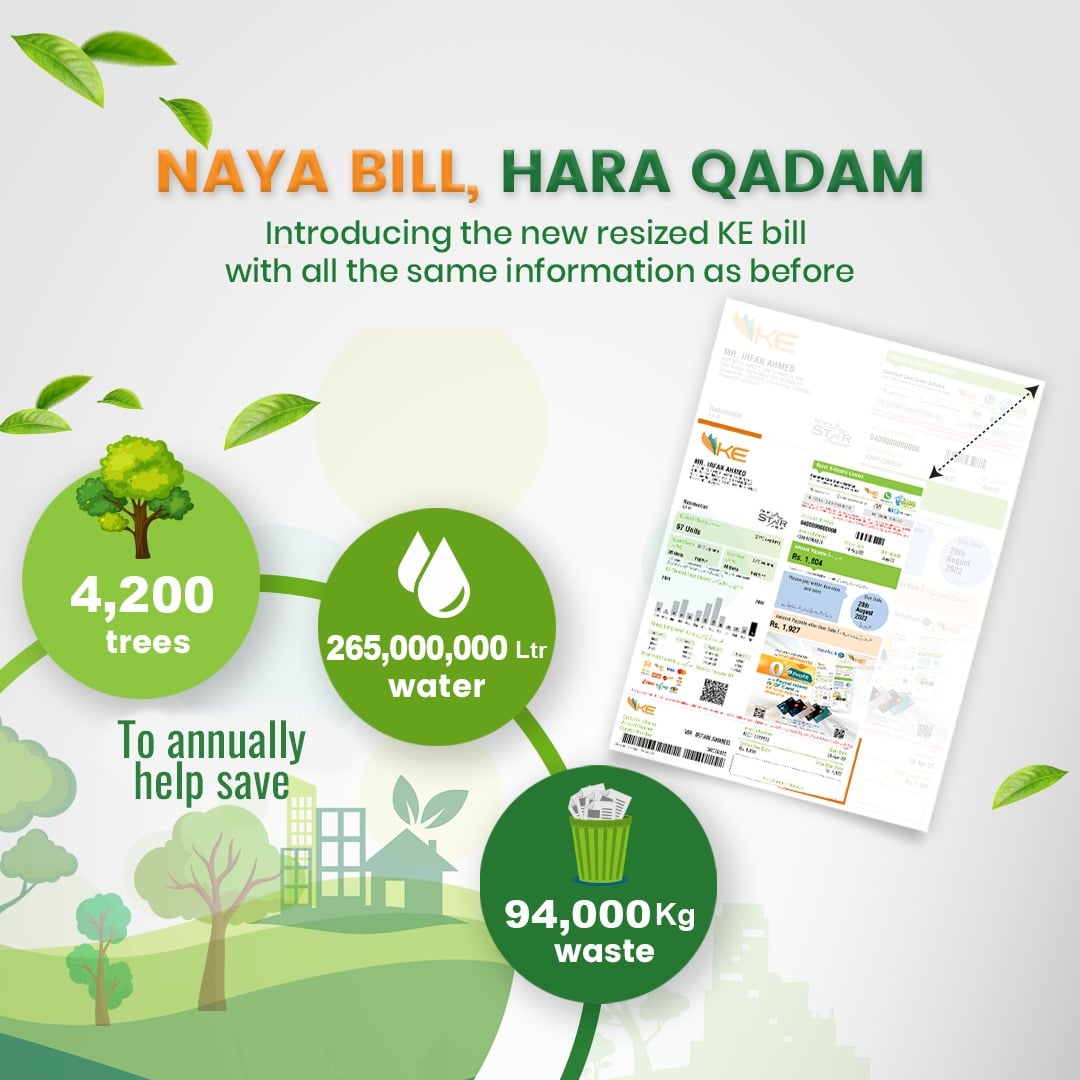
Recently, Karachi’s power utility company, K-Electric announced their “Naya Bill Hara Qadam” initiative which resized customers’ electricity bills to the smaller A5 from A4. Through this simple move, the utility claims that they will be able to conserve over 265 million liters of water a year and reduce 92-tonnes of paper-based waste from ending up in landfills annually.
A first of its kind step within the energy sector of the country, small steps like these create ripple effects and perhaps can be replicated by other power companies who print bills for consumers in rest of the country.
Stay Connected with ProPakistani
Get the latest news and stories wherever you prefer.
Add ProPakistani to Preferred Sources and see more of our stories in Google Search and Top Stories.