The Exynos 2500, Samsung’s latest flagship chipset, did not make it in time for the Galaxy S25 launch back in January, but it is finally ready after a few final touches from Samsung. The launch comes just a few weeks before the anticipated Z foldables launch in July.
The Exynos 2500 brings improved power efficiency thanks to Samsung’s new 3nm Gate All Around (GAA) node. It also comes in new packaging called Fan-Out Wafer-Level Packaging, which brings better heat dissipation with reduced chip thickness.
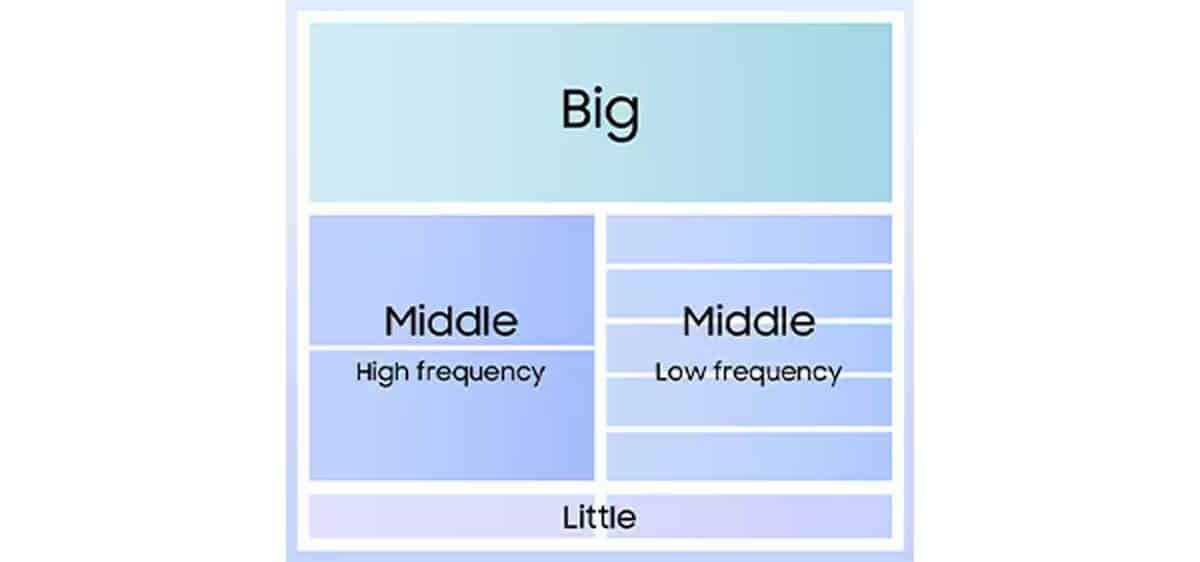
Samsung’s latest processor features a 10-core CPU, marketed as a 1+7+2 layout, but a closer look reveals it’s actually a 1+2+5+2 configuration. This split in the mid-tier cores is designed to improve power efficiency by dividing workloads more precisely across different core groups. According to Samsung, this new setup delivers a 15% boost in performance from its high-powered “big” core.
At the heart of the chip is a single Cortex-X925 core clocked at 3.3GHz, backed by two high-performance Cortex-A725 cores at 2.74GHz. These are joined by five additional Cortex-A725 cores running at a slightly lower 2.36GHz, and two energy-efficient Cortex-A520 cores operating at 1.8GHz.
Samsung’s latest GPU, the Xclipse 950, is the fourth generation of its AMD-based graphics technology. Built on the same RDNA 3 architecture as its predecessor, the new GPU continues to support hardware-accelerated ray tracing but brings noticeable upgrades under the hood.
Compared to the previous Exynos 2400, which featured six work group processors (WGPs) and four render backends (RBs), the Xclipse 950 increases that to eight WGPs and eight RBs—doubling the render backend capacity. This larger configuration is expected to boost frame rates by 28% with ray tracing on.
Alongside the GPU improvements, Samsung has significantly enhanced the chipset’s NPU (neural processing unit). It now delivers up to 59 trillion operations per second (TOPS), a 39% increase over what the Exynos 2400 offered. This allows for more complex AI features to run directly on the device, without needing cloud processing.
Samsung has made improvements to the camera system as well. It now supports AI-driven image processing for sensors up to 320MP. Photos benefit from advanced features like multi-layer noise reduction and Dynamic Range Compression (DRC), helping to deliver clearer, more detailed images. On the video front, the chipset can handle 8K recording at up to 30 frames per second, while playback is supported at up to 8K 60fps, complete with AV1 hardware decoding.
Another major enhancement comes with the integrated modem, which now includes support for non-terrestrial networks (NTN). This upgrade brings satellite-based messaging. The 5G modem complies with the latest 3GPP Release 17 standard and can reach download speeds of up to 9.6 Gbps on FR1 bands and up to 12.1 Gbps on FR2. For local wireless connectivity, the chipset offers Wi-Fi 7 and Bluetooth 5.4. Additionally, Samsung has refined the analog interface for GNSS, promising more accurate global positioning capabilities.
The Exynos 2500 is already in mass production, meaning it is more than likely going to be ready for the Galaxy Z Fold/Z Flip launch in July at the next Galaxy Unpacked event. It is unclear which other Samsung phones are going to use this chip.
Get the latest tech news, telecom insights, and product launches wherever you prefer.
Add ProPakistani to Preferred Sources and see more of our stories in Google Search and Top Stories.