In one fell swoop Meta just doubled its prices for OTP via WhatsApp. This small action has serious implications for Pakistan’s national digitization.
When I was at Levi’s in the 1990s, they were smart enough to never have Pakistan report to India. Same for multiple enterprise tech companies whose Pakistan operation would be managed by the head office in Dubai, Singapore or Istanbul. It is just common sense. Sadly, this principle has failed at Meta and other digital platforms. It is also why superior drama content from Pakistan never makes it on Netflix, which will be the subject of another article later.
Is This Business as Usual?
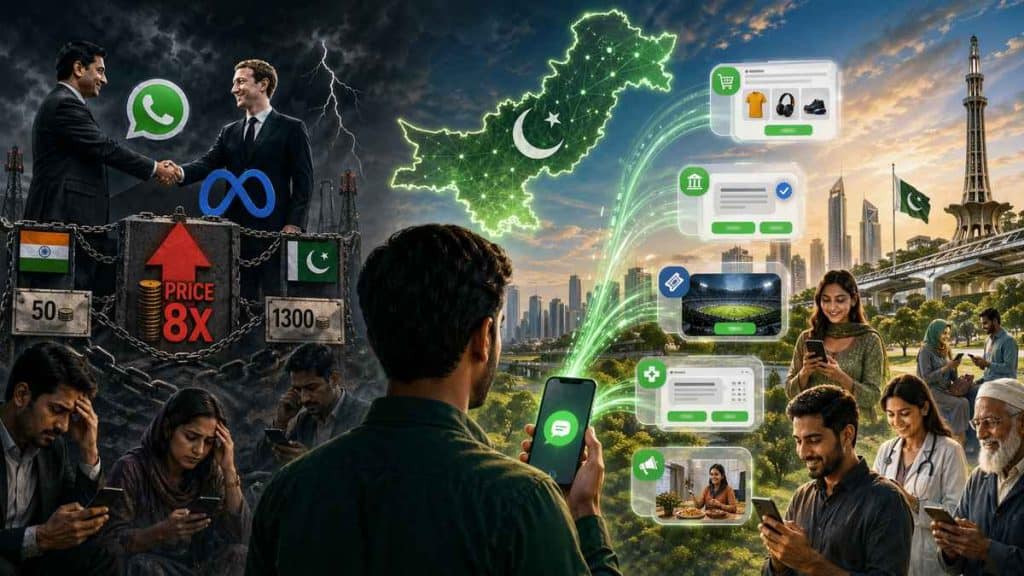
I feel the doubling of prices by Meta is related to this principle. Meta India controls Meta Pakistan prices. Meta OTP prices in Pakistan are EIGHT TIMES those of India. On the surface, this can be justified as a business move. Pakistan’s telecom companies raised SMS prices (together, which I am sure was a coincidence *rolls eyes*). This forced people to move to Meta, which understood that for the OTP workflow, Pakistani businesses are trapped, and doubled prices. Ostensibly, it looks like a case of two powers screwing the customer in between them, but for Pakistan, this issue is existential.
We’re in a War No One Sees
The core digital accelerator of a nation is Digital Public Infrastructure (DPI). And one of the key aims of DPI is to lower onboarding costs. And one of the key components of onboarding is OTP. It costs roughly 50 PKR to onboard a customer in India for a digital payments app. The same number for Pakistan is roughly 1300 PKR. This number is critical because the rise of digital payments is the holy grail of a nation’s digitization. And the OTP price is a battle in this war and it is a battle for Pakistan; its businesses are going digital, and especially its digital payment providers are losing. If you wanted to hurt Pakistan’s rise as a global digital tiger and wished it ill, raising OTP prices would be a clever, innocent way of doing it.
Google’s Checkmate Move: RCS
The situation as it stands leaves a massive opening for Google and if Google plays it smart and focuses its efforts in the right direction and invests accordingly, it can score a stunning victory. SMS traffic is declining. Telecom operators are trying to suck it for all its worth, but it does not change the fundamental reality and the steeply downward trajectory. Google’s Rich Communication Services (RCS) is a way they can bring SMS revenue back, allowing telecom providers to and force Meta to stop extorting Pakistan.
Every time you log into JazzCash, verify a transaction on Easypaisa, or authenticate yourself on Daraz, a one-time password is sent to your phone via SMS. That single text costs the sending business between $0.20 and $0.47 per message, depending on the carrier and aggregator. As per my calculation, Zong sits at the low end, ~$0.26, while Jazz routes can run up to $0.47. These are what FinTechs, banks, and e-commerce platforms pay for the privilege of verifying you based on the number you gave.
Now multiply that by Pakistan’s exploding digital payments ecosystem. In FY25, mobile banking alone clocked 1.8 billion transactions worth PKR 83.2 trillion, up 59% year-on-year. JazzCash and Easypaisa dominate, and both rely on OTP-based authentication. Even a conservative estimate, that 30% of those transactions trigger an OTP, puts the SMS authentication bill for Pakistan’s mobile finance stack at roughly $189 million per year. A lot of them will shift to in-app authentication and pins if telecoms do not act now.
Why should they? Because Pakistan is building the Pakistan Digital National Stack that has a foundational data exchange layer, a digital ID on top of that and a universal payments interface on top of that. A national stack turbocharges digital payments. That $189 million is easily over a billion dollars in 5 years, even after drastically reducing prices. That is the pot Google is looking at just for one sector!
RCS is the protocol Google has spent a decade pushing as the successor to SMS. It rides on data connections, not the telco’s SMS gateway. With Apple finally adopting RCS in iOS 18 (68% adoption among compatible iPhones by January 2025), and Google’s RCS Business Messaging platform now live in 60+ countries, including neighbouring India, the infrastructure is in place and battle-tested. RCS, delivered over data rather than carrier SMS pipes, could collapse current prices to the $0.10–$0.15 range, a potential 50–66% reduction in per-OTP cost to begin with.
Why would carriers cooperate? Well, that is simple yet really hard. They need to have the vision to realize that if they grow the pie as partners, they will all win. Pakistan is not yet on Google’s RCS Business Messaging map. The current operator list covers India (Airtel, Jio, BSNL, Vodafone Idea), Nigeria (9Mobile), South Africa (Cell C), and much of Latin America and Europe. Pakistan’s telcos are conspicuously absent. But Google’s Guest Mode already bypasses operator networks entirely, delivering RCS via data connections through the Android Messages app. In a country where Android dominates the smartphone market share, the operator gatekeepers may find themselves bypassed whether they cooperate or not. All it takes is for the PTA to send one circular.
Mobilesquared research suggests operators who proactively deploy RCS could see a 240% revenue uplift versus SMS-only, but those who delay risk cannibalisation with no upside. For Pakistan’s fintechs and banks, the incentive is clear: cheaper OTPs, richer verification experiences (branded sender IDs, verified badges, interactive buttons instead of a plain six-digit code), and reduced fraud surface. For the telcos, it’s an ultimatum: partner now and share revenue, or watch it walk out the door entirely. OTP’s moving to WhatsApp was that cannibalization. Do you want another rebel pretender to rise from the ashes of your lack of innovation and kill your fast-dying SMS revenue further?
The fraud point is meaningful. It is a well-known secret among banks, financial services providers, and Law Enforcement Agencies that South of Punjab is the epicenter of financial fraud in Pakistan. Anecdotal evidence suggests Pakistan is one of the countries with the most financial fraud in the world if measured by fraud per active accounts. RCS networking API’s, if used smartly by the ecosystem, can detect SIM Swap, when someone steals a SIM and tries financial fraud from a new phone. Vice versa, enterprises can also work with telecoms to ensure other use cases. RCS allows a lot of new use cases for Telcos to use to add value to the digital ecosystem, protect their margins, and grow their revenue.
A Brand New World
RCS messages can contain product carousels, images, quick-reply buttons, and deep links, turning a text thread into a mini storefront. A customer browsing a Daraz-style retailer wouldn’t need to open a browser. The product catalogue comes to them, they swipe through options, tap “Buy Now,” and complete the purchase, all within Google Messages.
Imagine your bank sends you an RCS message you can chat with. For a market like Pakistan, where JazzCash, Easypaisa, Zindigi, and soon the new cohort of Digital Retail Banks are racing to acquire customers, RCS unlocks something SMS never could: interactive financial journeys. You could receive a message from your bank that doesn’t just say “You spent PKR 856 on Foodpanda.” Instead, it presents a branded carousel right before the weekend, telling you about new credit card deals, helping you upgrade it, or apply for a personal loan…. all with one-tap buttons, inside a verified, blue-checkmarked thread. In November 2025, Solutions by Text became the first company to go live with RCS in U.S. financial services, delivering verified, branded bill payment experiences that achieved up to 400% ROI and a 97% reduction in time to revenue versus traditional collection channels. Madness!
Pakistan’s cricket and entertainment economy is exploding with PSL, concerts, live events, curated raves, and more cinemas. Currently, ticket promotions go out via SMS blasts or social media ads. RCS converts that into an interactive experience: swipeable match schedules, embedded seat maps, one-tap purchase buttons, and real-time updates.
Pakistan’s healthcare sector relies heavily on manual phone calls and basic SMS for appointment reminders. The no-show rate is bad. RCS enables interactive appointment management: confirm, reschedule, or cancel with a single tap. Add medication reminders with dosage images. Follow up post-visit with branded, trusted messages. Every sector that needs appointments benefits from this.
According to Infobip, retail brands switching promotional campaigns to RCS rich cards report a 30% increase in click-through rates. Overall, RCS messages achieve 72% open rates (comparable to SMS) but with 10x higher engagement due to rich media capabilities. The cost-per-click is 14x lower than SMS because fewer messages are needed to achieve the same conversion. Pakistan’s e-commerce market is <1% of its total retail market. After Pakistan’s DPI revolution, it is expected to rise to 4%. Do you honestly want to not use RCS to win in it? This extends to all brands using marketing! Home chefs could stay at home and advertise within their neighbourhood, allowing women to be powerfully included in the economy. The possibilities are mind-blowing!
All telcos need is vision.
I believe Pakistan’s telecom companies are true to Pakistan. Jazz, Ufone, and Zong will do the right thing and work with Google to save Pakistan from Meta’s disastrous decision, which literally amounts to a stab in the back of our national digitization. Google is betting on Pakistan by opening an office; the least the government and PTA can do is support them on RCS and help save Pakistan.
Disclaimer: The views and opinions expressed in this article are those of the author and do not necessarily reflect the official policy or position of ProPakistani. The content is provided for informational purposes only and is not intended as professional advice. ProPakistani does not endorse any products, services, or opinions mentioned in the article.