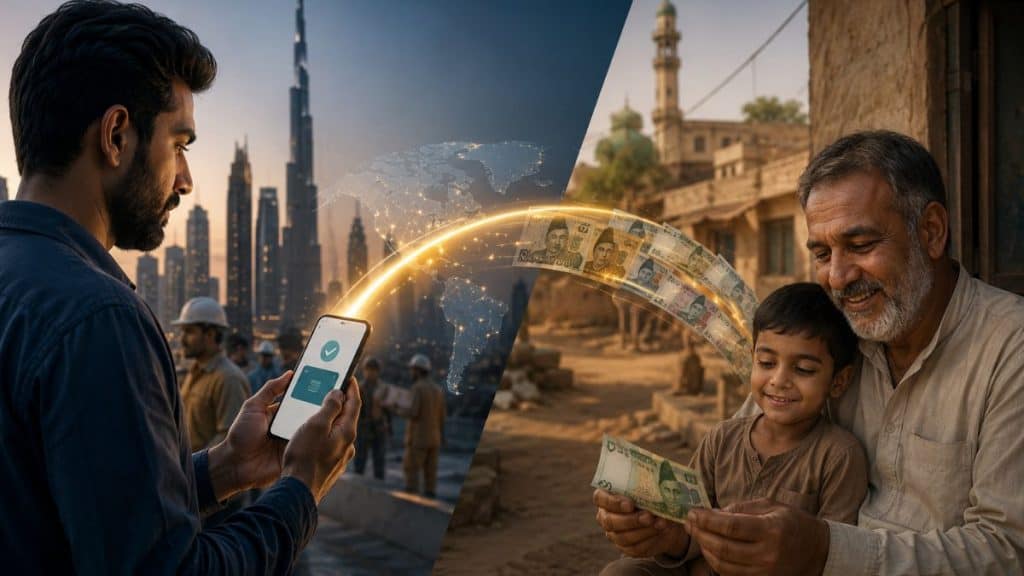
Every month, millions of Pakistanis working abroad send money home. These remittances pay for school fees in Gujranwala, medicines in Multan, rent in Karachi, and weddings in Swat. They are not merely financial transfers; they are Pakistan’s largest unofficial social safety net.
In recent years, remittances have consistently ranged between $28 billion and $31 billion annually, which is close to 9 per cent of GDP and substantially larger than foreign direct investment (According to SBP & World Bank KNOMAD database). In difficult economic periods, they have often acted as the country’s most reliable external stabilizer.
The Hidden Cost Inside Formal Channels
Yet hidden within these enormous inflows is a quieter problem: Pakistan may be losing hundreds of millions of dollars every year simply because overseas workers are not shown the best available remittance rates. There is no official statistic for this loss. The State Bank tracks inflows, not inefficiency. But the leakage can be estimated by comparing the exchange-rate spreads and transfer costs charged across different providers.
The global average cost of sending remittances remains above 6pc according to the World Bank, despite the UN Sustainable Development Goal target of reducing costs to below 3pc (World Bank RPW Q1 2026). Pakistan’s corridors are often cheaper than the global average because of intense competition.
On some UAE-to-Pakistan transfers, the difference between providers on the same day can exceed 7pc. Which means, a worker sending AED5,000 home may unknowingly sacrifice between Rs20,000- Rs 25,000 simply by choosing a poorly priced channel

In UK corridors, the spread on a £1,000 transfer can exceed Rs24,000 between competing services. Multiply such gaps across millions of annual transactions and the implied national loss becomes substantial.
Using conservative assumptions, a 1pc avoidable inefficiency on Pakistan’s annual remittance inflows would equal roughly $280 million per year. A more realistic blended estimate places the figure closer to $500m-$600m annually. At the upper end, the leakage may approach $900m.
This is not “lost” money in the literal sense. The funds do not disappear; they are absorbed by intermediaries which includes exchange houses, correspondent banks, FX desks and transfer agents. But from the perspective of Pakistani households, the effect is the same: less money reaches Pakistani families.
Why Consumers Often Miss the Best Rates
To be fair, not all pricing differences are irrational. Many overseas Pakistanis prioritize reliability, familiarity and cash-pickup convenience over securing the absolute best exchange rate. Elderly recipients may prefer collecting cash from known agent locations rather than receiving digital wallet credits. Trust still matters, especially for lower-income families.
Nor should policymakers ignore the complexity created by informal hawala and hundi networks. These channels sometimes offer attractive exchange rates but come with regulatory, transparency and anti-money-laundering concerns. Pakistan has spent years encouraging flows into formal systems through the Pakistan Remittance Initiative and related incentives. That effort should continue.
However, a significant portion of the current remittance gap appears to stem from one simple issue: price opacity.
Most senders compare transfer fees but not exchange-rate markups. A “zero fee” transfer can still be expensive if the provider quietly widens the exchange spread. Consumers frequently focus on what is deducted upfront rather than what the recipient ultimately receives in rupees.
A national efficiency gain of even 1pc would matter. An additional $280m annually flowing directly into households would strengthen consumption, improve foreign-exchange resilience and increase savings without requiring new taxation, borrowing or IMF negotiations.
In development economics, governments often search for expensive reforms with uncertain outcomes. But here is a rare case where the gains may come from something much simpler: helping consumers make better-informed decisions. This is where technology and policy can converge constructively.
An Invisible Gap Pakistan Can No Longer Ignore
Pakistan’s remittance story is often celebrated in aggregate terms by stating record inflows, rising monthly numbers, stronger reserves. But less attention is paid to what happens between the sender’s hard-earned dirhams or pounds and the rupees ultimately received by a family member back home. That invisible gap deserves scrutiny.
Platforms such as Send Money Compare, run by two overseas Pakistanis, illustrate how data-driven comparison tools can improve transparency by exposing hidden exchange-rate markups in real time.
A country struggling for external-sector stability cannot afford unnecessary leakage in one of its most vital financial lifelines. Better transparency, smarter digital infrastructure and wider financial literacy may not sound revolutionary, but together they could quietly return hundreds of millions of dollars to Pakistani households every year.
Disclaimer: The views and opinions expressed in this article are those of the author and do not necessarily reflect the official policy or position of ProPakistani. The content is provided for informational purposes only and is not intended as professional advice. ProPakistani does not endorse any products, services, or opinions mentioned in the article.