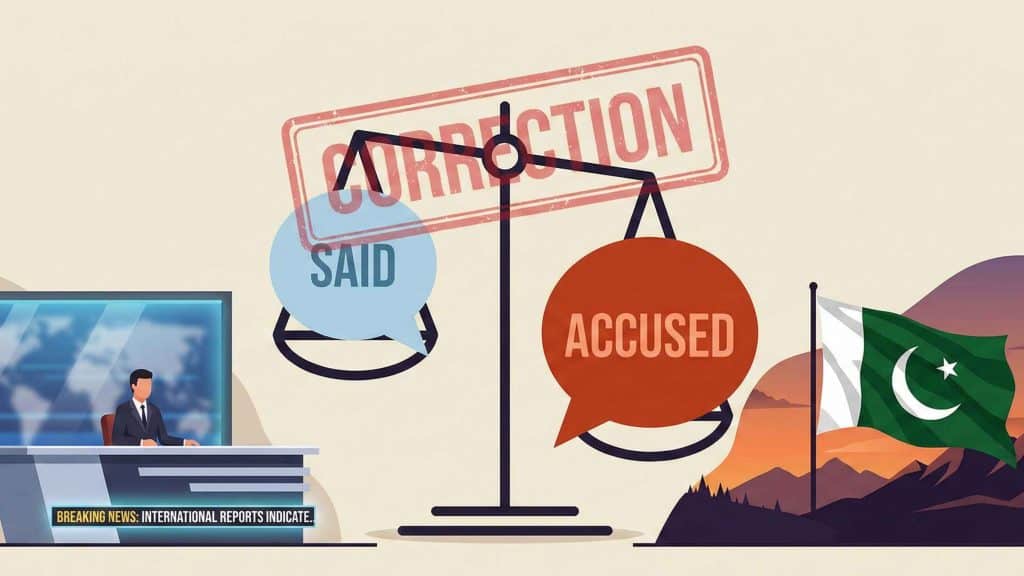
When Pakistan and Afghanistan exchanged heavy fire along the border on Friday night, it was a serious security incident in an already tense region. Reuters moved quickly with a story, quoting both Afghan Taliban spokesman Zabihullah Mujahid and the spokesperson for Pakistan’s prime minister. On the surface, it was a standard breaking-news report. In its first version, however, one small editorial choice spoke volumes.
In that original story, Reuters wrote that Mujahid “said” Pakistani forces had launched attacks in Spin Boldak district of Kandahar. The same paragraph then described Pakistan’s position very differently: a spokesman for Pakistan’s prime minister “accused” Afghan forces of “unprovoked firing” along the Chaman border. In other words, the Taliban representative “said” something; the Pakistani government merely “accused” someone.
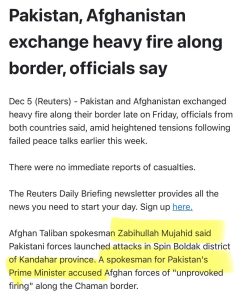
The revised story now available on Reuters’ website quietly fixes this imbalance. The relevant line has been changed to say that a spokesman for Pakistan’s prime minister “said” Afghan forces carried out “unprovoked firing” along the border, putting both statements on the same linguistic footing.
This might look like a minor edit. It is not. In breaking-news journalism, verbs such as “said,” “claimed” and “accused” signal to readers how seriously to take a statement. “Said” is neutral. “Accused” introduces doubt and casts the speaker as confrontational. When an international news agency gives the Taliban the neutral verb and gives Pakistan the loaded one, it shapes perceptions in millions of minds around the world. It subtly presents the Taliban as a credible narrator of events and Pakistan as a party hurling allegations.
That is why the initial version of the story was so troubling. It did not simply report two conflicting accounts. It created an unnecessary hierarchy of credibility between a militant regime and an elected government. For a country like Pakistan, which has long struggled with how it is portrayed in Western media, this looks less like an innocent wording choice and more like a familiar pattern.
The subsequent correction is therefore important. The language now treats both sides in a comparable way, which is what basic fairness demands. Yet it also raises a legitimate question: why did the story appear in its unbalanced form in the first place, and why did it change only after public and diplomatic pressure?
In recent days Pakistan has been unusually active on the diplomatic front. The country hosted the president of Kyrgyzstan, signalled a renewed push for regional economic links, and reaffirmed its strong alignment with Arab and Muslim countries on Gaza. Against that backdrop, the change in the Reuters story looks less like an isolated edit and more like evidence of a more assertive, yet quiet, foreign policy under Foreign Minister Ishaq Dar.
No foreign office issues a press release every time it pushes back against unfair coverage. But the sequence here is telling. A problematic story appears. The Afghan Taliban spokesman’s tweet and the Pakistani spokesman’s tweet are both used, but framed asymmetrically. After objections are raised, including on social media, Reuters updates the copy and brings Pakistan’s statement into parity with the Taliban’s. It is reasonable to assume that, alongside public criticism, there was also discreet outreach from Islamabad. If so, that is exactly how effective diplomacy on media narratives often works: firm, targeted, and mostly unseen.
For Pakistan, this matters beyond a single report. International wire services set the tone for how global audiences, investors, and policymakers understand events in our region. When their language routinely leans in one direction, the cumulative effect is damaging. It reinforces old stereotypes of Pakistan as reckless, irresponsible, or always “accusing” others, even when it is responding to cross-border violence or terrorism.
Deputy Prime Minister and Foreign Minister Dar’s tenure has already been marked by a more deliberate effort to engage partners, from Central Asia to the Gulf, on issues of mutual concern. Securing a fairer presentation of Pakistan’s position in a major Western news agency is not as visible as a summit photo-op, but it is no less significant. It shows that Islamabad is willing to challenge bias, not by shouting slogans, but by using the tools of statecraft.
None of this absolves the international media of their own responsibilities. Reuters publicly grounds its work in the Thomson Reuters Trust Principles, which emphasise integrity, independence, and freedom from bias. Those principles are only meaningful if newsrooms continually examine their own assumptions – including the quiet power of the verbs they choose for different actors in a conflict. When a correction like this is made, it should prompt internal reflection about why the imbalance was there to begin with.
At the same time, Pakistan must recognise that such corrections rarely happen on their own. They follow from sustained engagement, careful monitoring of coverage and timely responses from officials who understand both diplomacy and media. If the change in this particular story reflects the foreign minister’s behind-the-scenes efforts, then it is one more indication that Islamabad is beginning to take its information environment as seriously as its traditional diplomatic files.
For too long, Pakistan has treated unfair reporting as an unavoidable fact of life. The quiet revision of this Reuters story suggests a different path. When the country speaks with clarity, stands by its narrative, and insists on equal treatment, even powerful global institutions have to listen. That is not spin. It is simply Pakistan asking for – and increasingly getting – what every nation deserves: to be heard in the same neutral language that others are afforded as a matter of routine.
Disclaimer: The views and opinions expressed in this article are those of the author and do not necessarily reflect the official policy or position of ProPakistani. The content is provided for informational purposes only and is not intended as professional advice. ProPakistani does not endorse any products, services, or opinions mentioned in the article.