A major structural shift is happening in Pakistan’s petroleum sector as legacy Western companies exit, quickly replaced by massive global trading and sovereign investment giants.
Wafi Energy acquired Shell Pakistan, actively scaling its Middle Eastern mobility footprint into South Asia. Gunvor, a global commodities powerhouse, formed a joint venture with Total PARCO, integrating Pakistan’s 800 retail sites into its trading operations. Saudi Aramco has taken a 40 percent stake in Gas & Oil Pakistan (GO), marking its direct entry into Pakistan’s downstream retail sector to secure a dedicated outlet.
To understand why this capital invasion is happening, one has to look past local petrol pumps. This is a strategic play for guaranteed markets. In the global oil business, upstream producers like Aramco and Gunvor need stable, high-volume destinations where they can offload refined products without aggressively fighting for buyers in the spot market. For them, Pakistan’s population of 240 million represents the perfect guaranteed dumping ground for bulk fuel.
However, operating in Pakistan is rarely simple, and the geopolitical reality of the region often shatters private corporate planning. When war returns to the Middle East, oil stops being a commodity and becomes a local crisis. Recent disruptions around the Strait of Hormuz injected severe fear into global energy markets, pushing crude benchmarks upward.
For an oil-importing country like Pakistan, that global surge translates into immediate chaos at the pump. Recently, diesel and petrol prices surged by over 37 percent. Pakistan State Oil (PSO) reported that its diesel premium spiked to over $35 per barrel, an extraordinary leap from the standard $5.
This geopolitical shock defines the true meaning of a “Sovereign Moat.” During the recent US-Iran clashes, many private oil marketing companies simply stopped importing and allowed their pumps to run dry, refusing to absorb diesel premiums that would destroy their margins. PSO continued importing because, as a state-owned entity, it carries obligations that commercial logic alone cannot override.
The problem is that these same state obligations are what drain it financially. Whenever international prices rise, the government freezes fuel prices, forcing companies to absorb the difference through delayed Price Differential Claims (PDCs). Using taxes like the Petroleum Development Levy (PDL) to plug budget holes turns pricing into a political game instead of an economic signal.
This is exactly why PSO is now trapped in a massive Rs. 412 billion circular debt burden. The dysfunction runs even deeper. Recently, Petroleum Minister Ali Pervaiz Malik highlighted a glaring failure: the Power Division, under Awais Leghari, ordered PSO to import fuel but later refused to take responsibility or lift the cargo, leaving PSO stranded with massive costs.
A sovereign moat cannot hold if it is constantly undermined by the same government it serves. The state must establish binding fuel-lifting agreements under which ministries face immediate penalties for unlifted imports, permanently separating PSO’s commercial operations from political whims.
The financial record tells the same story. As the industry leader, PSO constantly absorbs the brutal impacts of shifting state policies. It has endured everything from a massive drop in furnace oil sales in FY18 to unprecedented flash floods wiping out 93 percent of its profits in FY23.
Yet, despite these shocks, PSO’s physical infrastructure remains undeniably strong, posting a solid Rs. 12.1 billion profit in the first half of FY26 alone. State policy creates volatility, but physical dominance is what keeps the company standing.
On May 18, 2026, Jawwad Ahmad Cheema takes charge as Chief Executive Officer of PSO to navigate this collision of foreign capital and broken state policy. A 26-year veteran of Shell, who built retail networks from scratch in Indonesia and managed billion-dollar global portfolios, is stepping into the state-owned giant just as his former employer exits the country.
The mandate for the new leadership is not merely corporate survival. It is about solving a structural puzzle: how do you compete against multi-billion-dollar giants like Aramco when your own finances are tied up by the government?
To survive the coming retail wars, PSO must double down on what foreign entrants cannot easily replicate. While Wafi and Gunvor focus on retail fuel at the forecourt, PSO remains the main importer of LNG keeping the national power grid running and holds a massive stake in Pakistan Refinery Limited (PRL).
Its dominant position in aviation, marine, lubricants, and defense fueling lies entirely outside the convenience wars that foreign capital will ignite on the streets. These are high-margin, long-contract, business-to-business sectors where scale and state relationships are the only entry tickets.
The future of an oil company is no longer limited to selling liquid fuel. The rapid shift toward electric bikes presents a major threat to petrol sales, meaning the future of the fuel station lies in Non-Fuel Retail (NFR). Globally, mature markets see NFR contributing upwards of 20 to 30 percent of gross margins.
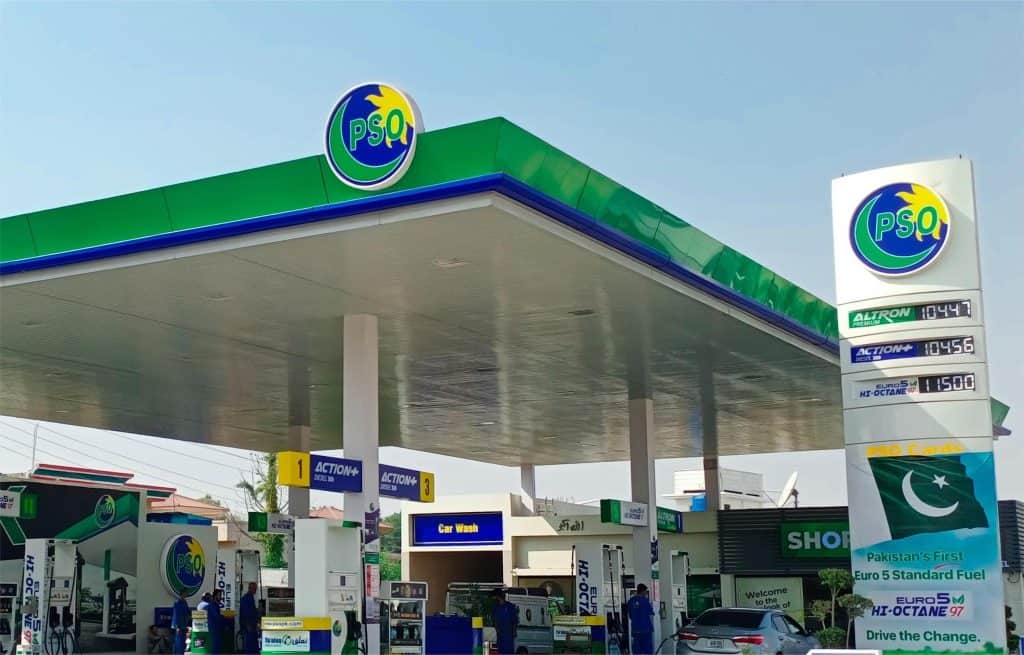
PSO has already begun this transition by expanding its Shop Stop convenience network and launching premium VIBE Café lifestyle hubs. With 3,500 prime real estate locations across the country, capturing even a fraction of global NFR parity represents billions of rupees in untapped, high-margin profit.
Executing this kind of strategy requires more than corporate planning in Karachi. Pakistan’s biggest fuel bottleneck remains the movement of product from southern ports to the northern heartland. PSO’s ultimate advantage lies in mastering this last-mile logistics chain.
By deeply integrating its road freight network and ground-level retail partners, it can turn its physical footprint into something no foreign trading giant can replicate overnight. The game has changed. The state anchor will not just survive this capital invasion; it will dictate the terms of Pakistan’s energy future.
Disclaimer: The views and opinions expressed in this article are those of the author and do not necessarily reflect the official policy or position of ProPakistani. The content is provided for informational purposes only and is not intended as professional advice. ProPakistani does not endorse any products, services, or opinions mentioned in the article.