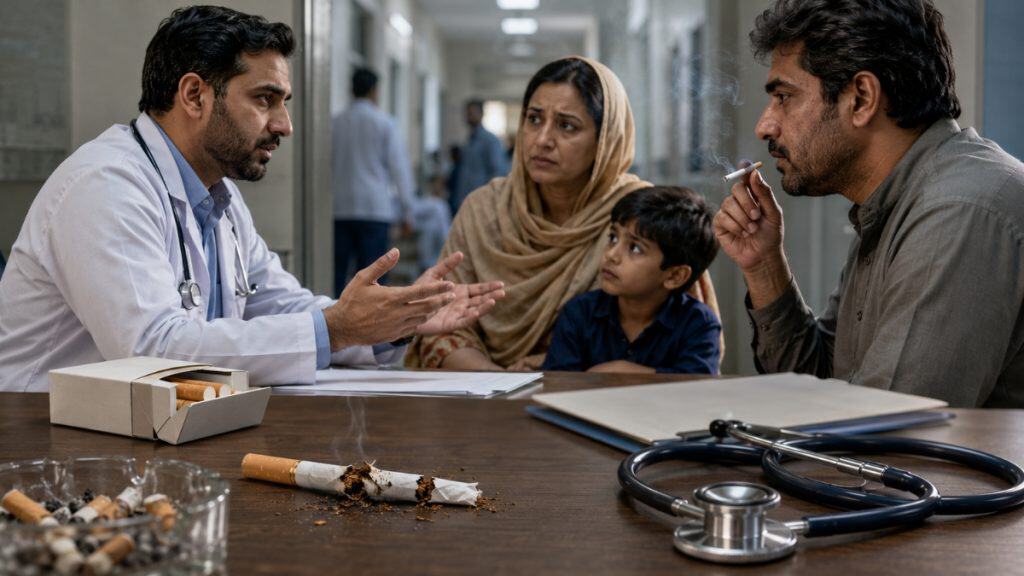
Two decades after ratifying the FCTC, the tobacco control fight stands at a crossroads in Pakistan. With millions exposed to tobacco’s deadly grip, the country faces rising cancers, heart disease, and oral health devastation.
Smoking remains one of Pakistan’s most pressing public health challenges.
With over 23 million tobacco users nationwide, this habit contributes to thousands of preventable deaths each year and places immense strain on families and the healthcare system. Other estimates say the number of tobacco users is now more than 31 million in Pakistan.
Though out of the 31 million tobacco users, more than half of them are those who smoke cigarettes, the use of bidis, paan with tobacco, gutka, and naswar is widely consumed across regions and social classes. Smoking is linked to heart disease, stroke, cancer, chronic lung conditions, and complications in pregnancy. Secondhand smoke harms children and elders, and tobacco spending often diverts household income from essentials.
Pakistan ranks among the 15 countries with the highest tobacco consumption.
Alarmingly, nearly 40% of adults and 55% of children are routinely exposed to secondhand smoke. The toll on health is immense: smoking is a leading contributor to cancer, cardiovascular disease, diabetes, and respiratory illnesses such as COPD and tuberculosis.
According to the WHO, tobacco causes over 8 million deaths globally each year — including 1.2 million from secondhand smoke. Within Pakistan, the annual smoking-related death rate stands at 91.1 per 100,000 people—higher than both the South Asian and global averages.
Drawing on the WHO Global Tobacco Epidemic Report (2023), the WHO FCTC Implementation Report, and the WHO Investment Case/NCD Report, it will be instructive to examine Pakistan’s performance across key indicators of tobacco control. It is important to recognize that the INDEX, as published in the BMJ, identifies these factors as fundamental to ensuring the sustainability of tobacco control.
In terms of adopting the MPower framework, Pakistan has achieved mixed results. Though a national tobacco control law exists and tobacco control is included in the national health policy, the country lacks a comprehensive national tobacco control strategy, and evaluation mechanisms for policy implementation are absent. At best, this can be described as a fragmented approach. Making matters worse, the enforcement of the tobacco control law remains weak.
Now that health is a provincial subject, the provinces seem least bothered to tackle the issue of tobacco control. None of the provinces has come up with legislation on tobacco control. Provinces must take the lead in enacting stronger tobacco control laws, moving beyond the outdated 2002 ordinance to curb tobacco use.
Pakistan increased taxes on locally manufactured cigarettes in early 2023, when the government sharply increased the Federal Excise Duty. However, the decision had more to do with economic downturn than tobacco control. Additionally, Pakistan has not addressed the market for illicit cigarettes.
A report by Oxford Economics – An Economic Assessment of the Illicit Cigarette Market in Pakistan – says illicit cigarettes now account for more than half of the tobacco market in the country. More than 80 billion cigarettes are smoked a year, but more than half are illicit.
At 43.5 billion sticks, the black market is swallowing legal sales and placing the country among the world’s worst-hit markets. Revenue losses from illegal cigarette trade, projected at Rs 274–343 billion, may exceed Pakistan’s entire excise revenue from legitimate sales, the report warns. In other words, higher taxes failed to deter the smoking habit as illicit tobacco products remained accessible, especially to youth and low-income groups.
Reliable and up-to-date data regarding smoking and vaping is missing. Estimates vary about the number of tobacco users. The country participated in the Global Tobacco Surveillance System surveys and has partial systems for monitoring tobacco-related mortality and morbidity. However, economic and social cost data remain incomplete, and there is no national evaluation framework. Without robust data, evidence-based policymaking is compromised.
Though Pakistan did establish a national Tobacco Control Cell in July 2007, there was a lack of allocating a consistent annual tobacco control budget, as it relied on WHO, Bloomberg Initiative, and other international partners for funding. After initial establishment, the Tobacco Control Cell saw its funding reduced and eventually absorbed into the broader Non-Communicable Diseases Desk, limiting its independence.
The most critical void in Pakistan’s tobacco control strategy is the absence of structured smoking cessation support. Without national cessation clinics, subsidized therapies, or trained health professionals, most tobacco users are left to quit without guidance—if they attempt at all. Every smoker, at some point in life, wants to quit smoking. On this occasion, a smoker should have knowledge of and access to smoking cessation programs at the local level.
In 2023, Pakistan announced regulatory measures for alternative tobacco products such as e-cigarettes and heated tobacco, signaling the government’s intent to expand tobacco control beyond conventional cigarettes. These measures were tied to the launch of the National Tobacco Control Strategy (2022–2030), but enforcement remains weak and fragmented.
Now the question is where does Pakistan’s tobacco control drive goes from here. The tobacco control over the last two decades paints a troubling picture: strong laws but weak enforcement, partial policies but no funding, and institutional structures without capacity.
Tobacco control needs to be adopted by the provinces, as they have the responsibility for health. Unless the provinces move forward with forward-looking legislation and policies, tobacco control will remain stagnant.
Moreover, Pakistan must ensure the availability of effective and affordable smoking cessation services, while integrating tobacco harm reduction into its national tobacco control policy to curb the prevalence of combustible smoking.
Smokers should be part of efforts for a smoke-free future, since their participation in smoking cessation efforts at the policy level will provide the critical link for knowing what help they need to quit or switch.
All policies may ensure that the opinions and needs of smokers are valued in line with Article 14 of the FCTC.
A smoke-free Pakistan is possible to achieve before 2030, provided the country ensures effective cessation services are accessible and affordable, and tobacco harm reduction is made part of the national tobacco control policy.
Disclaimer: The views and opinions expressed in this article are those of the author and do not necessarily reflect the official policy or position of ProPakistani. The content is provided for informational purposes only and is not intended as professional advice. ProPakistani does not endorse any products, services, or opinions mentioned in the article.