
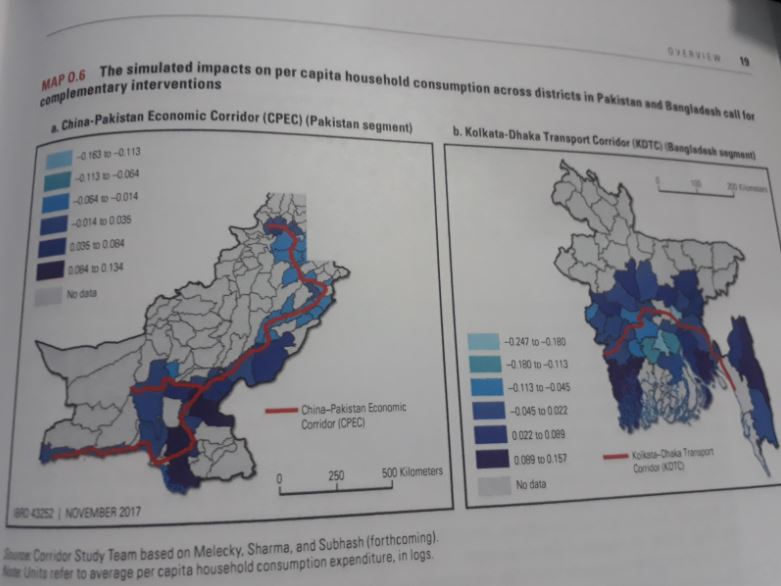
The World Bank Group (WBG) on the protest of Pakistan has removed a controversial map from its report titled “The Web of Transport Corridors in South Asia”.
Former Minister for Planning, Development and Reform Ahsan Iqbal on March 22, 2018 had protested with the WBG for not showing Northern Areas (Azad Jammu & Kashmir and Gilgit-Baltistan) in the map of Pakistan in the presence of Indian High Commissioner to Pakistan during the launching ceremony of this report tiled “The Web of Transport Corridors in South Asia”.
The report was published by the Asian Development Bank, United Kingdom’s Department for International Development, Japan International Cooperation Agency and the World Bank.
Lead Economist WBG Martin Melecky was presenting an overview of the report, during which Iqbal had noticed that Pakistani map was incomplete and said that Kashmir was not there. Later, the officials assured him and announced that they would revisit the report. The report was also not uploaded on its website. However, the amended report uploaded on its website, does not show the controversial map.
Here is the picture of the map as it appeared originally:
About the Report
The report states that China has committed over $45 billion to construct infrastructure projects under the China-Pakistan Economic Corridor (CPEC) Agreement, with funding from Chinese banks and corporations focused on energy (75 percent of the total committed) and roads/ports/railways (25 percent of the total). Usually, the loans are based on a sovereign guarantee (for example, in the case of province-level transport projects); on a repayment guarantee for project loans from domestic banks with an acceptable credit rating guaranteeing the repayment of project loans; or on a repayment guarantee from a Chinese sponsor that holds majority ownership in the infrastructure project. To date, few such loans have been extended on a project finance basis.
Transport corridors offer enormous potential to boost South Asia’s economic growth, reduce poverty, and spur job creation, provided the new trade routes spread their benefits broadly and limit negative environmental impacts, says the report.
The report argues that the many transport corridors proposed across Asia would cost trillions of dollars to implement, far exceeding the financing resources available.
Hence, countries need to prioritize the most promising corridors that will deliver transformative impacts on economies and people – or, in the terms of the title of the report, will offer wider economic benefits. And while engineering designs and geopolitical considerations are important factors in the decision, sound economic analysis is key to designing truly successful corridors, the report notes.
“The largest economic gains from investing in transport corridors may arise from urbanization and job creation around this new infrastructure, rather than from many more vehicles using it,” said one of the report’s authors, World Bank lead economist Martin Melecky, who added: “Corridor investments involve significant tradeoffs and are not all equally successful in creating large economic surpluses that spread fairly throughout society.”
The Report conducts illustrative appraisals of three major transport corridors in South Asia. These are the completed Golden Quadrilateral and North-South-East-West highway systems in India; the planned China-Pakistan Economic Corridor in Pakistan; and the anticipated Kolkata-Dhaka transport corridor between India and Bangladesh.
The importance of complementary interventions is also revealed by simulations for the prospective China-Pakistan Economic Corridor (CPEC) in Pakistan. These simulations suggest that the proposed corridors could have widely diverse impacts on household expenditures, poverty, the inclusion of women in the labor market, and air pollution.
Debt financing can be sourced from the domestic financial system or from international financial institutions. With respect to domestic debt, banks remain the major source for commercial infrastructure projects in South Asia.
South Asia has huge financing needs to develop its infrastructure. In 2014, the World Bank estimated that Bangladesh, India, Nepal, Pakistan, and Sri Lanka would require US$408–US$685 billion in investment at 2010 prices to bridge gaps in the transport sector alone. Moreover, many of the projects are complex and risky because of the political economy environment. This is particularly true for major corridor projects. Thus, PPPs are an enormous challenge because unstable project environments can easily compromise bank ability.
Conversely, in Pakistan, PPPs for ports and container terminals appear to have performed better. Gwadar Port entered into an agreement with the Port of Singapore Authority to manage operations, and Karachi Port engaged Hutchison Port Holdings to construct and operate the Karachi Deep Water Port. It also appears that India’s relatively small but important railway PPP projects are succeeding. However, the positive examples of delivering better results in the highways sector projects are limited. Generally, the ability of PPPs to consistently deliver the large-scale, complex, Greenfield corridor infrastructure projects South Asia needs is still unproven, despite significant support from the international community and the region’s governments.
Stay Connected with ProPakistani
Get the latest news and stories wherever you prefer.
Add ProPakistani to Preferred Sources and see more of our stories in Google Search and Top Stories.















There is only one way to take back Every inch of Kashmir is by WAR!
As if previous wars have yielded any results.
Yea, you We got Azad Kashmir, and if UN didn’t poke its nose, we already had Full Kashmir!
Conclusion Batao : Kasmir Hamara Howa Ya Nahi ?
yehi map the educators ki book me show huwa tha!
Kahmir banayga Pakistan.
shayad harey bachon key bachey dekhlein Kashir in Pakistan.