TinyCorp, an AI-focused startup, has successfully managed to make Nvidia’s RTX 30, 40, and 50 series graphics cards compatible with MacBooks using USB4 and Thunderbolt 4 connectivity. However, while this breakthrough enables AI development on Macs, users should temper their expectations, as these drivers do not support display functions on MacBook devices.
Key Developments
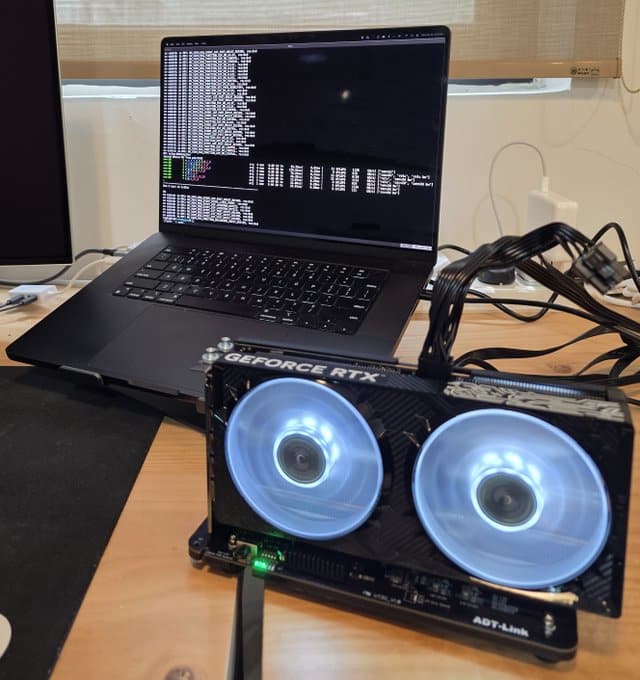
TinyCorp demonstrated its achievement on X, providing instructions on how AI developers can install the new drivers. In a post, the startup shared an image of a MacBook Pro M3 Max running Tinygrad, an AI framework, using an unnamed RTX GPU connected through an ADT-UT3G dock via USB4.
While the new drivers support the RTX 30, 40, and 50 series, TinyCorp also noted that the RTX 20 series might work, though this requires additional steps from users. GTX-series GPUs are not supported, as TinyCorp’s drivers are only compatible with Nvidia cards featuring a GPU system processor. Additionally, AMD GPUs from the RDNA 2, 3, and 4 families are also reportedly supported, making the system versatile for AI development.
No Display Support
Despite the progress in getting Nvidia GPUs to work with MacBooks, display output is not currently supported. Since Apple’s M-series chips exclusively rely on an integrated GPU, there has been no need for external graphics support in MacBooks until now. TinyCorp’s breakthrough in Nvidia GPU compatibility is thus focused on the AI development sector, leveraging eGPU docks for external processing rather than visual output.
Still a Breakthrough
Getting Nvidia GPUs to function on Apple’s ARM-based MacBooks has been a persistent challenge since Apple transitioned from Intel processors to its own M-series chips. Apple’s reliance on an integrated GPU left users and developers to figure out workarounds, including creating their own drivers for external GPU docks. TinyCorp’s experience with AMD graphics cards on USB3 laid the groundwork for this successful Nvidia implementation, now extended to USB4/Thunderbolt 4.
The development of this new capability was made easier by the USB4/Thunderbolt 4 standards, which are designed with external GPU docks in mind. These standards support native PCIe connectivity, offering substantial bandwidth improvements over older USB standards, such as USB3. The added PCIe support likely simplified TinyCorp’s task in making Nvidia GPUs work with Apple’s ARM architecture.
Bottom Line
TinyCorp’s success with Nvidia GPUs on MacBooks represents a major step forward in external graphics support. While display output remains absent, this breakthrough is a milestone for AI developers using MacBook systems. Future updates may expand compatibility to include display functionality, but for now, this remains a specialized solution for developers in the AI field.
Stay Connected with ProPakistani
Get the latest tech news, telecom insights, and product launches wherever you prefer.
Add ProPakistani to Preferred Sources and see more of our stories in Google Search and Top Stories.