
Valve is making a renewed push into living-room gaming with a redesigned Steam Machine, set to arrive in early 2026 across every region where the Steam Deck is already sold. The new device marks a shift from the fragmented approach of the original Steam Machines, offering a fixed hardware specification paired with Valve’s Linux-based SteamOS.
Performance
In early testing, the system averaged around 65fps in Cyberpunk 2077 at 4K using FSR upscaling from 1080p. Native 4K performance in the same short test session dropped to roughly 24fps. Valve claims the new Steam Machine delivers about six times the performance of the Steam Deck and places it close to or above the expected performance of the PlayStation 5 Pro
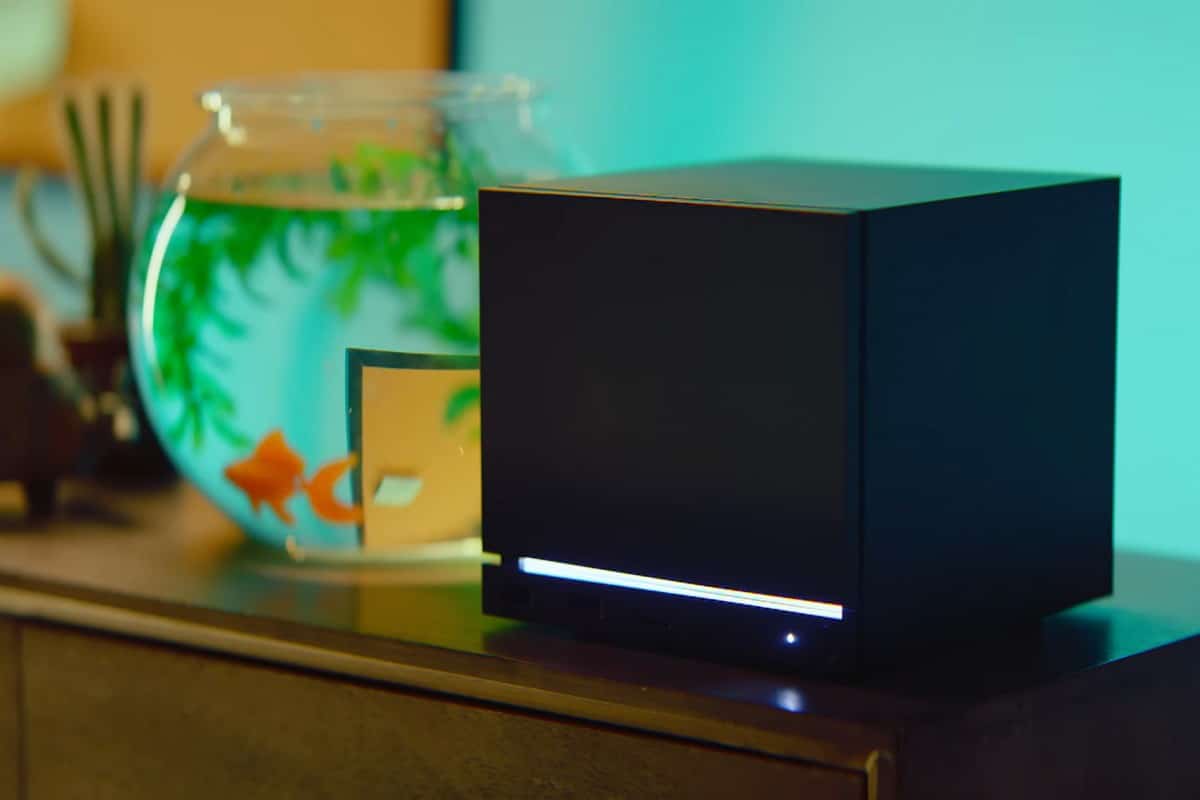
The system uses a compact, cube-shaped design measuring roughly six inches on each side. Inside, Valve has built the device around a semi-custom AMD Zen 4 processor with six cores and twelve threads, capable of boosting to around 4.8GHz. A second chip runs at a lower 30-watt envelope. The GPU is also semi-custom, built on AMD’s RDNA 3 architecture with 28 compute units running close to 2.45GHz and rated at about 110 watts.
Valve pairs this setup with 16GB of DDR5 RAM and 8GB of GDDR6 VRAM. Storage options include either a 512GB or 2TB NVMe SSD, and users can add more through a microSD slot.
The Steam Machine supports dual-display output through DisplayPort 1.4, which can push up to 4K at 240Hz or 8K at 60Hz, and HDMI, which officially reaches 4K at 120Hz.
Cooling, Form Factor, and Connectivity
Valve has placed a strong focus on cooling. A large 120mm fan and an array of custom heat pipes take up a significant amount of the internal space, working alongside a compact 300-watt Chicony power supply. The front panel attaches magnetically and can be swapped out, and Valve has released CAD files so users can create their own replacements.
The system includes USB-A ports on the front and back, a 10Gbps USB-C port, Gigabit Ethernet, DisplayPort, and HDMI. WiFi 6E and Bluetooth are also built in.
Software and Compatibility
The Steam Machine runs SteamOS and relies on Valve’s Proton compatibility layer to run Windows games, just like the Steam Deck. Valve says titles marked as “Steam Deck Verified” will carry over to “Steam Machine Verified,” allowing the company to maintain consistency across its hardware.
Users can also move their library between the Steam Deck, Steam Frame, and Steam Machine simply by using the same microSD card, a feature Valve emphasized during demonstrations.
Pricing?
The company has not yet announced pricing, but says the cost should be similar to a PC built with comparable hardware rather than a traditional game console.
Even with the improvements to SteamOS and Proton, Valve still faces well-known challenges in ensuring full compatibility with the widest range of PC games. The system will also compete directly with established living-room platforms like Xbox and PlayStation, which benefit from unified ecosystems and long-standing brand familiarity.
Stay Connected with ProPakistani
Get the latest tech news, telecom insights, and product launches wherever you prefer.
Add ProPakistani to Preferred Sources and see more of our stories in Google Search and Top Stories.












