Google has introduced a major upgrade to its AI-powered weather forecasting system, announcing that the new model will now be integrated into widely used products such as Search, Gemini, and Pixel phones.
The company has been experimenting with AI-driven weather predictions for years, and early results have shown that these models can generate forecasts more quickly and with greater efficiency than traditional physics-based systems. Now, Google says it is confident enough in the technology to bring it directly to consumers.
Peter Battaglia, senior director of research and sustainability at Google DeepMind, said the company is shifting from experimental trials to full integration. “We’re taking it out of the lab and really putting it into the hands of users,” he told reporters during a briefing, adding that the forecasts have proved “quite effective and quite useful.”
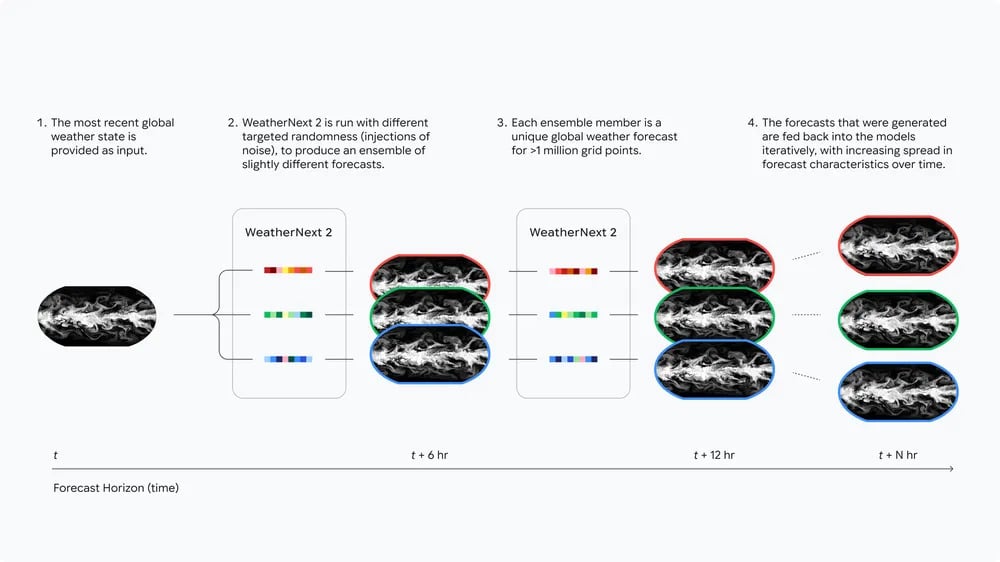
The new model, called WeatherNext 2, marks a significant improvement over Google’s previous AI system. It produces forecasts eight times faster and delivers higher accuracy across 99.9% of variables, including temperature and wind. It can also produce hundreds of possible outcomes from a single starting point.
WeatherNext 2 can generate predictions in under a minute using one Google TPU chip. By comparison, conventional weather models often require several hours of computation on powerful supercomputers because they attempt to recreate the complex physics of the atmosphere. Google’s AI approach studies patterns from historical weather data to anticipate future conditions, dramatically reducing the computational load.
A key part of the upgrade is Google’s Functional Generative Network, or FGN. Earlier AI models needed repeated processing to produce one forecast, while FGN introduces targeted randomness into each input, allowing WeatherNext 2 to generate numerous outcome variations in a single pass.
These improvements enable WeatherNext 2 to deliver predictions up to 15 days ahead and produce hourly updates. Google believes this level of detail will appeal to industries that rely heavily on weather data.
Akib Uddin, a product manager at Google Research, said sectors such as energy, agriculture, transportation, and logistics want more precise, hour-by-hour forecasting. “It helps them make more precise decisions relating to things that affect their business,” he explained.
The new model will appear in Google Maps, Search, Gemini, and the Pixel Weather app. Google is also launching an early access program for businesses that want custom weather models. Forecast data from WeatherNext 2 will be available through Google Earth Engine for geospatial work and BigQuery for large-scale data analysis.
Get the latest tech news, telecom insights, and product launches wherever you prefer.
Add ProPakistani to Preferred Sources and see more of our stories in Google Search and Top Stories.