Pakistan’s labour market has undergone steady structural improvement over the past three decades, with 2025 emerging as the strongest year on record for the share of salaried workers, according to the latest Household Integrated Economic Survey (HIES) released by the Pakistan Bureau of Statistics.
The report shows that an increasing proportion of earners are now engaged in stable, paid jobs rather than informal, unpaid, or self-employment arrangements.
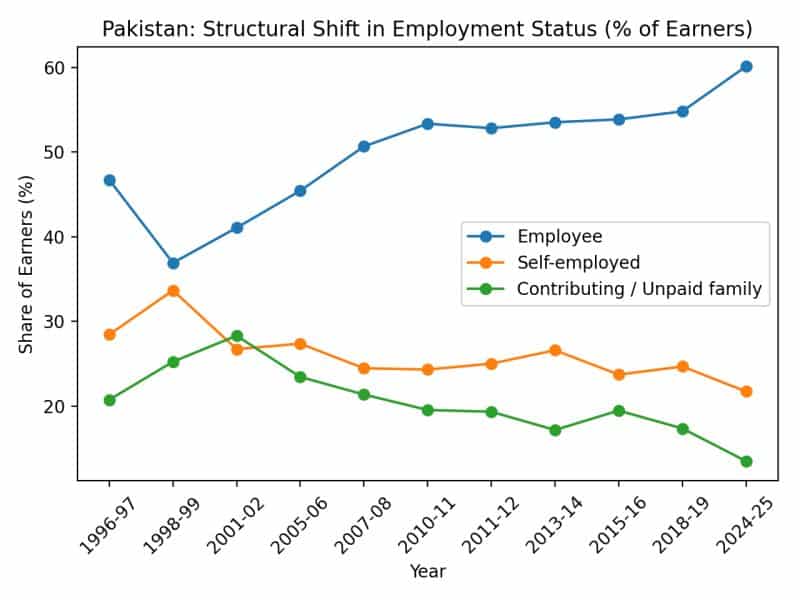
The share of salaried employees has risen sharply over time. In the mid-1990s, less than half of all earners in the country were salaried employees. Today, that number has reached nearly 60%, meaning six out of every ten earners now depend primarily on a salary.
This shift is doing far more than changing job titles; it is quietly reshaping the very foundations of social and economic life in Pakistan.
The rise of salaried work is redefining middle-class identity, altering political expectations, changing household attitudes toward risk, and influencing how families spend and save. It is also reshaping education and career aspirations, as more young Pakistanis now plan around structured career ladders rather than informal or seasonal work.
A monthly salary brings something rare in a volatile economy: predictability. And with predictability comes the psychology of the middle class. Families begin to think in terms of monthly budgets, school fees, rent payments, bank loans, promotions, and pensions.
But beneath this transformation lies a striking paradox: Pakistan is creating a middle class faster than it is creating middle-class security. Millions are entering salaried employment, but the safety nets typically associated with middle-class life are lagging behind.
Large segments of this emerging middle class still lack stable job contracts, pension coverage, health insurance, and protection against inflation. Many salaried workers remain only one medical emergency or job loss away from financial distress. The outward markers of middle-class life, schooling, apartments, and consumer goods, are expanding faster than the structures that would make those gains durable.
In 1996-97, salaried employees made up around 46% of earners. This figure dipped slightly in the late 1990s but began rising steadily in the early 2000s. By 2007-08, more than half of all earners were salaried employees. The upward trend continued in the following years, reaching about 60% by 2024-25, the highest level recorded so far.
At the same time, the share of self-employed workers has gradually declined. In the late 1990s, self-employment accounted for more than 30% of all earners. Over the years, this figure has dropped and now stands at just over 20%. While self-employment remains an important part of the economy, its relative share has reduced as more people move into regular salaried work.
The most significant decline has been seen in the category of contributing or unpaid family workers. In the 1990s, this group made up over 20% of earners. By 2025, it had fallen to nearly 13%. This change suggests that fewer people are working without direct pay and more are securing formal income sources.
This could prove to be a sign of gradual economic maturity, where formal employment becomes more common and income stability improves. A higher share of salaried workers usually reflects better job security, predictable income, and improved access to social and financial services.
The Pakistan Bureau of Statistics’ HIES report, which covers the period up to June 2025, indicates that this long-term trend has remained largely consistent despite economic ups and downs. The steady rise in salaried employment suggests structural changes in the labor market rather than short-term fluctuations.
While challenges remain, the data shows that Pakistan’s workforce is becoming more formalized, with more people entering paid employment than ever before.
The growth of salaried work may be building a larger middle class, but the real test will be whether the country can also build the security systems needed to sustain it.
Get the latest business news, market insights, and economic updates wherever you prefer.
Add ProPakistani to Preferred Sources and see more of our stories in Google Search and Top Stories.