
India faced up to $50 billion in military-related costs and procurement commitments following the four-day military confrontation with Pakistan in May 2025 due to aircraft losses, intelligence failures, and subsequent defence spending.
According to a study shared by ‘The Pakistan Playbook’, the 4-day clash marked the first confirmed combat loss of a French-built Rafale fighter jet.
On May 8, 2025, Reuters reported that two U.S. officials assessed with high confidence that Pakistani J-10C fighter jets had shot down multiple Indian aircraft, including at least one Rafale. CNN quoted a senior French intelligence official who had separately confirmed the loss the same day.
The Rafale had previously seen combat operations in Libya, Mali, Iraq, and Syria without being shot down by enemy fire. India, however, denied losing any aircraft during the 40day fight with Pakistan, until May 31, when its Chief of Defence Staff acknowledged aircraft losses during the Shangri-La Dialogue in Singapore, without specifying the number or type.
The study mentions a Reuters investigation published in August 2025, which attributed the losses to an intelligence miscalculation regarding the range of China’s PL-15 beyond-visual-range air-to-air missile.
According to the report, Indian planners believed the export version of the missile had an effective range of around 150 kilometres, but Pakistani aircraft launched missiles from beyond what Indian pilots believed was a safe distance.
The study estimates India’s direct financial losses during the first year after the conflict at between $2.3 billion and $5.3 billion, depending on the number of aircraft assumed lost. Pakistan’s corresponding realised costs are estimated at $160 million to $420 million.
When post-war procurement decisions are included, India’s total estimated cost rises to between $42 billion and $50 billion.
On realised costs alone, the paper estimates India absorbed between $2.3 billion and $5.3 billion, depending on the aircraft loss scenario adopted. Pakistan’s corresponding realised cost sits between $160 million and $420 million. The ratio of realised costs runs at approximately 10 to 30 to one in Pakistan’s favour.
When India’s forward procurement commitments are added, India’s total twelve-month cost rises to between $42 billion and $50 billion, pushing the overall ratio to approximately 100 to one.
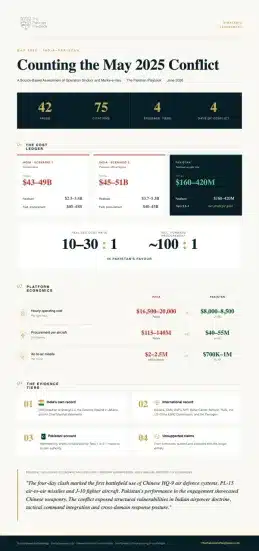
The largest component is India’s proposed acquisition of 114 additional Rafale fighter jets, approved in principle by the Defence Acquisition Council in February 2026 and valued at an estimated $36-40 billion.
The paper notes that the deal had not been signed at the time of publication due to disagreements with France over access to aircraft source codes.
India’s increased procurement reflects efforts to rebuild deterrence following the conflict, while noting that Pakistan is expected to field two fifth-generation stealth fighter platforms before India inducts one.
The paper states that its findings are based on a four-tier evidence framework using India’s official statements, international reporting, and assessments from institutions including Reuters, CNN, The Washington Post, The New York Times, Harvard Kennedy School’s Belfer Center, the Stimson Center, RUSI, Carnegie, and the U.S.-China Economic and Security Review Commission.
It says Pakistani official claims were included only when independently confirmed.
The most consequential institutional finding came from the 2025 Annual Report of the United States-China Economic and Security Review Commission, a bipartisan Congressional body.
It concluded that the four-day clash marked the first battlefield use of Chinese HQ-9 air defence systems, PL-15 air-to-air missiles, and J-10 fighter aircraft, that Pakistan’s performance showcased Chinese weaponry, and that the clash exposed structural vulnerabilities in Indian airpower doctrine and tactical command integration.
Stay Connected with ProPakistani
Get the latest business news, market insights, and economic updates wherever you prefer.
Add ProPakistani to Preferred Sources and see more of our stories in Google Search and Top Stories.













And how much did we lose ?
3 trillion pkr budget
Provinces are now forced to give huge chunk of their revenue to them as well.
What a sad headline