Nvidia’s decision to bring the GeForce RTX 3060 12 GB back to stores is not good news for gamers. It is a clear sign of how badly the graphics card market has deteriorated.
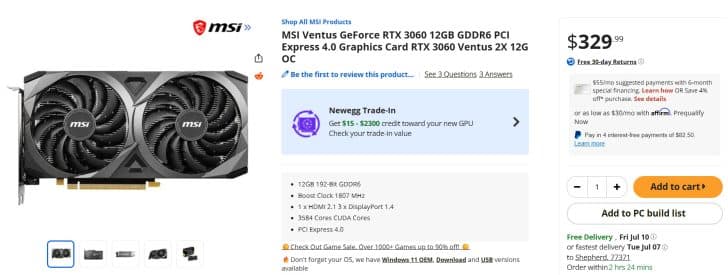
The card first launched in 2021 for $329. Five years later, retailers in the United States are selling it again for the same price.
Consumers are being asked to pay launch prices for hardware based on a five-year-old architecture.
At this stage, Nvidia would normally be preparing to share information about the RTX 50 Super series, which would refresh its Blackwell graphics card lineup.
Instead, the company is reviving the RTX 3060.
Reports about its return began last year as demand for mainstream graphics cards increased. At the same time, chipmakers continued to focus heavily on artificial intelligence products, leaving fewer resources for the consumer market.
The growing DRAM shortage has made the situation even worse. Add-in board manufacturers now face expensive and limited memory supplies, while consumers are left with fewer reasonably priced options.
The most frustrating part of the relaunch is the price.
The RTX 3060 launched at $329 in 2021. The MSI Ventus GeForce RTX 3060 12 GB is now available in the US for $329.99, while the ASUS Dual RTX 3060 V2 OC LHR is selling in Europe for €333.
Five years of hardware development have passed, yet the price has not moved.
That is not progress. It shows how shortages and rising component costs have erased the normal price reductions consumers should expect from ageing technology.
The RTX 3060 includes 12 GB of GDDR6 memory, which is more than the 8 GB available on the RTX 5060 and some RTX 5060 Ti models.
However, that larger memory capacity does not make it the better graphics card.
| Specification | Nvidia GeForce RTX 3060 | Nvidia GeForce RTX 5060 |
|---|---|---|
| Architecture | Ampere, 8nm | Blackwell, 5nm |
| Video Memory | 12 GB GDDR6 | 8 GB GDDR7 |
| Memory Bandwidth | 360 GB/s | 448 GB/s |
| Memory Bus | 192-bit | 128-bit |
| Boost Clock | 1,777 MHz | 2,497 MHz |
| Power Consumption | 170W | 145W |
| Floating-Point Performance | Around 12.7 TFLOPS | Around 19.2 TFLOPS |
The RTX 5060 uses a newer Blackwell architecture, delivers higher floating-point performance and consumes less power.
It also supports newer technologies that the RTX 3060 lacks, including the DLSS 4.5 suite, faster Tensor Cores, an updated display engine and improved video encoding and decoding.
The RTX 3060 may have more memory, but it remains significantly weaker in most games.
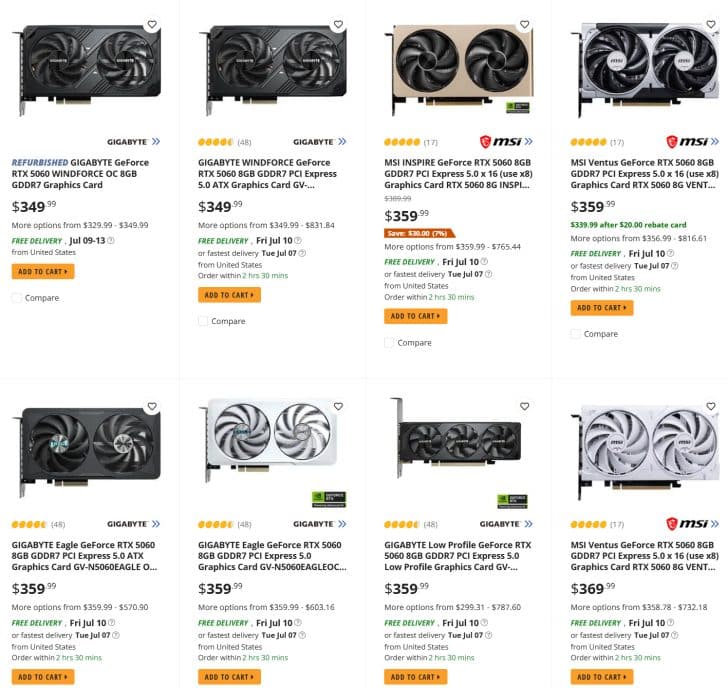
The RTX 5060 currently sells for around $349 to $359, even though its official launch price is $299. That pricing is already disappointing. However, it is only around $20 to $30 higher than the returning RTX 3060.
For that small difference, buyers get a newer architecture, stronger performance, and more modern features.
The RTX 3060 could have made sense below $300. At $329, it is difficult to defend. Its extra memory may help in limited situations, particularly at 4K resolution, but 4K gaming is not practical for this class of graphics card. In most games, the RTX 5060 remains faster.
The RTX 3060 relaunch reflects a much wider problem.
Memory prices have risen sharply as demand from the AI industry continues to consume available production capacity. New RTX 50 graphics cards use GDDR7, but all major categories of commodity memory have become more expensive.
Manufacturers are also prioritising higher-capacity products where they can earn better margins. That approach leaves mainstream buyers with ageing products and inflated prices.
The gap between the RTX 3060 and RTX 5060 currently stands at around $20 to $40. Continued DRAM shortages could push that difference above $50.
DRAM manufacturers have already signed multi-year and long-term supply agreements, making a quick recovery unlikely.
They have also announced billions of dollars in spending on new factories. However, much of that additional capacity is being built to serve AI demand rather than the consumer market.
As a result, gamers may continue paying more for both new and old graphics cards.
The return of the RTX 3060 is not a comeback worth celebrating. It is a reminder that consumers are now being offered ageing hardware at prices that should have disappeared years ago.
Get the latest tech news, telecom insights, and product launches wherever you prefer.
Add ProPakistani to Preferred Sources and see more of our stories in Google Search and Top Stories.