
Gulf countries have raised a record $112 billion in bonds so far this year as Saudi Arabia, the United Arab Emirates, Kuwait, and Qatar ramp up borrowing to finance new pipelines, ports, and transport corridors that reduce their dependence on the Strait of Hormuz, one of the world’s most important energy shipping routes.
The record issuance, covering the period from January 1 to July 23, comes as the Iran conflict has exposed the risks of relying on a narrow waterway that previously handled around 15 million barrels of oil per day.
Bloomberg data shows Gulf bond sales have more than tripled since 2022, while investors continue to show strong demand despite heightened geopolitical tensions.
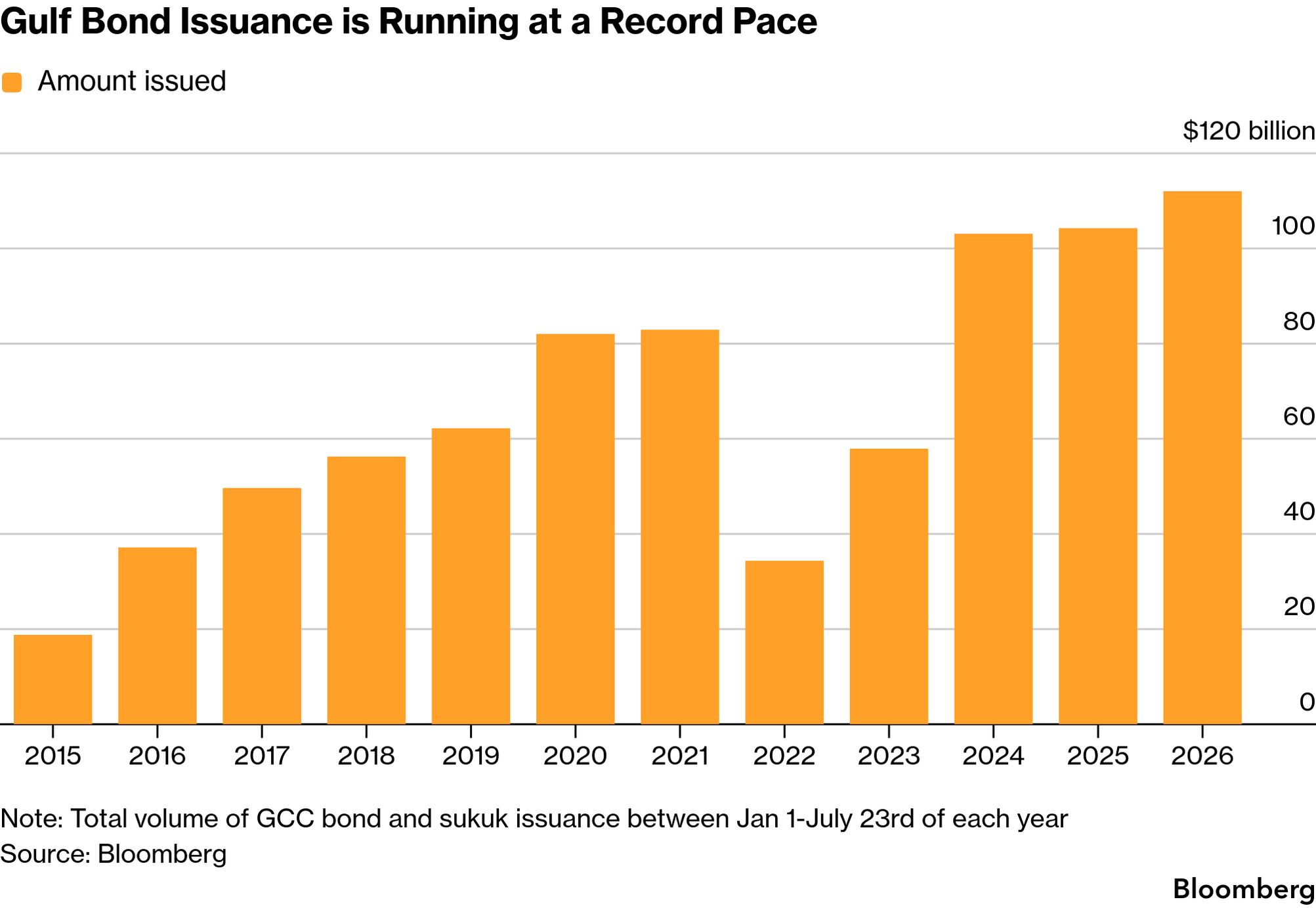
Separate data from Markaz shows the Gulf Cooperation Council raised $102.69 billion through bond and sukuk issuances during the first half of 2026, with Saudi Arabia accounting for nearly half of the market after issuing $49.34 billion.
The borrowing boom has been met with strong investor appetite. Kuwait recently raised $6 billion, attracting $14.8 billion in investor orders, while Saudi Arabia, Abu Dhabi, Qatar, and Bahrain have also completed successful debt sales.
The region’s strong foreign exchange reserves and investment grade credit ratings are expected to support additional borrowing as governments continue investing in long term energy security and trade infrastructure.
The infrastructure push includes new export terminals on the Red Sea and the Gulf of Oman, expanded oil pipelines, rehabilitation of aging energy infrastructure, and upgraded road networks. Saudi Arabia is reviving and expanding routes to its Yanbu Red Sea port, while the UAE is accelerating a $3 billion pipeline to Fujairah that will increase oil exports outside the Strait of Hormuz.
Iraq is also pursuing new pipeline links to Turkey, Syria, and Jordan to diversify export routes.
According to Goldman Sachs, the new projects could add 3.8 million barrels per day of bypass capacity by the end of 2027 and 7.3 million barrels per day by the end of 2028.
That would allow roughly 60 percent of the Gulf’s prewar oil exports to avoid the Strait of Hormuz if necessary.
Stay Connected with ProPakistani
Get the latest business news, market insights, and economic updates wherever you prefer.
Add ProPakistani to Preferred Sources and see more of our stories in Google Search and Top Stories.












