




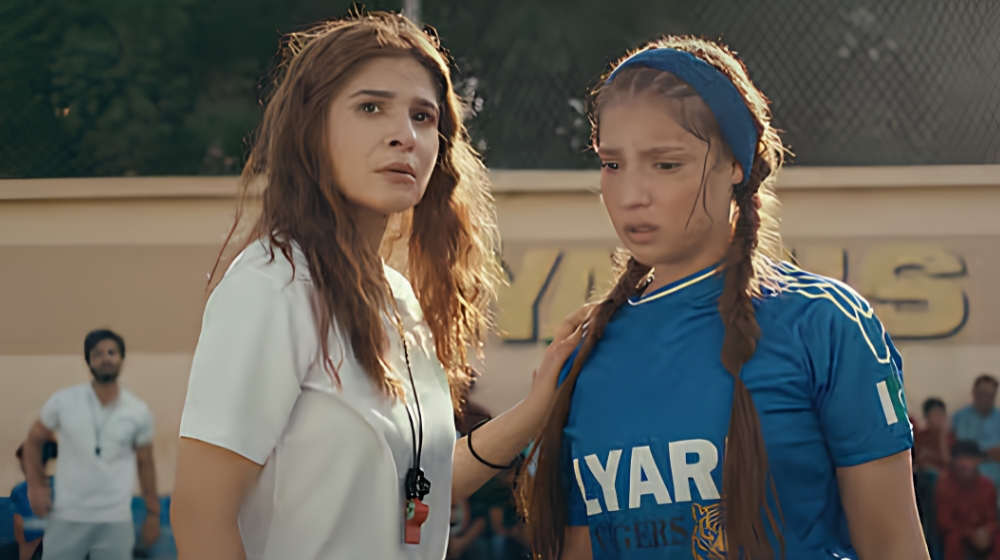
Mera Lyari (formerly titled Behnaz), a film that was supposed to be the shining light for sports movies in Pakistani cinema, ultimately proved to be a meek attempt to revive the passion for football among Pakistani audiences.
It turned out to be a disappointment for those who thought this would be impactful for the growth of football in Pakistan, just as ‘Chak De India’ was impactful in re-igniting the passion for hockey in our neighboring country.
It’s a movie one should not pay Rs. 1,000 per person to watch; it is a one-time boring watch on an OTT platform for a lazy Sunday.
The movie went wrong in the development of characters, story, and screenplay, and it has tedious, lengthy scenes, which make one yawn in the midst of an almost empty cinema on a Sunday.
Abu Aleeha has made 7 major films, including crime thrillers like Kukri, also known as Javed Iqbal, Taxali Gate, Daadal, Udham Patakh, Kataksha, Super Punjab, and Sheenogai.
He frequently tackles the genre of crime thrillers and local socio-political issues, but only two of his releases have tasted commercial and critical acclaim so far, which include Taxali Gate and Javed Iqbal (Kukri).
His track record of delivering hit impactful films is pretty average, and this 94-minute-long flick is dragged at a snail-like pace. It’s a film that can be easily trimmed into a 40-minute telefilm.
Tedious Screenplay and Repetitive Dialogues
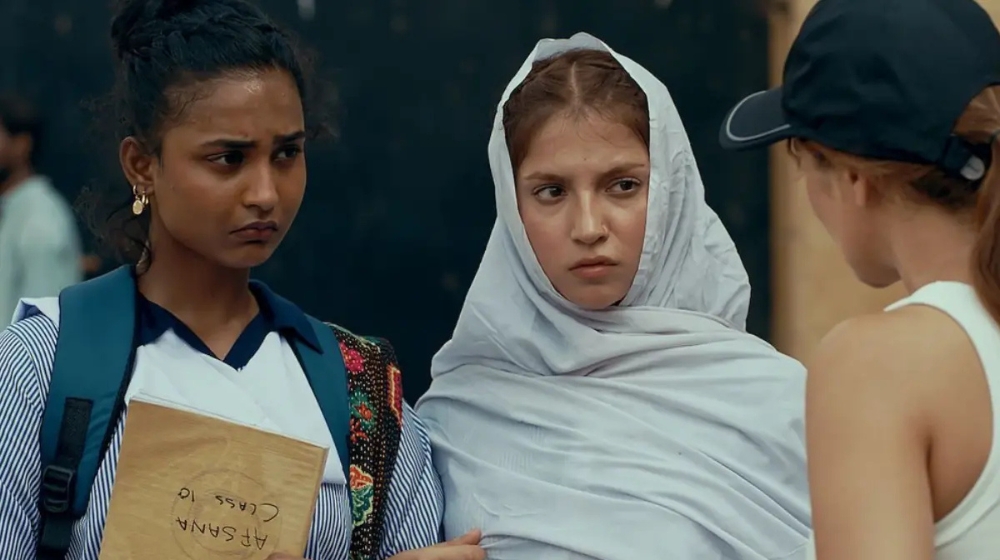
The star cast includes Dananeer Mobeen and Ayesha Omer in the lead roles. Dananeer Mobeen plays the character of Afsana Baloch, who is an aspiring teenage matric student who wants to become a footballer in Lyari district.
While Ayesha Omer plays the character of Behnaaz Baloch, a football coach in her 30s who could not fulfill her dreams as a player because of her husband’s ignorance and anger that led to domestic violence, which subsequently ended her career.
The supporting cast includes Nayyar Ejaz as Arif Baloch, Shoaib Hassan as Shah Baloch, Trinette Lucas, Samiya Mumtaz, Adnan Shah Tipu, and Paras Masroor, who are also part of the ensemble cast.
The integration of sponsors and outdated text fonts in the opening scenes is not seamless; rather, it is integrated right to the audience’s face, which makes the opening scenes seem like a worthless PowerPoint slide of a corporate employee’s presentation.
The film has a non-linear screenplay which means that the film goes in the past flashbacks of the story and then reverts back to the present day of the story in a to and fro manner.
The scenes are lengthy, slow-paced, tedious, and have no synchronization between them. The script has no flow and is not knitted together crisply; rather, it is all over the place in terms of pacing.
Samiya Mumtaz’s montage of washing clothes was so slow-paced that a 2-minute-long scene felt like a decade; it was a scene that could’ve been avoided with crisp editing.
None of the montage scenes in the film condensed time or showed character development, nor did they evoke a strong emotional response.
The dialogues are not impactful, and they don’t support the narrative of the themes, such as domestic violence and patriarchy, such as “Mard bahar ka ghussa ghar ake nikalte hein.”
The film depicted Lyari as a football-loving district, but it showed no world-class stadiums because the truth is, there are none in Lyari; in fact, no stadium in Karachi meets the standard of AFC or FIFA requirements.
The lack of state-of-the-art stadiums in Karachi depicts the seriousness of the Sindh government regarding sports in the city, let alone Lyari.
There was no twist or cliffhanger in the script that would keep the audience hooked during the film, nor is there any thrill in the manner in which Afsana Baloch’s character joins her football team; it’s a script that is deprived of excitement and anticipation. It’s an absolutely flat script, devoid of highs and lows.
The film does not do justice to the football genre it is based on; rather, it diverts from the crux of the film and focuses on repetitive themes we often see countless times in our dramas.
Acting, Character Depth, and Production

Ayesha Omer’s character as Behnaz Baloch lacked depth; her story of a footballer whose career was cut short due to domestic violence could have evolved as a glorified coach coming back to her roots, but that character arc never developed.
Her Lyari accent lacked emotion and was inconsistent throughout the movie, while her stylish white blazer put you off as a viewer when you know that her character comes from humble working-class roots.
Dananeer Mobeen was the star of the show in terms of acting. She worked hard on her characterization, styling, wardrobe, demeanor, and accent, even though the writer did not do justice to her character’s evolution in the film.
The film could’ve used an actor with a naturally tan or dark complexion, as most girls in Lyari are not as fair as Dananeer. They could also go the ‘Parizaad route,’ making the actor’s complexion according to the real characters in Lyari, but Abu Aleeha did not put much thought into that as a writer and director of this film.
There is no depiction of Lyari’s local football structure, and how it works; there is no mention of the Pakistan women’s national football team. The protagonist does not strive to play for Pakistan; rather, she competes for a team in her ‘Mauhala.’
Dananeer’s character not having a dream to play for Pakistan is a massive disappointment, and it doesn’t serve the purpose of the film.
Paras Masroor was also a shining light in the movies and deserves credit for his performance in the film with limited screen time.
However, Nayyar Ejaz was disappointing; he looked like a native of Lyari, but his accent, characterization, and body language showed no signs of the character he was assigned to play. Samiya Mumtaz was given nothing to work with by the writer in this project; her character had no depth or arc in the script. She was wasted thanks to Abu Aleeha’s mediocre script.
A positive point in this movie was the sets, especially the school and the home of the main characters of the film. The props and the styling of most characters in the film were on point, and the wardrobe also depicted the main essence of the locals of Lyari, not to mention 70% of the cast from Lyari helped.
Nayyar Ejaz’s character, Arif Baloch, is a rickshaw driver, so they show an old rickshaw nicely integrated in the shallow background of the scenes shot indoors.
Music and Background Score
Most of the Pakistani filmmakers are not skilled in finding the perfect blend of integrating the background score with the narrative of the story. The BGM should make sense with the mood of the scenes and the narrative of the story, and this film used the background score excessively, with no synchronization.
The sound design made no sense in the scene where Behnaz and Shah Baloch were having an intense conversation, and the director suddenly switches the camera to teenage kids who were playing football in the background.
It should be noted that this was done by a director who used to be a film journalist in the past.
The Rap song in the trailer was not present in the film because the screenplay did not have any room for that rap song. The most disappointing factor of the film is that there is less focus on football and more focus on social issues.
The lack of football scenes kills the essence of the film and does not fulfill the expectations that come from its sporting genre.
Direction

The wide-angle scene from the top, where Samiya Mumtaz and Dananeer Mobeen’s characters are having a conversation while they lie on the bed, is well-directed, and it’s the highlight of the film as far as direction goes. The lighting and camera angles are the strong aspects of this film.
The scenes, however elegant they seem, are not impactful; the weak screenplay kills the strong direction.
The film has issues in continuity with the wardrobe, as well as the appearance of the actors at some points. Even though the film is shot in the space of two months, some of the actors have inconsistencies in their weight, which kills the continuity of their characters in different scenes.
Was It Really a Response to Dhurandhar?
This was never an attempt by the director to respond to a film like Dhurandar, as it was shot way before Dhurandar’s teaser came back in May 2025. It’s a low-budget film, just like any average Pakistani movie, and the makers struggled with financial constraints.
The Sindh government has claimed it’s a response to propaganda, but Abu Aleeha has repeatedly denied this in his press statements.
However, the director did not have any budget for projects like Javed Iqbal or Taxali Gate, yet he delivered with his creativity in those films. In this particular instance, he lacked vision and creativity.
The movie is not cinema-worthy because of the haphazard screenplay, and it failed to create any impact as a film that was supposed to help football elevate in the country. A massive sporting genre at the heart of Lyari could have been exploited with the powerful medium of cinema, but Abu Aleeha’s lack of intent wasted that opportunity.
For all its worth, it’s a one-time watch on an OTT platform and not a cinematic spectacle as the Mera Lyari team fumbles a chance to make sporting films in Pakistan a medium to disseminate the passion for sports.
About the Author: Shayan Obaid Alexander is a popular YouTuber behind the channel Cinema Ki Baatien. He has worked for ProPakistani, Urdu Times, Roze TV, and the English-language newspaper Patriot.