




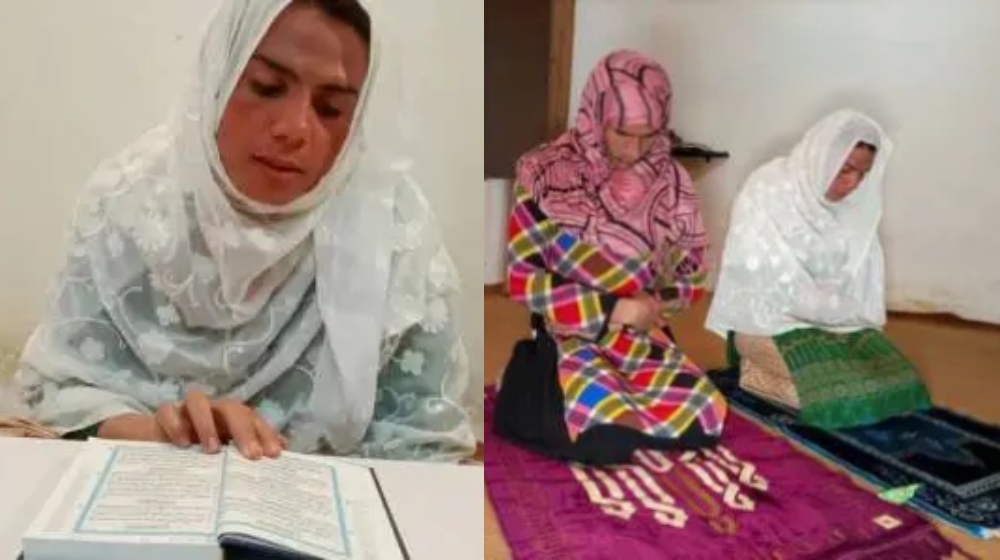
Despite being equal citizens, many public spaces remain closed for the transgender community. For decades now, there has been a nagging reluctance in accepting these communities as equals. In a remarkable feat, the transgender communities are now creating their own spaces. With the first of its kind being, a transgender madrassa.

Image Source: Reuters
A trans-woman Rani Khan set up this Islamic religious school herself using her life savings. While Islam is open to all, Muslims aren’t. While there is no official restriction to anyone attending religious schools or praying at mosques, it is assumed that ‘outsiders can feel ostracized’.
“Most families do not accept transgender people. They throw them out of their homes. Transgender people turn to wrongdoing,”
ALSO READ
Transgender Christians Get A Church Of Their Own In Karachi
Which explains why the trans-community feels unwelcome at local mosques and madrassa. She felt a need for a safe and accepting space for her community where they can learn about their religion Islam. That space is now Pakistan’s first transgender madrassa.
34-year-old Rani Khan opened her own madrassa. Reuters reports that she offers daily Quran lessons at Pakistan’s first transgender-only madrasa.

In a country where transgender people aren’t accepted by their own family, it can be hard to believe people will not judge them in public spaces such as mosques. Rani teared up recalling how her family disowned her at the age of 13.
She was forced to beg on the streets after being left on her own. By age 17, she joined a transgender group. This constituted the usual dancing at weddings and other functions. The trans-community has previously voiced discrimination they face by employers when applying for regular jobs.
Rani later quit her life as a wedding dancer and set off on a spiritual journey. A deceased transgender friend and fellow dancer pleaded with her to do something for the community. So she studied the Quran at home, and attended religious schools.
By October 2020, she opened her own two-room madrasa. This is also a safe space for transgender people to offer their prayers. Mosques are mostly gender-segregated in Pakistan. With only a male and female section were should the transgender people pray?
“I’m teaching the Quran to please God, to make my life here and in the hereafter,”

One of Rani’s students’, a 19-year-old trans-woman, Simran Khan has found peace by learning more about Islam.
“It gives my heart peace when I read the Quran, … It is much better than a life full of insults,” the 19-year-old said.
While Rani is now a religious teacher, she still needs to earn a living. She also teaches her students vocational skills like sewing and embroidery and tries to raise funds for the school by selling clothes.
The trans-community has previously voiced discrimination in the workspace. They are marginalized and not encouraged to participate in the public sphere. Like other minorities, trans-people have a quota in government job listings. However, 05% in Sindh and 2% in Khyber Pakhtunkhwa are nowhere near sufficient.
ALSO READ
Transgender Woman Who Holds Degree is Still Looking for a Job
There have been efforts over the years from free education to vocational training. However, these efforts are nowhere near enough.
Just recently a petition was filed in Lahore High Court for non-allocation of job quota for trans-people by the Punjab Public Service Commission (PPSC).
Rani said that while her school has not received aid from the government, some officials promised to help students find jobs.