
South Africa
Fixtures


-
AIDEN MARKRAM (C)
-
DAVID MILLER
-
KESHAV MAHARAJ
-
KAGISO RABADA
-
MARCO JANSEN
-
TONY DE ZORZI
-
QUINTON DE KOCK
Wicket-keeper -
ANRICH NORTJE
All-rounder -
GEORGE LINDE
-
DEWALD BREVIS
Batter -
DONOVAN FERREIRA
All-rounder -
LUNGI NGIDI
-
JASON SMITH
-
CORBIN BOSCH
-
KWENA MAPHAKA
Bowler
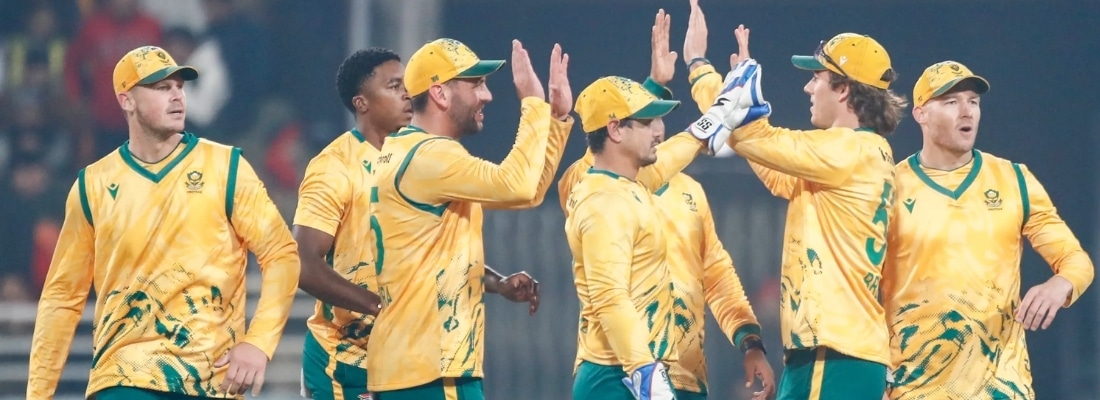
South Africa Team for T20 World Cup 2026
South Africa enter the T20 World Cup 2026 with a clear target. They want to turn consistency into a title run. They also bring a squad built for pace and bounce. At the same time, India conditions demand control in the middle overs. Therefore, South Africa must balance aggression with discipline.
The tournament runs from February 7 to March 8 across India and Sri Lanka. South Africa play all four group matches in India. As a result, they can settle into a single set of conditions early.
South Africa at T20 World Cup 2026: Quick Overview
| Group | Group D |
| Captain | Aiden Markram |
| Vice captain | Not announced |
| Head coach | Shukri Conrad |
| Group stage venues | Ahmedabad and New Delhi |
T20 World Cup 2026 Groups
The T20 World Cup 2026 groups feature four pools of five teams. Each team plays four group matches. Then, the top two teams qualify for the Super Eights. Consequently, early points and net run rate can decide everything.
Group D mixes elite quality with tricky matchups. New Zealand bring structure and depth. Afghanistan bring world class spin. Meanwhile, Canada and the United Arab Emirates often play fearless cricket when they sense an opening. Therefore, South Africa must start fast and avoid slow chases that hurt net run rate.
South Africa Squad for T20 World Cup 2026
South Africa named a strong South Africa squad with proven finishers, multiple pace options, and flexible all round depth. In addition, the squad includes players who can cover more than one role. That flexibility helps in tournament cricket.
South Africa Fixtures and Schedule in the Group Stage
South Africa play three matches in Ahmedabad and one in New Delhi. Therefore, the team gets continuity on similar surfaces. It can also plan bowling matchups more clearly.
February 9 – South Africa vs Canada – Ahmedabad
February 11 – South Africa vs Afghanistan – Ahmedabad
February 14 – New Zealand vs South Africa – Ahmedabad
February 18 – South Africa vs United Arab Emirates – New Delhi
Key Players to Watch for South Africa in T20 World Cup 2026
South Africa’s campaign often starts with Quinton de Kock. He can win powerplay overs quickly. He also forces opponents to change plans early. Meanwhile, Aiden Markram sets the tone through decision making. He can stabilise a chase. He can also accelerate when matchups open up.
In the middle and late overs, David Miller remains a key finisher. He converts good platforms into big totals. In addition, Dewald Brevis can shift momentum against spin with clean hitting. Therefore, South Africa can attack across phases instead of waiting for the last five overs.
With the ball, Kagiso Rabada and Anrich Nortje give wicket taking threat at pace. They can also defend at the death when batters swing hard. Keshav Maharaj adds control through the middle overs. As a result, South Africa can build pressure even when wickets do not fall immediately.
South Africa’s Strengths in Indian Conditions
South Africa bring a pace attack that can win games on its own. They also have left arm variety through Marco Jansen. That helps against lineups stacked with right hand batters. Moreover, their batting includes power and experience. This matters on grounds where totals can jump quickly.
However, South Africa must avoid losing shape against spin. They need clear roles for the middle overs. They also need strong running between the wickets. Therefore, strike rotation will be a constant priority.
What South Africa Needs to Reach the Super Eights
South Africa’s route is direct. First, they must beat the teams they should beat. Next, they must handle Afghanistan’s spin threat with patience. Then, they must treat New Zealand as the game that can decide the group lead. Finally, they must keep net run rate strong because group tables can tighten quickly.
Frequently Asked Questions



ProPakistani is the premier and most trustworthy resource for all happenings in technology, telecom, business, sports, auto, education, real estate and entertainment news in Pakistan.
Whether it's the top trending news, inside scoops or features, interviews, market trends and analysis, product reviews, How to's or tutorials – we cover it all.
© 2026 ProPakistani.PK - All rights reserved