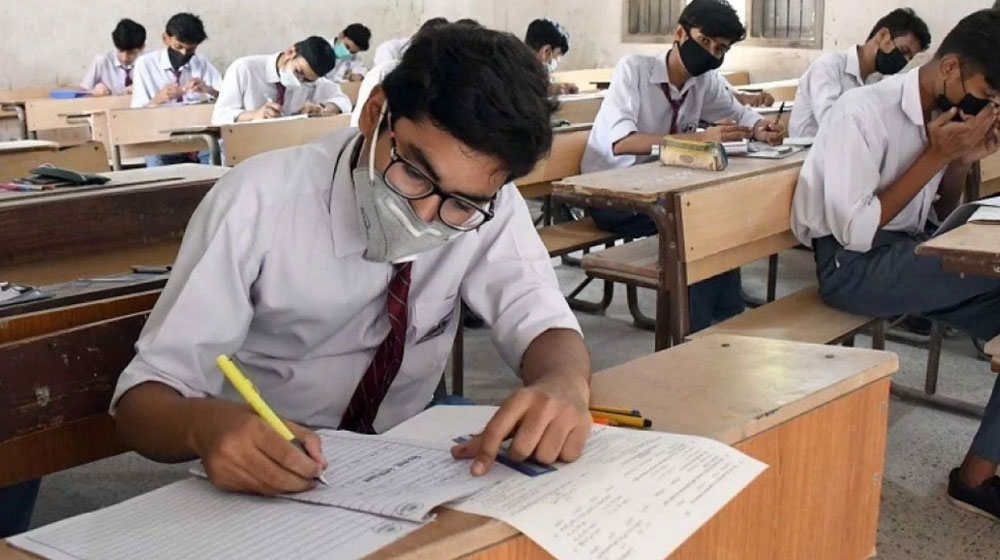
The Inter-Boards Coordination Commission (IBCC) has replaced the marking system with a grading formula for matric and intermediate exams. Initially, this new system will be applied to exams conducted by the Federal Board of Intermediate and Secondary Education (FBISE) and the boards of Sindh, Balochistan, Azad Kashmir, and Gilgit-Baltistan.
The grading system will be implemented in phases over the next three years.
According to Education Secretary Mohyiuddin Wani, the new grading system for the Secondary School Certificate (SSC) and Higher Secondary School Certificate (HSSC) exams aims to promote fairness, transparency, and accuracy in evaluating students’ academic performance. The system is designed to address grade inflation, reduce the intense competition for high marks, and accurately reflect student learning and achievement.
The passing mark has also been raised from 33% to 40%.

A press release from the IBCC highlighted that the grading system would minimize the competition for maximum marks among students, parents, and schools. The FBISE, Balochistan Board of Intermediate and Secondary Education (BISE), and the Sindh government have announced that the grading system will be implemented starting from the annual board exams 2025.
IBCC Executive Director Dr. Ghulam Ali Mallah explained that the 10-point grading system will replace the traditional method of reporting results through raw marks and grades. Under the new system, students scoring 96-100 will receive an A++, 91-95 an A+, 86-90 an A, 81-85 a B++, 76-80 a B+, 71-75 a B, 61-70 a C, 51-60 a D, and 40-50 an E. Those scoring below 40 will receive a U and be considered to have failed.
Dr. Mallah also noted that the new grading system would be introduced in phases, starting with 9th and 11th-grade results in 2025. In the following year, grades and marks will be applied to 10th and 12th grades, with full implementation by 2027.
The IBCC, which oversees 29 education boards in the country, stated that the federal government (FBISE), Sindh (with nine boards), Balochistan, Azad Kashmir, and Gilgit-Baltistan have agreed to adopt the new system. However, Punjab and Khyber Pakhtunkhwa, with eight boards each, have yet to make a decision.
“We have requested the governments of Punjab and Khyber Pakhtunkhwa, and we are hopeful they will adopt the new grading system to ensure uniformity across all boards,” said Dr. Ghulam Ali Mallah.
Stay Connected with ProPakistani
Get the latest education news, admissions updates, and scholarship alerts wherever you prefer.
Add ProPakistani to Preferred Sources and see more of our stories in Google Search and Top Stories.