The global AI race is shifting once again, this time with the debut of Kimi K2 Thinking, a new model from Beijing-based Moonshot AI Lab. The company claims that its latest release surpasses OpenAI’s GPT-5 and Anthropic’s Claude Sonnet 4.5 on several leading benchmarks, and it’s completely free thanks to being open-source.
Kimi K2’s Features and Capabilities
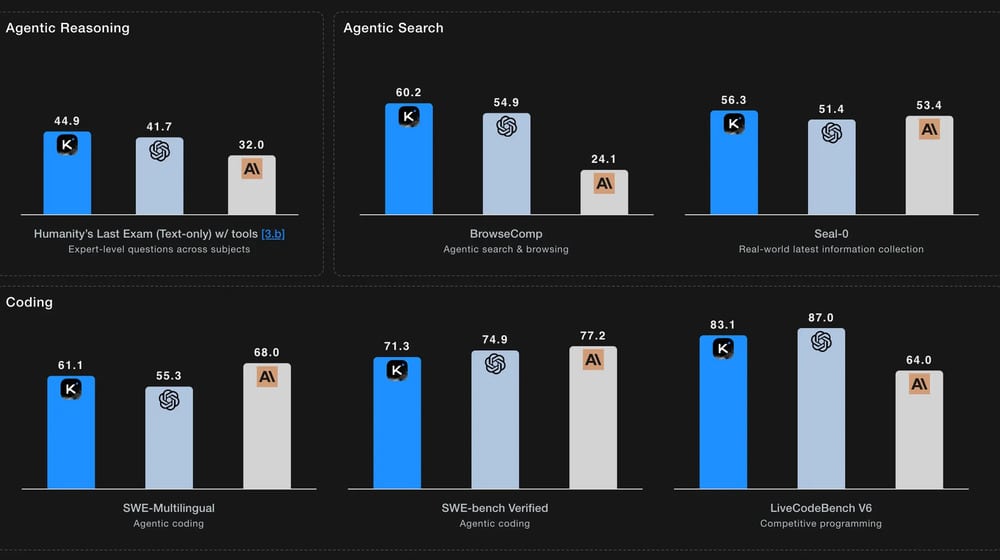
Moonshot describes Kimi K2 Thinking as a reasoning-focused, Mixture-of-Experts (MoE) model. The system combines long-horizon planning, adaptive reasoning, and integrated online tools, such as browsers, enabling it to tackle complex academic and analytical tasks. On tests like Humanity’s Last Exam, BrowseComp, and Seal-0, the model reportedly outperformed GPT-5 and Claude Sonnet 4.5 in reasoning, planning, and web browsing tasks. Its coding performance matched that of its main competitors, though it did not notably surpass them.
The model’s architecture enables it to decompose ambiguous problems into clear, actionable steps and to adapt across hundreds of reasoning stages. Kimi K2 was trained on roughly 1 trillion parameters and is openly accessible on Hugging Face, which is essentially the GitHub for Large Language Models (LLMs).
Trained in a Fraction of GPT’s Cost
Crucially, Kimi K2 Thinking is open source. Developers can access and modify the code and weights for free, a move that directly challenges the prevailing trend of closed, subscription-based AI platforms. Moonshot claims the model’s development cost only $4.6 million, a fraction of the sums spent by top US AI labs. If these results hold up under independent review, this could throw both Silicon Valley and Wall Street into panic mode once again, just like DeepSeek did earlier this year.
The arrival of Kimi K2 has the potential to disrupt established business models. Since the launch of ChatGPT, companies have been encouraged to invest in premium enterprise AI subscriptions, often at considerable cost. Now, businesses may reconsider their spending as powerful, free alternatives become available. Some US companies, such as Airbnb, are already turning to Chinese-developed models, citing better performance and lower costs for critical tasks.
However, security experts remain cautious. Open-source AI models with foreign origins have drawn scrutiny from regulators, and several US agencies banned DeepSeek earlier this year for similar reasons.
Growing fears of an AI bubble, driven by spiraling infrastructure costs and uncertain returns, have unsettled some investors. If free, high-performing models such as Kimi K2 can match or beat the best proprietary alternatives, it may prompt a re-evaluation of where capital is directed in the sector.
Stay Connected with ProPakistani
Get the latest tech news, telecom insights, and product launches wherever you prefer.
Add ProPakistani to Preferred Sources and see more of our stories in Google Search and Top Stories.