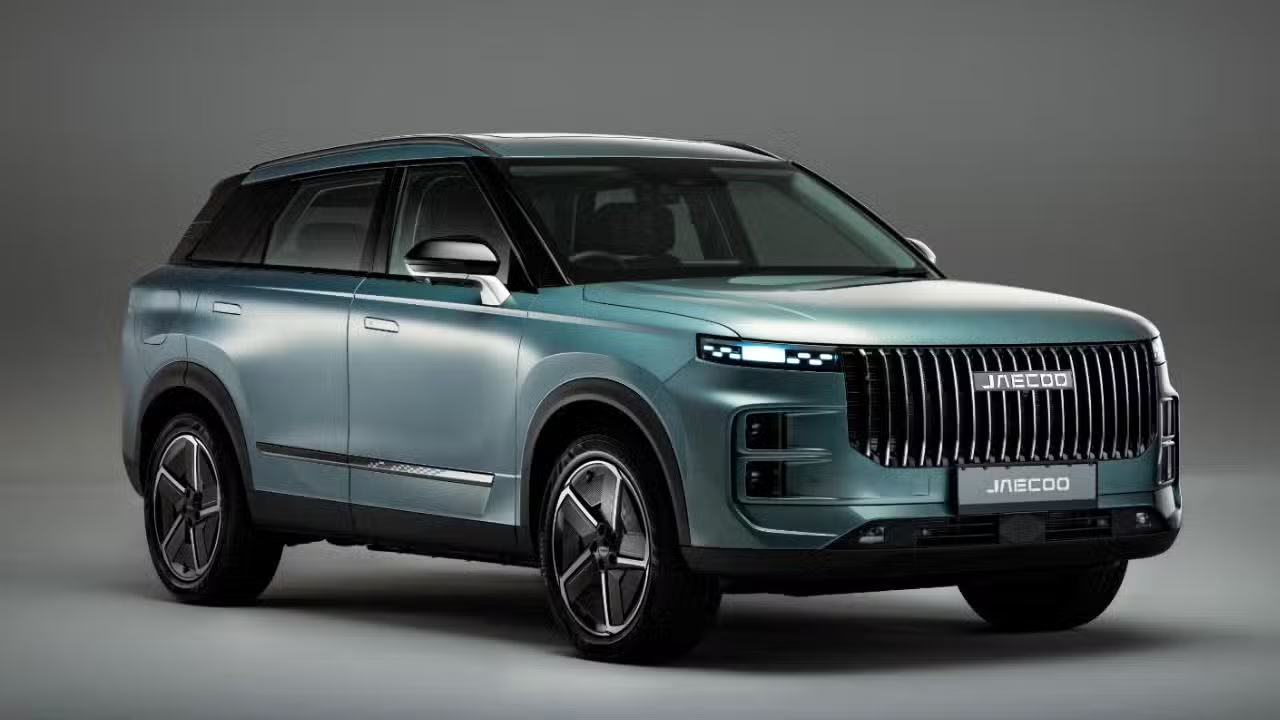
At Omoda & Jaecoo Pakistan, vehicle development doesn’t end at production. It continues long after, shaped by real-world driving, customer feedback, technical evaluation, and constant coordination between international engineering teams. That approach is now reflected in a new update introduced for the Jaecoo J7 SHS in Pakistan.
Earlier this year, in January 2026, engineers identified an opportunity to further refine an additional protective shield component as part of ongoing technical assessments. Alongside internal evaluations, feedback from customers also contributed to a broader review of the component. It was part of a routine improvement cycle rather than a response to any specific issue, with the aim of keeping product performance aligned with evolving global standards.
By March 2026, after internal review, global field insights, and close coordination with the engineering team in China, a refined solution was finalized for implementation.
A coordinated rollout for new and existing owners
From 15 May 2026 onwards, all Jaecoo J7 SHS vehicles dispatched from the plant in Faisalabad, Pakistan are being equipped with the updated protective shield from the factory.
For existing owners, the update is offered free of cost through the authorized dealership network. Omoda & Jaecoo’s technical and aftersales teams will directly engage with customers to manage installation scheduling and support, aiming to keep the process simple and accessible.
Customer voice shaping refinement
Feedback from Jaecoo J7 SHS owners across multiple markets has also played a meaningful role in shaping this update. While the vehicle has been well received for its hybrid technology, safety features, and driving experience, ongoing user insights have helped engineering teams fine-tune specific components as part of continuous improvement.
A quieter kind of commitment
In a market where product conversations often focus on features and performance figures, this kind of update says something else. It points to how ownership is being treated as an ongoing relationship rather than a one-time transaction.
The idea is simple: if something can be improved, and it benefits customers, it should be done without hesitation or added burden on the owner.
The Jaecoo J7 SHS continues to draw attention in Pakistan’s emerging new energy vehicle space. Its blend of hybrid technology, safety-focused engineering, and driving experience has made it one of the more prominent SUVs in its category.
This update puts a focus on continuous refinement and customer confidence over time. Seen in this light, it also sets a practical benchmark for customer service that other new automotive entrants in Pakistan can learn from as the market continues to mature.
Stay Connected with ProPakistani
Get the latest automobile news, car launches, bike reviews, videos and analysis wherever you prefer.
Add ProPakistani to Preferred Sources and see more of our stories in Google Search and Top Stories.













Not trusting this nonsense. The car costs 1 crore
The oil change costs 40000 (10000 per litre) .
And the parts are really expensive
If the battery discharges , which it does, the freight charges are paid by customers. Not to mention the dealerships don’t fix the cars yet.
They don’t have the technical labor.
What customer excellence ?
just marketing bs nothing concrete of what exactly was done.
I have never read a more biased and more paid off piece of journalism in my entire life. There is no acknowledgement of the fact that it should have been there from the beginning (the shielding) and obviously has been only done to save face and reputation that got hurt after the taobat incident. If the incident didn’t gain as much traction as it did so changes would have been made.
Nishat often don’t have parts, rude employees, substandard after safe and they never claim warranty at first place. Even Suzuki warranty claim is much smoother comparatively.
I’m still waiting for tucson window to be replaced and they hardly pick the call.