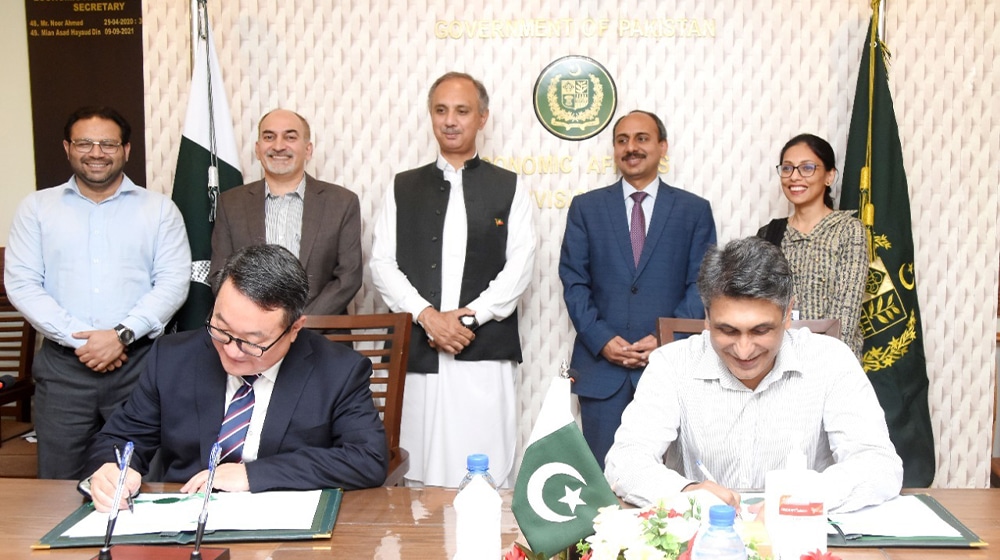
The Economic Affairs Division, the Government of Pakistan, and the Asian Development Bank (ADB) have signed the Capital Market Development Program (Subprogram 2) worth US$ 300 million to help Pakistan develop its capital markets, promote private investment, and mobilize domestic resources to finance sustainable growth.
Federal Minister for Economic Affairs, Omar Ayub Khan, witnessed the signing ceremony alongside Country Director, ADB, Yong Ye.
The program objectives include strengthening market stability, improving market facilitation, enhancing supply-based steps, and improving demand-based measures for capital market development.
Under the Capital Market Development Program (Subprogram 2), Pakistan has successfully completed 19 prior policy actions in the following areas:
Reform Area 1: Market Stability Strengthened
These reforms are designed to promote more robust, resilient, and stable capital markets. Under subprogram 1, amendments were initiated to the Securities & Exchange Commission (SECP) Act, 1997 to ensure structural changes in the appointment process of commissioners and enhance operational efficiency by having commissioners operate as a collegiate body, while the National Finance Stability Council was established to deal with issues in cross regulatory domains. A new broker model was introduced to strengthen the brokerage industry by reducing the likelihood of broker defaults.
The new model categorizes brokers according to their net worth and governance requirements, which will ascertain appropriate operational risks to be assumed by the brokers. These reforms continued with follow-up policy actions under subprogram 2, such as approval of the SECP Act amendments by the National Assembly, exemption from income tax for the SECP, and notification of a customer custody regime for the brokerage industry.
Reform Area 2: Market Facilitation Enhanced
These reforms will support more efficient resource mobilization and allocation in the economy by expediting the adjudication of enforcement actions, strengthening auditing standards, and enhancing market surveillance systems. Financial infrastructure including well-developed trading platforms and surveillance systems that facilitate efficient information exchange and disclosure, as well as stronger legal framework and resolution mechanisms are necessary to complement the institutional environment for the development of capital markets.
Reform Area 3: Supply Measures Enhanced
This area focuses on increasing the depth and breadth of the capital markets by promoting alternative financial instruments including derivatives and commodity futures, as well as providing an enabling framework to allow for increased access to financing by growth companies and SOEs. Supply measures under subprogram 2 include:
- facilitate and expand the issuance of sovereign Sukuk
- facilitate listing of SOEs on the PSX to broaden and deepen the capital markets;
- promote the introduction of alternative asset classes, such as exchange-traded funds, options, futures, and sharia-compliant (compliant with Islamic principles) products; and
- issuing a framework for women entrepreneur bonds whose proceeds will help finance SMEs owned or led by women. The increased listing of SOEs will also help the government address other binding constraints in SOE management such as poor corporate governance and commercial performance.
Reform Area 4: Demand Measures Enhanced
These reform measures aim to enhance the scale of capital markets by not only encouraging investments by institutional and retail investors, but also by strengthening the government debt market. Local currency government bond markets can be a catalyst for the development of corporate bond markets by providing a yield curve benchmark against which to price bonds, market liquidity, and price revelation.
The Minister for Economic Affairs acknowledged the ADB’s continued assistance to the Government of Pakistan. It was further highlighted that Pakistan has recently completed various reforms under ADB’s technical and financial assistance including Trade & Competitiveness Program (US$ 800), Energy Sector Reforms & Financial Sustainability Program (US$ 600), and Capital Market Development Program (US$ 600).
The Minister expressed that the Government is also committed to introducing reforms in other areas such as Domestic Resource Mobilization, Climate Change, and Public-Private Partnerships. Domestic Resource Mobilization would help the government to create fiscal space through enhanced revenue collection and overcome the challenge of fiscal deficit. He stressed using digital tools for effective project management and monitoring. At present, 37 ADB-funded development projects amounting to US$ 7.9 billion are under implementation across the country in energy, road & transport, agriculture, urban infrastructure, and the social sector. During the current fiscal year, ADB has disbursed over US$ 1.1 billion for various development projects and programs.
Yong Ye acknowledged the Government of Pakistan’s efforts for completing reforms in the Capital Market. He also discussed the ADB’s ongoing portfolio and future interventions. He highlighted various issues pertaining to the energy sector including MFF Power Transmission Enhancement Investment Program II (Tranche 3) and Greater Thal Canal Irrigation Project. He also shared that ADB would provide support to Pakistan for the development of e-portal for effective project management.
Stay Connected with ProPakistani
Get the latest business news, market insights, and economic updates wherever you prefer.
Add ProPakistani to Preferred Sources and see more of our stories in Google Search and Top Stories.












