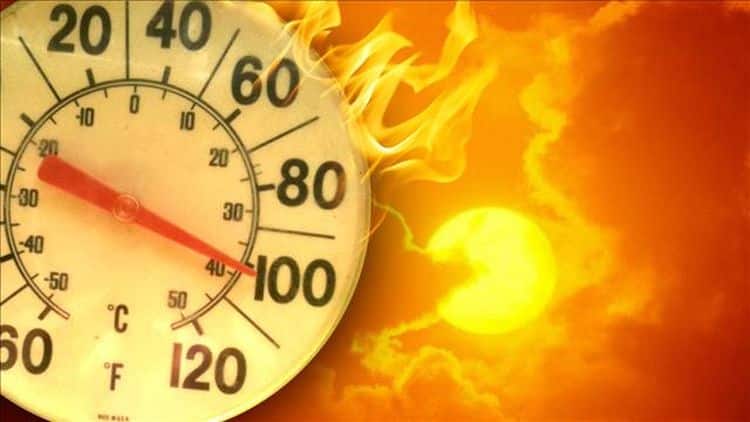
This year is “virtually certain” to be the hottest on record and the first to surpass a critical threshold aimed at protecting the planet from severe overheating, Europe’s climate monitor, the Copernicus Climate Change Service, reported on Monday.
The announcement caps a year marked by climate disasters worldwide, affecting both wealthy and developing nations, with scientists linking these events to the rapid warming driven by human activities. Copernicus reported that an unprecedented stretch of extreme heat from January to November had pushed global temperatures to record-breaking levels, making it inevitable that 2024 would surpass all previous records.
“At this point, it is effectively certain that 2024 will be the warmest year on record,” the EU agency confirmed in its monthly bulletin. Copernicus also noted that climate-related disasters had caused $310 billion in economic losses this year.

Copernicus scientist Julien Nicolas projected that 2025 would begin with global temperatures “near record levels,” likely persisting for several months.
In another alarming milestone, 2024 is expected to be the first calendar year with temperatures 1.5 degrees Celsius above pre-industrial levels—a critical threshold associated with the onset of severe climate impacts. Preliminary data from Copernicus indicates the global average temperature so far this year is nearly 1.6C higher than the pre-industrial era (1850–1900).
Escalating Risks
Scientists warn that every fraction of a degree in global warming increases the risks to ecosystems and human societies. Sustained warming beyond 1.5C over decades could have devastating effects. Under the Paris Climate Agreement, countries pledged to limit global temperature rise to 1.5C, but achieving this goal appears increasingly difficult.
Samantha Burgess, deputy director of the Copernicus Climate Change Service, emphasized that a single year exceeding 1.5C does not mean the Paris Agreement has been violated but underscores the urgent need for ambitious climate action.

Catastrophic Trends
The world is far off course to meet its climate goals. In October, the UN warned that the current trajectory of climate action could result in a catastrophic 3.1C of warming. Despite global pledges to phase out fossil fuels, emissions from coal, oil, and gas continue to rise, fueling further warming. This excess heat disrupts climate systems, intensifies extreme weather events, and exacerbates the water cycle.
In 2024, climate-induced disasters included deadly flooding in Spain and Kenya, violent storms in the United States and the Philippines, and severe droughts and wildfires across South America.
Economic and Social Impact
Swiss Re, a global insurance company, estimated that climate-related disasters caused $310 billion in economic losses this year. Developing nations remain particularly vulnerable, requiring an estimated $1.3 trillion annually by 2035 for energy transitions and climate adaptation. However, at the UN climate talks in November, major historic polluters committed to raising only $300 billion per year by 2035—a target criticized as grossly insufficient.
Stay Connected with ProPakistani
Get the latest international news and global stories wherever you prefer.
Add ProPakistani to Preferred Sources and see more of our stories in Google Search and Top Stories.













Tch tch tch tch tch tch
Rija again doing what everyone already knows
We heard this every year for last 15 years . Every year is hotter then the last 1.
As Peter Hatfield pointed out , the peer reviewed research conducted by weather and climate scientists already pointed this out since 1970s.
Funny how these articles by you are not even showing the reason why