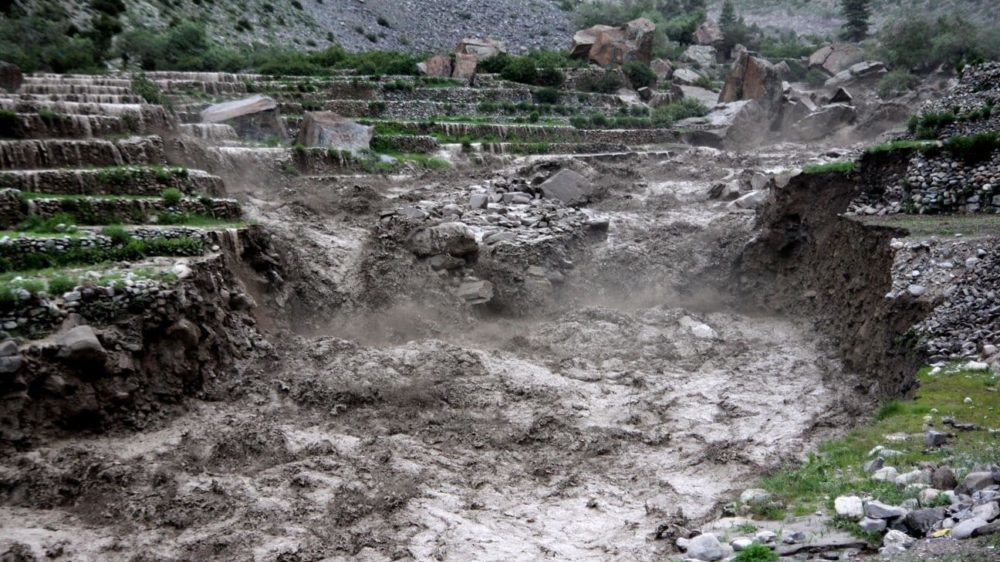
Record-breaking heat in Gilgit-Baltistan (GB) has triggered widespread flooding due to rapidly melting glaciers, causing extensive damage to infrastructure, roads, and homes across the region.
The Gilgit-Baltistan Disaster Management Authority (GBDMA) reported that soaring temperatures have accelerated glacier melt, leading to dangerous water levels in rivers and streams. Chilas recorded a peak temperature of 48.5°C last week, the highest since 1997. Bunji reached 46.1°C, a record since 1971.
Floods caused by glacier lake outburst floods (GLOFs) blocked major routes, including the Karakoram Highway at Gandlu-Muladad Padi and roads in Nagar Khas and Hoper Valley. Siachen Road in Ghanche and routes in Chilas, Chipurson, and Hunza were also damaged. A GLOF from Shishper glacier in Hunza threatened homes and forced evacuations in Hassanabad.
Floodwaters damaged makeshift bridges, agricultural land, water supply systems, and public infrastructure. The local administration reported continued land erosion in Nagar Khas, endangering homes and fields. Several areas were left without power and water.
GBDMA Director General Zakir Hussain said machinery has been mobilized to reopen blocked roads and evacuate residents. Authorities are restoring irrigation channels to support farming communities. The agency has also requested monitoring equipment from SUPARCO to track glacier behavior more effectively.
Punjab Not Safe Either
In Punjab, heavy monsoon rainfall led to urban flooding across multiple cities. Lahore recorded significant waterlogging in areas like Jail Road and Lakshmi Chowk, where drainage systems failed to cope. Wasa workers deployed pumps for round-the-clock water removal, with rainfall in some areas reaching 52mm.
In Sheikhupura, rainfall totaled 48mm. The Provincial Disaster Management Authority (PDMA) warned that the province may see 40% to 60% above-normal rainfall in the coming weeks.
PDMA Director General Irfan Ali Kathia chaired an emergency meeting in Sialkot, directing officials to reinforce electricity poles and set up relief camps. Gujranwala’s commissioner ordered the evacuation of dangerous buildings to prevent casualties.
Punjab Chief Minister Maryam Nawaz Sharif instructed all departments, including Wasa, PDMA, and Rescue 1122, to stay active and ensure smooth drainage in low-lying areas. She also directed traffic police to implement congestion management plans during peak rainfall.
Stay Connected with ProPakistani
Get the latest news and stories wherever you prefer.
Add ProPakistani to Preferred Sources and see more of our stories in Google Search and Top Stories.