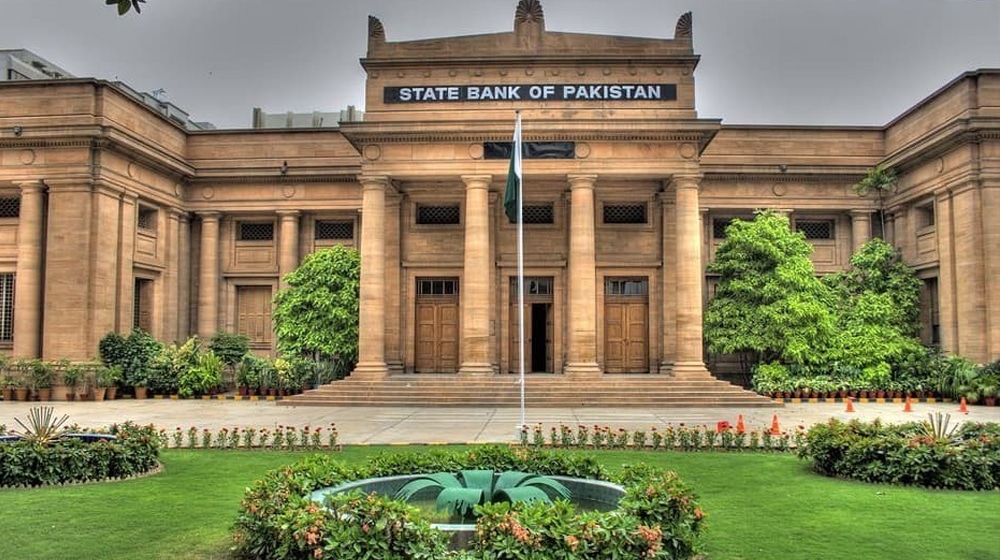
The State Bank of Pakistan (SBP) announced on Wednesday that it has kept the interest rate unchanged at 11 percent.
In its last monetary policy meeting for FY25 in June, SBP kept the rate unchanged at 11 percent.
The Monetary Policy Committee (MPC) decided to maintain the policy rate at 11 percent in its meeting today. The Committee observed that inflation in June 2025 had slowed to 3.2 percent year-on-year, primarily due to lower food prices, while core inflation also registered a slight decline. However, it noted that the inflation outlook has deteriorated slightly due to higher-than-expected adjustments in energy prices, particularly gas tariffs. Nonetheless, inflation is projected to remain within the target range in the coming months.
The MPC also noted that economic activity is gradually strengthening, reflecting the lagged impact of earlier rate cuts. However, the trade deficit is projected to widen in FY26 due to a combination of rising domestic demand and slowing global trade. In light of these dynamics, the Committee considered the decision to hold the policy rate as necessary for maintaining price stability.
Key Developments Since Last MPC Meeting
The MPC highlighted the following developments:
-
Foreign Reserves: The SBP’s foreign exchange reserves crossed $14 billion, supported by improved financial inflows and a current account surplus.
-
Credit Rating: Pakistan’s sovereign credit rating was upgraded, leading to a decline in Eurobond yields and narrower CDS spreads in global markets.
-
Inflation Expectations: Sentiment surveys showed a slight uptick in inflation expectations among consumers, while expectations fell for businesses.
-
Revenue Collection: FBR’s tax revenue for FY25 reached Rs11.7 trillion, about Rs200 billion short of revised estimates.
-
Global Commodities: Oil prices remained volatile; metal prices increased. Uncertainty around global trade tariffs led central banks to adopt a cautious stance.
Real Sector Outlook
High-frequency economic indicators suggest a gradual recovery. Year-on-year growth was seen in auto sales, fertilizer offtake, private sector credit, imports of intermediate goods and machinery, and the purchasing managers’ index. This improvement has also started to show in Large-Scale Manufacturing (LSM), which posted growth in both April and May after five months of contraction.
The agricultural outlook has improved due to recent rainfall, particularly for major crops, while the services sector is expected to benefit from stronger performance in commodity-producing sectors. With positive business sentiment and improved financial conditions, real GDP growth is projected between 3.25 and 4.25 percent in FY26, up from the provisional 2.7 percent recorded in FY25.
External Sector
The current account registered a $328 million surplus in June, bringing the FY25 cumulative surplus to $2.1 billion (0.5 percent of GDP). Remittances played a key role in offsetting the widening trade deficit. Official inflows also supported FX reserves, pushing them above $14 billion.
However, remittance growth is expected to slow in FY26 due to a high base and revisions in incentive schemes. Meanwhile, the trade deficit is likely to expand, driven by stronger import demand, slowing global demand, and unfavorable export prices — particularly for rice. The current account deficit for FY26 is projected between 0 and 1 percent of GDP. The SBP’s reserves are forecasted to rise to $15.5 billion by end-December 2025, aided by improved private inflows following the recent credit rating upgrade.
Fiscal Sector
Revised estimates show an improved fiscal position for FY25, with both the primary and overall balances surpassing their respective targets due to strong growth in tax and non-tax revenues. However, FBR missed its revised target despite achieving 26 percent growth.
For FY26, the government is targeting a primary surplus of 2.4 percent of GDP, which will require robust revenue collection and expenditure rationalization. The MPC emphasized the need for continued fiscal consolidation to preserve recent macroeconomic gains.
Money and Credit
Broad money (M2) growth rose to 14.0 percent year-on-year as of July 11, up from 12.6 percent at the previous MPC meeting, mainly due to higher Net Foreign Assets (NFA) following improved FX reserves. Private sector credit expanded by 12.8 percent year-on-year, reflecting better economic conditions and easier financial access.
The credit growth was broad-based, with increases in working capital, fixed investment, and consumer financing. Key sectors included textiles, telecom, and retail trade. The currency-to-deposit ratio, which had fallen in June, increased again in July, prompting SBP to inject additional liquidity to maintain the interbank rate near the policy rate, which in turn contributed to higher reserve money growth.
Inflation Outlook
Inflation stood at 3.2 percent in June 2025, down from 3.5 percent in May, mainly due to easing food inflation and a slight decline in core inflation to 7.6 percent. Despite recent increases in fuel and electricity prices, overall energy inflation remained lower on a year-on-year basis.
Going forward, energy inflation is expected to rise due to significant increases in gas tariffs, the phase-out of temporary electricity tariff reductions, and rising motor fuel prices. While annual inflation is projected to stay within the 5–7 percent range in FY26, it may temporarily exceed the upper limit in certain months.
The MPC warned of multiple risks to this outlook, including volatile global commodity prices, unforeseen adjustments in energy tariffs, and the potential impact of widespread flooding.
Stay Connected with ProPakistani
Get the latest business news, market insights, and economic updates wherever you prefer.
Add ProPakistani to Preferred Sources and see more of our stories in Google Search and Top Stories.













Alot of hodge podge but too easy
Food prices are tailored to fuel and energy prices and currency movement
Chicken prices increased due to deregulation
Sugar prices increased and now deregulation is coming
Inflation rose thanks to high fuel prices
New taxes and further increase in online prices
Fruits prices also rose
So interest rates should be increased
The rates should be increased
Country’s chamber of commerce and different trade bodies has been demanding further rate cut from 11 percent per annum( reduced from 22 percent). It is very unfortunate nobody has done any home work on this account. First of it ,is there any appetite by the private sector for financing? No body has presented any working list of industries / that are suffering only due to high mark up rate. If for argument sake mark up rate are reduced how and to what extent will boost our businesses and exports.
APTMA and different such bodies are always vocal to derive benefits and seldom they have performed.
There are many more factors that are harming growth of industry and exports like high energy cost, unnecessary intervention by govt departments like FBR etc.on top of that is inefficiency of our industrialists. No body like to work hard. They prefer to run spinning industries that is mostly run on automation. No body like to do research and development. More Interested in getting public money and than make merry.
It is time that industrialists start performing and fo innovation in their businesses.
why this country came into existence?
Learn from Quid e Azam statement at state bank gathering.
So far we are running away but for now
Learn and follow it.
Khird ko gulami se azzad kar de
jawano ko peroon ka ustad kar de
AMEEN