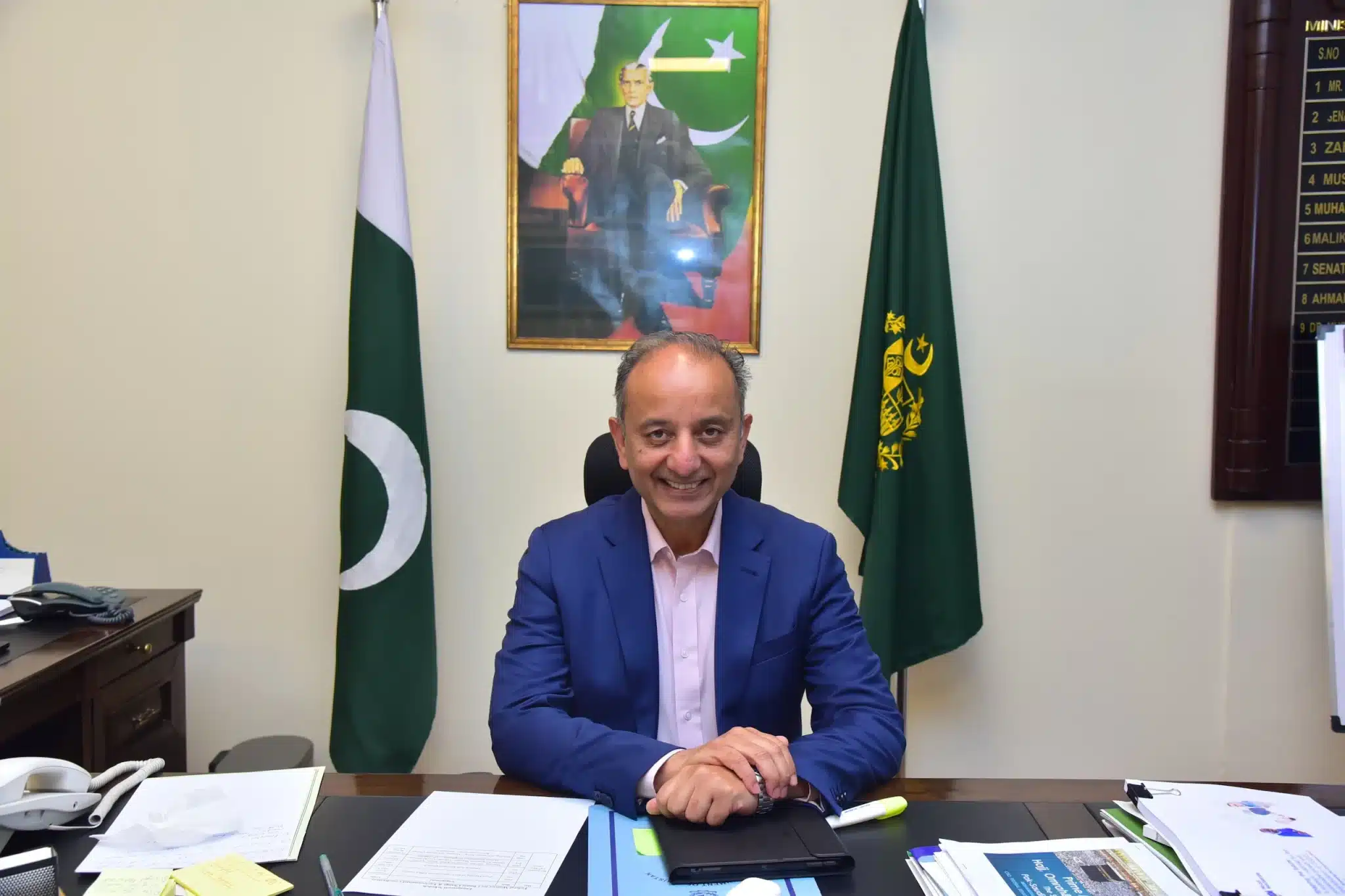
As scorching temperatures grip Karachi and tensions rise with India over the Indus Waters Treaty, Pakistan’s newly appointed federal minister for climate change and environmental coordination, Musadik Malik, sits composed with an Americano in hand. Formerly responsible for water resources and petroleum, Malik now faces what he describes as his most urgent and challenging role yet.
In his first exclusive interview since the March 2025 cabinet reshuffle, Malik outlines the country’s top environmental concerns: “Air pollution and its impact on public health and the economy, the crisis of water contamination and access, and the mismanagement of solid waste—especially methane and CO₂ emissions.”
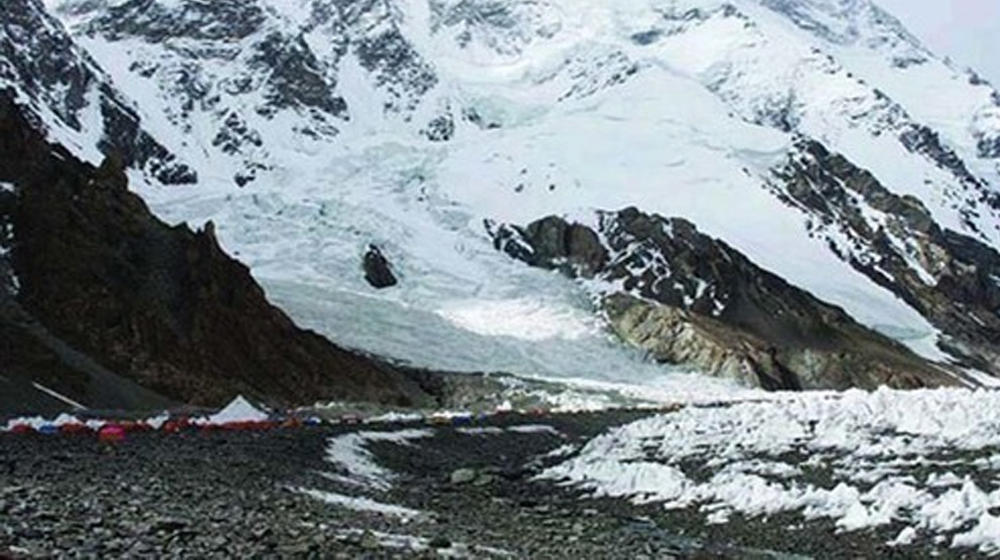
However, his deepest concern lies with Pakistan’s rapidly melting glaciers. Early in his tenure, Malik traveled to Gilgit-Baltistan, home to over 13,000 glaciers—some of the largest outside the polar regions—to observe efforts under a UN project aimed at reducing the risk of glacial lake outburst floods (GLOFs). “Population growth has forced communities into areas vulnerable to such hazards,” he notes.
Meanwhile, Karachi presents an entirely different climate challenge. Malik is tasked with uniting federal and provincial entities while addressing competing interests. One of the biggest hurdles is fostering coordination and trust among the provinces.
A Complex Climate Finance Landscape
Despite Indian objections, the International Monetary Fund (IMF) recently approved a $1.4 billion loan for Pakistan under the Resilience and Sustainability Facility (RSF), intended to support climate adaptation. While the funding is welcome, Malik expresses doubts over the reliability of global support mechanisms. “We’re still recovering from the 2022 floods,” he says. “Many promises were made, but actual disbursements have fallen short.”
He questions the sincerity of the global community: “Is it all just performance—eloquent speeches and no action?” Still, Malik continues his advocacy. “I’m lobbying not just for Pakistan, but for all vulnerable nations. This is about climate justice.”
At forums like the Geneva climate summit, he has criticized the current climate finance system for favoring a select few while neglecting developing countries. “What about Pakistan?” he asks pointedly.
The Six Canals Controversy
Domestically, one of the most divisive environmental projects is the proposed construction of six canals in southern Punjab’s Cholistan desert. Sindh province strongly opposes the plan, fearing it will reduce water flow downstream. Malik supports the concept in principle but insists it must be built on transparency and interprovincial consensus.
“The solution lies in deploying a reliable water telemetry system to track water flow at every interprovincial boundary. That way, allocations are based on data, not politics,” he asserts.
Due to mounting protests, the project is currently on hold until all provinces reach an agreement. Malik emphasizes that unilateral decisions are off the table, and future water governance must be collaborative and transparent.
He also stresses the importance of improving agricultural water efficiency. “Boosting productivity by just 3% is equivalent to saving 3 million acre-feet of flood irrigation water. We need to focus on doing more with less,” he says.
When asked about the politically charged issue of dam construction, he responds with a wry smile: “If I mention the dam, I might be damned.”
Indus Waters Treaty Under Strain
Despite a recent ceasefire with India, the decades-old Indus Waters Treaty remains on shaky ground. Following a militant attack in Pahalgam, India unilaterally suspended treaty obligations—a move Pakistan strongly condemns. Malik explains the treaty’s dispute resolution mechanism and warns against undermining its value. “If this treaty is meaningless, then what hope is there for any international agreement?”
He accuses India of violating treaty protocols by failing to hold regular meetings and withholding critical hydrological data. “Calls to renegotiate predate the Pahalgam incident. Was it just a pretext?” he asks.
A Cultural Loss
For Malik, climate change is not only destroying infrastructure—it is also eroding Pakistan’s cultural and ecological identity. “Our schools and hospitals are disappearing. Women and girls suffer the most. And beyond that, where are the fireflies and green parrots we once chased in our gardens? They’re vanishing too.”
He mourns the fading of poetry and folk traditions once inspired by the land’s beauty. “These disasters don’t just damage property—they steal our heritage.”
Stay Connected with ProPakistani
Get the latest news and stories wherever you prefer.
Add ProPakistani to Preferred Sources and see more of our stories in Google Search and Top Stories.















IMF, World bank, Asian Banks, and countries who give loans to Pakistan should follow the loan trails where they are being consumed. It should not go into the hands of any Pakistani Ministry. payment should only be made if there are some quality developments to the organization performing the task