
Engineers at the University of Texas at Austin have developed a jacket that can collect moisture from the air and turn it into drinking water.
Depending on humidity levels, the wearable system can produce between 400 and 900 millilitres, or around 14 to 30 fluid ounces, of water per day. The technology could help hikers, campers, runners, farm workers, emergency responders and military personnel working in places where clean water is difficult to obtain.
Wearable Water Collection
Atmospheric water-harvesting systems commonly use fixed equipment such as large panels, boxes or beds of moisture-absorbing material.
The researchers instead placed the water-collecting technology inside a textile, creating a portable system that users can wear.
Guihua Yu, a chair professor in the Cockrell School of Engineering’s Walker Department of Mechanical Engineering and the Texas Materials Institute, said the team wanted to move the technology beyond stationary equipment.
He said fabrics capable of collecting atmospheric moisture could create a new method of providing portable and personal access to water.
The research was published in the journal Science Advances.
How The Jacket Works
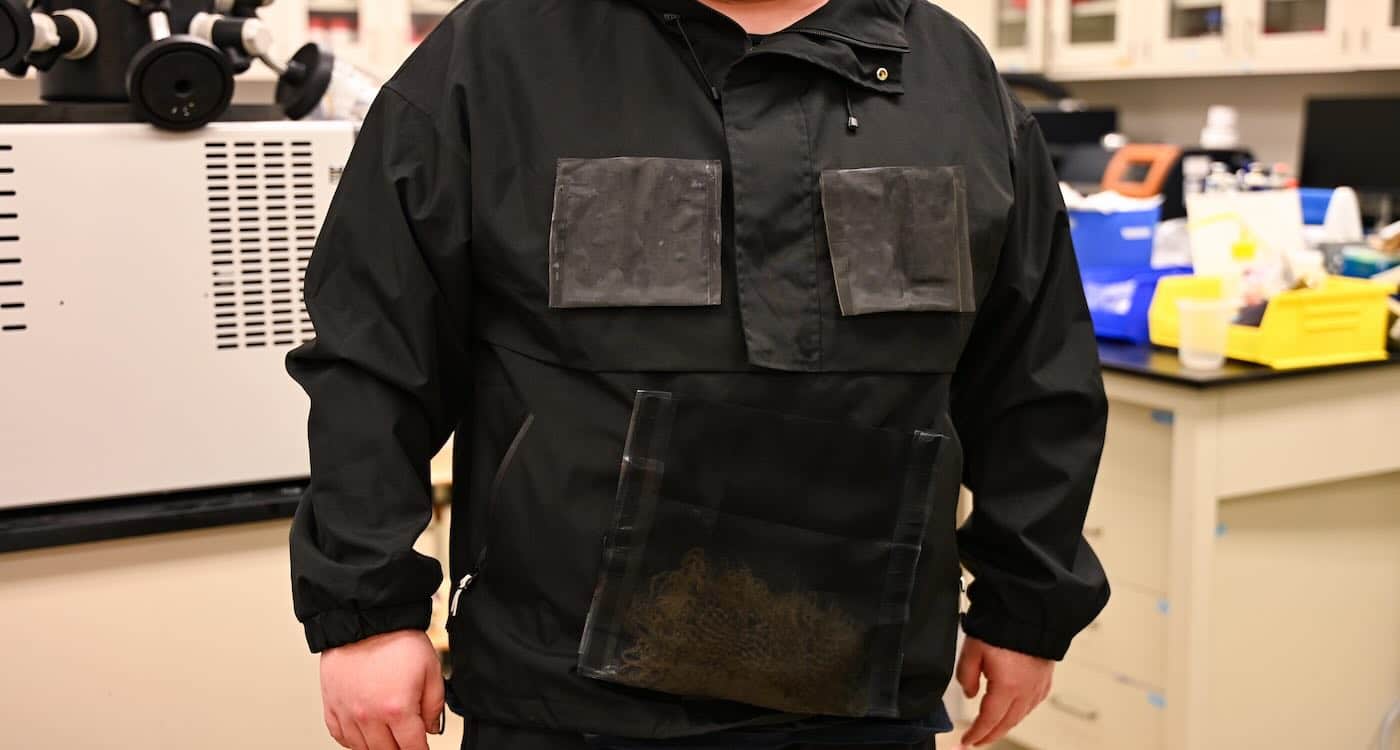
The jacket contains a specially designed textile that absorbs moisture from the surrounding air and directs it into detachable collection units.
Users can remove these units and place them inside a foldable collector. Heating the collector releases the captured moisture, allowing it to condense into liquid water.
The completed wearable prototype produced between 400 and 900 millilitres of drinking water per day under different humidity conditions.
Improved Fabric Performance
The textile delivered three to 10 times better large-scale performance than conventional water-harvesting materials.
Instead of only increasing the amount of water that the material could absorb, the researchers focused on creating an efficient path for moisture to move through the fibres.
Water travels from vapour in the air to liquid on the surface of the fibres before moving into the textile.
Keith Johnston, a co-author and chair professor in the Cockrell School of Engineering’s McKetta Department of Chemical Engineering, said this transport system allows the material to operate in a wearable product rather than only in a small laboratory test.
Other Possible Uses
The researchers believe the material could also be incorporated into backpacks, tents, emergency shelters and other outdoor equipment.
Future research will examine its possible use in outdoor recreation, remote field operations, disaster response and regions where water infrastructure is limited, or the climate is dry.
Record Water Collection
The same research team also developed a separate atmospheric water-harvesting system that achieved record collection levels during field testing.
Researchers tested the device in the hot and dry Chihuahuan Desert in New Mexico and the more humid climate of Austin, Texas.
It collected 1.3 litres, or around 44 fluid ounces, of clean water per day in both arid and semi-humid environments.
The performance was equal to 4.3 litres, or 1.1 gallons, of water per kilogram of moisture-absorbing material each day, exceeding previously reported results from other research teams.
Solar-Powered System
The separate device uses an engineered hydrogel fabric made from materials derived from biomass.
The fabric absorbs water vapour from the atmosphere and releases it when warmed by sunlight. The system then condenses and collects the released moisture as liquid water.
Weixin Guan, one of the lead authors of the study published in Nature Water, said the field-ready device resulted from several years of work covering molecular design and practical operation.
Water-Stressed Regions
The researchers expect the technology to work well in several areas facing serious water shortages, including parts of North Africa, the Middle East, South Asia and sub-Saharan Africa.
The system could provide a decentralized source of drinking water for remote communities, disaster-response operations and locations where conventional water infrastructure is difficult to construct or maintain.
Stay Connected with ProPakistani
Get the latest tech news, telecom insights, and product launches wherever you prefer.
Add ProPakistani to Preferred Sources and see more of our stories in Google Search and Top Stories.












