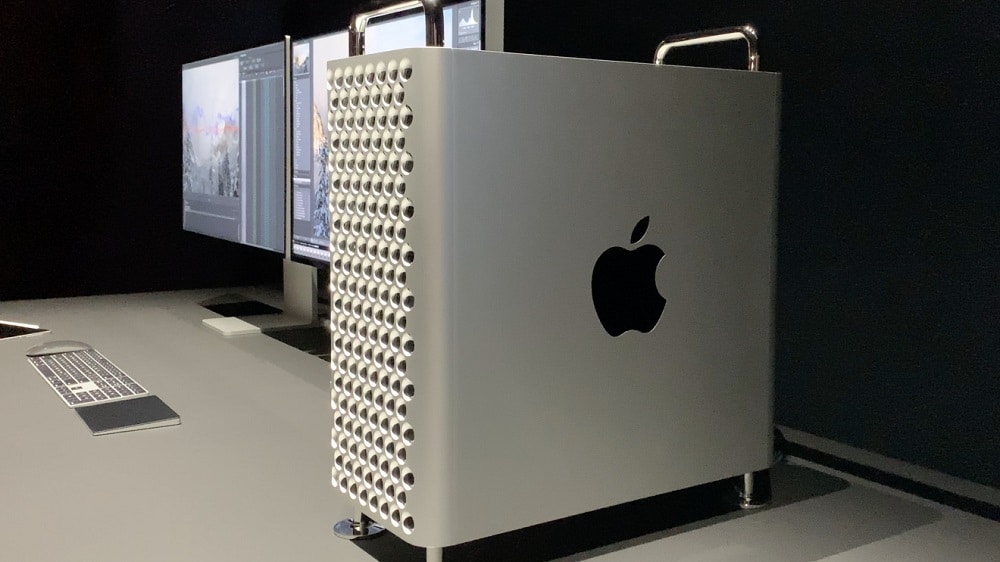
Apple’s Mac Pro has always catered to a small but loyal group of professional users, even if it never reached the mainstream popularity of the iMac or the MacBook Air. Because of this limited audience, owners have long been familiar with slow upgrade cycles.
The cylindrical Mac Pro from 2013 remained unchanged for six years, and Apple did not introduce an Apple Silicon version until 2023, three years after the first M-series notebooks arrived. The pattern shows how the Mac Pro has slipped from Apple’s core priorities, and current reporting suggests that this direction will continue.
Planned Updates
A new report from Bloomberg indicates that Apple has cancelled several Mac Pro revisions that were under consideration. After giving the current machine one significant internal update, Apple has reportedly decided not to refresh the desktop in 2026. Sources cited in the report claim that “Apple has largely written off the Mac Pro,” and there is no indication that a new generation of the tower is included in the company’s future product plans.
Despite this shift, Apple is not abandoning professional users. The company now views the Mac Studio as the central device in its professional desktop strategy, offering strong performance in a smaller and more efficient package.
Why the Mac Studio Is Taking the Lead
The tower-based Mac Pro carries a sense of heritage. Its design echoes earlier models such as the Power Mac G3, G4, and G5, which helped distinguish Apple’s high-end systems from its consumer offerings. However, with Apple silicon delivering significant performance in compact enclosures that require less complex cooling, the need for a large tower is no longer as clear.
It is also reasonable to assume that sales have played a role in Apple’s decision. If the Mac Pro were performing well in the market, Apple would have little incentive to scale back investment. In contrast, the Mac Studio provides more processing power and storage than Apple’s top iMac while being far easier to move.
Although a Mac Pro equipped with an M2 Ultra still outperforms a Mac Studio running an M4 Max in certain tasks, many professional users may find the Studio more than capable of meeting their needs.
Price and practicality further highlight the divide. The current Mac Pro weighs nearly 40 pounds and costs substantially more than the Mac Studio, which is small enough to be transported when needed. As Apple refines its desktop lineup, the Mac Pro’s place has become increasingly difficult to justify, even for demanding workflows.
Stay Connected with ProPakistani
Get the latest tech news, telecom insights, and product launches wherever you prefer.
Add ProPakistani to Preferred Sources and see more of our stories in Google Search and Top Stories.