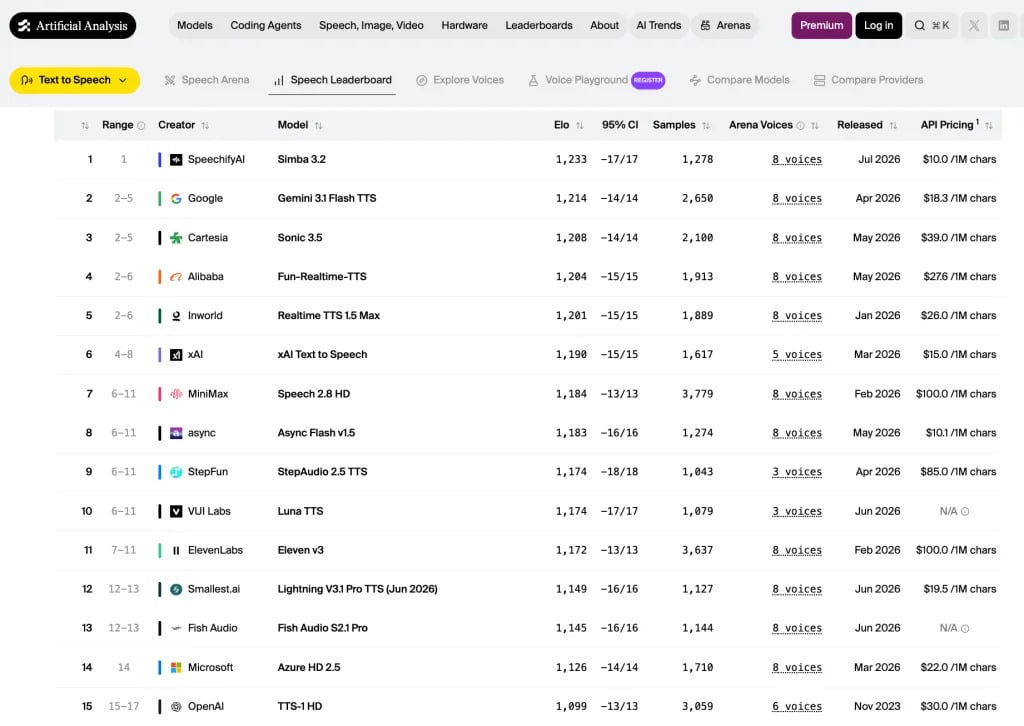
Speechify has introduced Simba 3.2, a real-time text-to-speech model that has moved to the top of Artificial Analysis’s independent voice leaderboard.
The model ranked above competing systems from Google, OpenAI, ElevenLabs, Cartesia, and other providers in blind listener comparisons. Speechify is also launching a developer platform and AI voice-agent service powered by the same technology.
Simba 3.2 currently holds first place on the Artificial Analysis Text-to-Speech Arena leaderboard, with an Elo rating of around 1,234.
Artificial Analysis calculates its rankings through blind comparisons. Listeners hear two clips generated from the same text without being told which models produced them and select the more natural-sounding result.
Simba 3.2 is also near the top of Voice Arena’s US English leaderboard. Current results place it third overall, although its confidence range overlaps with the second-ranked model. Its position can vary depending on the language and use-case category selected.
Speechify built Simba 3.2 as a streaming-native model for applications that need to begin speaking before the entire response has been generated.
The company claims it can deliver a time to first audio below 100 milliseconds. This makes it suitable for voice agents, customer-service systems, real-time readers, and other products where a long pause can make conversations feel unnatural.
The model also supports SSML controls for adjusting delivery, including pitch, speaking speed, pauses, and emphasis. Speechify’s API provides additional controls for emotional expression and word-level timing.
Simba 3.2 currently supports English. Speechify directs non-English and mixed-language requests to its separate Simba Multilingual model.
Speechify lists Simba 3.2 at $10 per one million characters under its standard pricing, falling to $6 per one million characters for customers on its Scale tier.
At the lower rate, the company says the model costs more than 15 times less than ElevenLabs and around six times less than Cartesia. Artificial Analysis also places Simba 3.2 among the strongest text-to-speech models for its combination of price and listener-rated quality.
The lower pricing could be particularly important for companies processing large volumes of calls, articles, accessibility content or voice-agent conversations, where text-to-speech costs can increase quickly.
Artificial Analysis runs evaluations against live text-to-speech API endpoints rather than relying on audio samples selected by the companies themselves.
Its leaderboard uses blind listener voting to generate an Elo score for each model. Models can move up or down as more comparisons and votes are recorded.
Voice Arena uses a similar pairwise comparison system and publishes confidence ranges alongside its rankings. This means small differences between closely placed models may not indicate a clear performance advantage.
Speechify says the technology behind Simba 3.2 was refined through its existing consumer text-to-speech products.
The company claims its applications have served tens of millions of users, giving it a large volume of feedback and testing data related to voice quality, responsiveness and operating costs. Its Android listing currently describes a user base exceeding 50 million.
Speechify says this consumer-scale usage encouraged it to focus on efficiency from the beginning rather than building an expensive enterprise model and attempting to reduce costs later.
Alongside Simba 3.2, Speechify is launching a platform for developers and a Voice Agents product for businesses.
The API allows developers to add streaming speech, voice cloning, emotional controls, and SSML support to their applications. It accepts up to 2,000 characters through its standard speech endpoint and up to 20,000 characters per streaming request.
Possible uses include automated phone agents, interactive readers, customer-support systems, educational tools, and applications that need spoken responses with minimal delay.
Speechify says it plans to add more voices, additional languages, and a lower-priced tier. However, those additions have not yet been released.
Simba 3.2’s early results suggest that developers may no longer need to accept a clear trade-off between natural-sounding speech, low latency, and affordable API pricing. Its long-term position will depend on how the rankings change as more users test it and rival providers release updated models.
Get the latest tech news, telecom insights, and product launches wherever you prefer.
Add ProPakistani to Preferred Sources and see more of our stories in Google Search and Top Stories.